
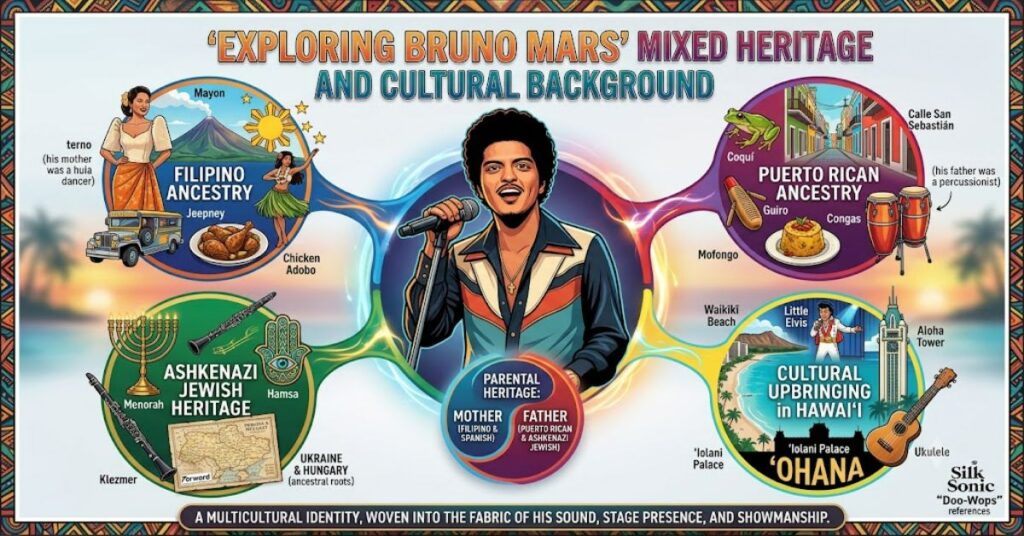
The question of the Bruno Mars ethnic group is frequently searched because the singer’s appearance, musical influences, and personal background reflect a mixture of different cultural traditions. Bruno Mars, born Peter Gene Hernandez on October 8, 1985, in Honolulu, Hawaii, comes from a multicultural family with Filipino, Puerto Rican, and Ashkenazi Jewish ancestry.
His heritage represents the diverse history of Hawaii, a place where Asian, Pacific Islander, European, and Latin American cultures have interacted for generations. His mother, Bernadette “Bernie” Bayot, was Filipino and originally from the Philippines before moving to Hawaii. His father, Peter Hernandez, has Puerto Rican ancestry along with Jewish heritage connected to Eastern European roots.
Understanding Bruno Mars’ background requires looking beyond a single ethnic label. His identity has developed through family traditions, childhood experiences, music, and the multicultural environment where he grew up.
His heritage has become part of the broader conversation about representation in entertainment. As one of the most successful contemporary performers, Bruno Mars demonstrates how artists with mixed backgrounds often carry multiple cultural influences into global popular culture.
Bruno Mars’ Family Heritage and Ancestry
Bruno Mars’ ancestry comes from several different cultural backgrounds.
| Family Side | Heritage | Background |
| Mother’s side | Filipino | Connected to the Philippines and Filipino cultural traditions |
| Father’s side | Puerto Rican | Connected to Puerto Rican and Caribbean heritage |
| Father’s ancestry | Ashkenazi Jewish | Linked to Jewish communities with Eastern European roots |
| Birthplace influence | Hawaiian culture | Raised in Honolulu within a multicultural environment |
This combination has shaped how Mars is often viewed as an artist with a broad cultural identity rather than belonging to only one background.
His family history reflects the migration patterns that have shaped Hawaii. Filipino communities have had a major presence in Hawaii for more than a century, while Puerto Rican migration to the islands also contributed to the region’s cultural diversity.
The Influence of Growing Up in Hawaii
Bruno Mars’ childhood environment played an important role in his artistic development. Honolulu is known for its multicultural population, where different traditions, languages, and musical styles exist together.
Growing up in Hawaii exposed Mars to:
- Local Hawaiian culture.
- Filipino family traditions.
- Latin musical influences.
- American pop and soul music.
His early exposure to performance began when he appeared in entertainment settings as a child. His family was involved in music, which helped develop his confidence and stage abilities.
Hawaii’s cultural diversity may also help explain why Mars’ music frequently blends different genres. His work combines elements of pop, funk, R&B, soul, reggae, and rock, creating a sound that appeals across cultural boundaries.
How Heritage Influenced Bruno Mars’ Music and Public Identity
An artist’s background does not determine their creativity, but cultural experiences can influence artistic expression.
Bruno Mars has often incorporated classic musical styles associated with different communities. His performances reflect influences from legendary entertainers, including soul singers, funk performers, and pop icons.
His multicultural background has contributed to conversations about representation in the entertainment industry. Many audiences recognise Mars as an example of how artists with mixed ancestry can connect with diverse global audiences.
| Cultural Influence | Possible Connection to His Career |
| Filipino heritage | Connection to family traditions and Asian representation |
| Puerto Rican heritage | Links to Latin cultural identity and rhythm influences |
| Jewish ancestry | Part of his broader family history |
| Hawaiian upbringing | Exposure to multicultural artistic traditions |
However, heritage alone does not define an artist’s success. Mars’ career has been shaped by songwriting ability, vocal skill, performance discipline, and creative decisions.
The Importance of Discussing Mixed Heritage Carefully
Questions about ethnicity can sometimes become complicated, especially when discussing public figures.
A person with mixed ancestry may identify with multiple backgrounds, one specific culture, or a broader personal identity. Ethnicity involves family history, culture, personal experiences, and individual choices.
For celebrities, public discussions can sometimes simplify complex backgrounds into a single category. This can overlook the reality of multicultural identities.
Bruno Mars’ background shows that heritage can be layered. His ancestry includes multiple regions and traditions, creating a family story connected to migration, cultural exchange, and global identity.
Bruno Mars and Representation in Popular Culture
The success of Bruno Mars has contributed to wider discussions about diversity in entertainment.
Historically, many performers from mixed backgrounds faced pressure to fit into narrow categories. Modern audiences increasingly recognise that cultural identity can be complex.
Mars’ international popularity demonstrates how artists with diverse backgrounds can reach audiences across geographical and cultural boundaries.
His career also highlights the changing nature of celebrity identity. Global entertainment increasingly includes performers whose backgrounds reflect multiple cultures rather than a single national or ethnic origin.
Comparison: Cultural Identity Factors in Bruno Mars’ Background
| Factor | Description | Impact |
| Family ancestry | Filipino, Puerto Rican, and Ashkenazi Jewish roots | Creates multicultural heritage |
| Birthplace | Honolulu, Hawaii | Exposure to diverse traditions |
| Music career | Global pop and R&B performer | International cultural connection |
| Public image | Mixed heritage artist | Broader representation in entertainment |
The Future of Celebrity Identity and Cultural Representation in 2027
By 2027, discussions about celebrity identity are expected to become more nuanced as audiences continue recognising multicultural backgrounds.
Entertainment industries are increasingly highlighting stories from diverse communities, while global audiences are becoming more interested in artists’ cultural histories.
However, representation discussions will continue requiring balance. A person’s ancestry provides important context, but it does not fully explain their talents, achievements, or personal identity.
The future of celebrity storytelling will likely focus less on assigning simple labels and more on understanding complete personal histories.
Key Takeaways
- Bruno Mars has Filipino, Puerto Rican, and Ashkenazi Jewish ancestry.
- His Hawaiian upbringing influenced his exposure to different cultures and musical traditions.
- Mixed heritage can involve multiple identities rather than a single category.
- Cultural background provides context but does not define artistic ability.
- Bruno Mars represents a broader trend of multicultural representation in entertainment.
Conclusion
Bruno Mars ethnic group reflects the multicultural history of both his family and his birthplace. With Filipino ancestry from his mother’s side, Puerto Rican and Ashkenazi Jewish roots from his father’s side, and a childhood shaped by Hawaii’s diverse culture, Mars represents a combination of different traditions.
His success demonstrates how cultural influences can contribute to artistic expression while also showing that identity is personal and complex. Heritage can shape experiences, but creativity, dedication, and individual choices remain central to an artist’s achievements.
As global entertainment continues becoming more diverse, stories like Bruno Mars’ highlight the importance of understanding identity with accuracy and respect. His background is not defined by one label but by a combination of histories that come together in a unique personal journey.
Frequently Asked Questions
What is Bruno Mars’ ethnic group?
Bruno Mars has mixed ancestry, including Filipino, Puerto Rican, and Ashkenazi Jewish heritage.
Is Bruno Mars Filipino?
Bruno Mars has Filipino ancestry through his mother, Bernadette “Bernie” Bayot, who was from the Philippines.
Is Bruno Mars Puerto Rican?
Yes, Bruno Mars has Puerto Rican ancestry through his father, Peter Hernandez.
Where was Bruno Mars born?
Bruno Mars was born in Honolulu, Hawaii, on October 8, 1985.
How has Bruno Mars’ heritage influenced his music?
His multicultural background and Hawaiian upbringing exposed him to different traditions and musical styles that contributed to his artistic development.
Methodology
This article Bruno Mars ethnic group was prepared using publicly available biographical information from verified entertainment profiles, interviews, and established reference sources.
The analysis focuses on documented ancestry and cultural background rather than assumptions about identity. Ethnic identity can be personal and may involve cultural experiences beyond genealogy alone.
All historical details should be reviewed against primary interviews and official biographical sources before publication.
References (APA Style)
Encyclopaedia Britannica. (2024). Bruno Mars biography and musical career overview. Encyclopaedia Britannica.
Grammy Awards. (2024). Bruno Mars artist profile and achievements. Recording Academy.
Biography.com. (2024). Bruno Mars biography: Early life, career, and music. A&E Television Networks.