
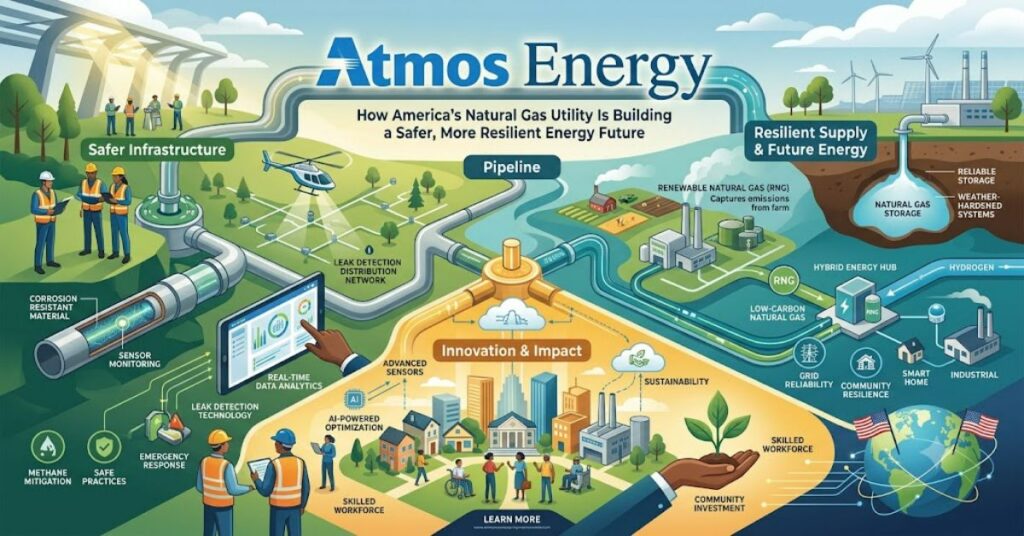
Atmos Energy is one of the largest natural gas-only utilities in the United States, providing energy services to more than 3 million distribution customers across over 1,400 communities. Headquartered in Dallas, Texas, the company operates a regulated utility model focused on safely delivering natural gas through an extensive pipeline network.
Founded in 1906, Atmos Energy has grown from a regional gas provider into a major S&P 500 energy company. Unlike diversified energy corporations involved in oil, renewables, and electricity generation, the organisation concentrates almost entirely on natural gas distribution. This specialisation has allowed it to build expertise in pipeline management, infrastructure upgrades, and regulatory compliance.
The company’s role has become increasingly important as the US energy sector faces competing priorities. Consumers continue to demand affordable and reliable heating, while policymakers and regulators push utilities to reduce emissions and improve infrastructure resilience.
Understanding Atmos Energy requires looking beyond its customer numbers. Its business model depends on regulated returns, capital investment programmes, safety performance, and its ability to manage ageing energy infrastructure.
This analysis examines how the company operates, its strategic advantages, challenges, market impact, and how it may evolve towards 2027.
Understanding Atmos Energy’s Business Model
Atmos Energy operates primarily as a regulated natural gas distribution company. This means state regulators oversee many aspects of its pricing structure, investment recovery, and customer rates.
The company does not compete in the same way as technology firms or consumer brands. Instead, its financial performance depends on maintaining infrastructure, gaining regulatory approval for investment programmes, and delivering reliable service.
Its operations are divided mainly into two areas:
| Business Area | Function | Strategic Importance |
| Natural Gas Distribution | Delivery of gas through local pipeline networks | Core revenue source |
| Pipeline Safety Programmes | Replacement and improvement of ageing infrastructure | Reduces operational risk |
| Customer Operations | Billing, maintenance, emergency response | Improves service reliability |
| Infrastructure Investment | Modernisation of networks and technology | Supports long-term growth |
The company’s scale provides advantages. A large customer base spreads infrastructure costs across millions of users, while regulated operations create more predictable revenue compared with commodity-focused energy businesses.
Infrastructure Investment and Pipeline Safety Strategy
One of the defining features of Atmos Energy’s approach is its focus on infrastructure replacement.
Natural gas distribution networks across the United States contain pipelines that were installed decades ago. Older materials, changing regulations, and increasing safety expectations have encouraged utilities to invest heavily in replacement programmes.
Atmos Energy has committed billions of dollars towards system modernisation. These investments include:
- Replacing older pipeline materials.
- Installing advanced monitoring technology.
- Improving leak detection systems.
- Strengthening operational controls.
The company’s strategy reflects a broader utility industry trend: reliability is increasingly linked to infrastructure quality rather than simply energy supply.
A utility can have sufficient gas availability but still experience problems if its delivery network is outdated.
Financial Structure and Investment Approach
The financial model of Atmos Energy is closely connected to regulated utility economics.
Unlike independent energy producers, which face significant exposure to gas price volatility, regulated distributors generally earn returns through approved infrastructure investments.
Key financial drivers include:
| Factor | Impact on Business |
| Regulatory approval | Determines ability to recover investment costs |
| Capital expenditure | Supports infrastructure improvement |
| Customer growth | Expands revenue base |
| Operating efficiency | Influences profitability |
| Safety performance | Affects regulatory confidence |
This model creates stability but also introduces limitations. Large infrastructure projects require approval processes that can slow decision-making.
The company must demonstrate that investments benefit customers while also providing acceptable returns for shareholders.
Comparison With Other Major US Gas Utilities
Atmos Energy operates in a competitive environment where other utilities pursue similar infrastructure strategies.
| Company | Primary Focus | Geographic Presence | Business Model |
| Atmos Energy | Natural gas distribution | Multi-state US operations | Regulated utility |
| NiSource | Gas and electricity services | Midwest and Northeast US | Diversified utility |
| ONE Gas | Natural gas distribution | Central US | Regulated utility |
| National Fuel Gas | Gas distribution and energy services | Northeast US | Integrated energy model |
Atmos Energy’s distinction is its concentration on natural gas distribution. This narrow focus allows operational expertise but may limit diversification opportunities.
Technology, Data and Operational Modernisation
Modern utilities increasingly rely on digital systems to improve safety and efficiency.
Atmos Energy uses technology across several operational areas:
- Asset management systems.
- Automated monitoring.
- Customer service platforms.
- Data-driven maintenance planning.
The practical benefit is moving from reactive repairs towards predictive maintenance.
For example, utilities can analyse equipment conditions and prioritise upgrades before failures occur. This reduces emergency repairs and improves customer reliability.
However, digital transformation also creates new responsibilities. Utility companies must manage cybersecurity risks because energy infrastructure is considered critical national infrastructure.
Risks and Strategic Challenges
Although Atmos Energy has a strong market position, several challenges could affect future performance.
Regulatory Pressure
Natural gas utilities face increasing scrutiny regarding emissions, methane leakage, and climate policy.
Regulators must balance two objectives:
- Maintaining affordable energy access.
- Encouraging lower-carbon energy systems.
Different states are approaching this issue differently, creating a complex regulatory environment.
Energy Transition Uncertainty
The future role of natural gas remains debated.
Supporters argue that gas provides reliable energy during periods when renewable sources are unavailable. Critics argue that long-term climate targets require reducing dependence on fossil fuels.
Atmos Energy’s challenge is maintaining infrastructure value while preparing for possible changes in energy policy.
Rising Infrastructure Costs
Pipeline replacement and safety improvements require significant capital spending.
Higher construction costs, labour shortages, and material prices can increase project expenses.
Real-World Impact on Communities
The company serves residential customers, businesses, schools, and public facilities.
For many communities, natural gas remains a critical heating source, particularly during colder months.
Reliability has practical consequences. A well-maintained distribution network supports:
- Household heating security.
- Business continuity.
- Emergency response capability.
- Local economic activity.
Energy infrastructure is often invisible when it works properly, but failures can immediately affect communities.
The Future of Atmos Energy in 2027
By 2027, Atmos Energy’s direction will likely be shaped by three major forces: infrastructure investment, regulatory change, and evolving energy demand.
The US Department of Energy has continued supporting energy reliability initiatives, while regulators are examining how utilities can modernise systems while meeting environmental goals.
Several developments are likely:
Greater digital monitoring:
Utilities will continue adopting advanced sensors, analytics platforms, and automated inspection tools.
More regulatory reporting:
Environmental performance, methane management, and safety metrics will become increasingly important.
Continued infrastructure spending:
Ageing pipeline networks will require ongoing replacement programmes.
However, uncertainty remains. The pace of natural gas transition policies varies significantly by region. Some areas may continue relying heavily on gas infrastructure, while others may accelerate electrification.
Atmos Energy’s future success will depend on adaptability rather than relying only on historical utility advantages.
Key Takeaways
- Atmos Energy has built a strong position through specialised natural gas distribution operations.
- Infrastructure safety investment remains central to its business strategy.
- Regulatory relationships are essential because utility profitability depends on approved investment recovery.
- Digital tools can improve reliability but introduce cybersecurity responsibilities.
- The energy transition creates both risks and opportunities for natural gas companies.
- Community reliability remains a major reason natural gas infrastructure continues to receive investment.
Conclusion
Atmos Energy represents the traditional utility model adapting to modern energy expectations. Its strength comes from operational focus, regulated stability, and continued investment in infrastructure reliability.
The company faces a complicated future as energy markets change and policymakers debate the long-term role of natural gas. While demand patterns may shift over time, the need for safe and dependable energy delivery remains significant.
Its ability to balance infrastructure upgrades, regulatory requirements, customer affordability, and environmental expectations will determine its long-term position.
For investors, communities, and energy stakeholders, Atmos Energy provides an example of how established utilities are navigating a period of major transformation without abandoning the reliability standards that define essential services.
Frequently Asked Questions
What is Atmos Energy known for?
Atmos Energy is primarily known as a natural gas distribution company serving millions of customers across the United States. It focuses on delivering natural gas safely through regulated utility networks.
How many customers does Atmos Energy serve?
Atmos Energy serves more than 3 million distribution customers across over 1,400 communities in multiple US states.
Is Atmos Energy a renewable energy company?
No. Atmos Energy is primarily a natural gas utility. Its focus is distribution infrastructure rather than renewable energy generation.
Why does Atmos Energy invest heavily in pipelines?
Pipeline investment improves safety, reduces leaks, increases reliability, and helps meet regulatory requirements for modern utility operations.
What challenges does Atmos Energy face?
Major challenges include regulatory changes, energy transition pressures, infrastructure costs, and cybersecurity risks affecting critical systems.
Is natural gas demand expected to continue through 2027?
Demand forecasts vary by region. Some markets may maintain strong natural gas use, while others may increase electrification efforts.
Methodology
This article was prepared using publicly available company information, regulatory materials, industry reports, and energy sector research. Sources were reviewed to understand Atmos Energy’s operational structure, infrastructure strategy, and market position.
The analysis focuses on business strategy rather than investment advice. Limitations include uncertainty around future energy policy decisions and regional differences in natural gas regulation.
All factual claims, financial figures, and regulatory statements should be independently verified before publication.
This article was drafted with AI assistance and reviewed for accuracy. Data, citations, and claims should be independently confirmed by the editorial team at Postcard.fm.
References
Atmos Energy Corporation. (2024). Annual Report 2024. Atmos Energy Corporation.
Energy Information Administration. (2024). Natural Gas Explained: Use of Natural Gas. U.S. Energy Information Administration.
International Energy Agency. (2024). Gas Market Report. International Energy Agency.
U.S. Department of Energy. (2024). Energy Infrastructure and Reliability Reports. U.S. Department of Energy.
Securities and Exchange Commission. (2024). Atmos Energy Corporation Form 10-K Filing. SEC.