Central Superior Services, or CSS, is one of Pakistan’s best-known routes into federal public administration. The examination is conducted by the Federal Public Service Commission (FPSC) to recruit candidates into BS-17 positions across 12 occupational groups and services.
CSS is often described simply as an examination, but that description misses an important part of the process. Candidates must progress through several stages, including the written examination, medical examination, psychological assessment and viva voce. Even after successfully completing these stages, allocation to a particular occupational group depends on factors such as merit, preferences, available vacancies and government policy.
The CSS Competitive Examination Rules, 2019 provide the principal framework for the current examination system. The 12 groups cover areas including administration, diplomacy, policing, taxation, customs, audit, information and transport.
For prospective candidates, understanding these differences is important. The most prestigious-sounding group is not automatically the best choice for every person. Each service offers a different professional environment, responsibilities and career trajectory.
CSS preparation therefore requires two types of thinking: examination preparation and career planning. A candidate needs strong writing and analytical skills, but should also understand what life in the selected occupational group may involve.
What Are Central Superior Services?
The term refers to the federal civil-service framework accessed through the CSS Competitive Examination. FPSC administers the examination and manages important stages of the recruitment process.
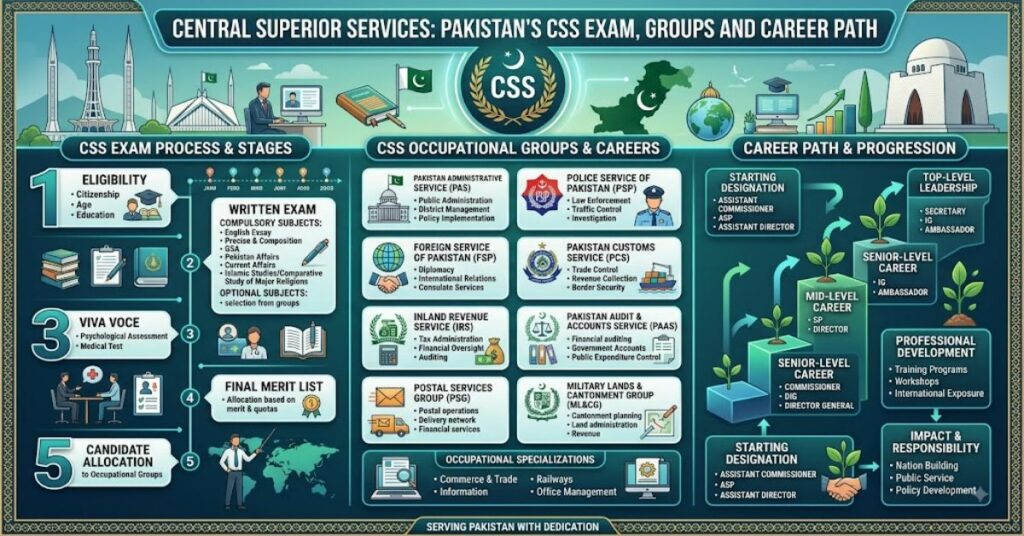
The 12 occupational groups and services include:
| Occupational Group | Main Area |
| Pakistan Administrative Service | Administration and governance |
| Foreign Service of Pakistan | Diplomacy and international relations |
| Police Service of Pakistan | Policing and public security |
| Inland Revenue Service | Federal taxation |
| Pakistan Customs Service | Customs and border-related administration |
| Pakistan Audit and Accounts Service | Government audit and accounts |
| Office Management Group | Federal secretariat administration |
| Information Group | Government information and communications |
| Commerce and Trade Group | Trade and commercial affairs |
| Military Lands and Cantonments Group | Administration of military lands |
| Postal Group | Postal administration |
| Railways Group | Commercial and transportation functions |
These groups should not be treated as interchangeable. Their responsibilities, working environments and professional demands can differ considerably.
How the CSS Selection Process Works
The CSS selection process contains several stages. The written examination is central, but it is not the entire recruitment process.
Candidates first have to satisfy the relevant eligibility requirements and complete the required examination stages. The written examination assesses subject knowledge, analytical ability, comprehension and written communication.
The process also includes medical examination, psychological assessment and viva voce.
A simplified structure looks like this:
| Stage | Purpose |
| Preliminary requirements | Establish eligibility |
| Written examination | Assess knowledge and analytical ability |
| Medical examination | Assess medical fitness |
| Psychological assessment | Examine suitability and personality-related characteristics |
| Viva voce | Assess communication, judgement and general suitability |
| Allocation | Assign successful candidates to available groups |
One important point is that qualifying the examination does not automatically guarantee allocation to a candidate’s first-choice group.
Understanding Merit and Group Allocation
Group allocation is one of the most misunderstood aspects of CSS. Candidates submit preferences for occupational groups, but preferences operate within the wider allocation system.
Merit position, available vacancies, candidate preferences and applicable quota arrangements can all influence the final result.
This means that candidates should avoid assuming that a particular score automatically guarantees a particular service. Vacancy numbers can change between examination cycles, while allocation policies also determine how available positions are distributed.
The practical lesson is straightforward: candidates should research several occupational groups rather than preparing with only one imagined outcome.
Why the Occupational Groups Matter
The Pakistan Administrative Service attracts candidates interested in administration, governance and field responsibilities. The Foreign Service is more suited to those interested in diplomacy, international affairs and overseas representation.
The Police Service of Pakistan has a distinct operational character, while Inland Revenue and Customs involve taxation, regulation and enforcement. Pakistan Audit and Accounts Service is centred on public financial management, accounting and audit.
Office Management Group offers a different experience within the federal secretariat. Other groups, including Information, Commerce and Trade, Postal, Railways and Military Lands and Cantonments, have specialised institutional responsibilities.
This diversity is one of the most important features of the CSS system. A candidate should consider professional interests and long-term suitability rather than choosing a group solely because of its reputation.
How to Prepare Effectively
Good CSS preparation involves more than collecting large quantities of study material.
Candidates need a structured approach built around four areas:
- Knowledge: Develop a strong command of compulsory and optional subjects.
- Analysis: Learn to connect political, economic, historical and social developments.
- Writing: Practise producing clear, organised answers within strict time limits.
- Revision: Revisit important material regularly rather than constantly adding new sources.
Essay writing and current affairs deserve particular attention. CSS questions often require candidates to analyse an issue rather than simply reproduce memorised information.
A useful preparation method is to create short topic frameworks containing key arguments, examples, opposing views and possible conclusions. This makes revision more efficient and encourages analytical writing.
The Risks of Choosing CSS for Prestige
The reputation surrounding CSS can sometimes overshadow the realities of civil-service work.
A candidate may spend considerable time preparing for the examination without receiving an allocation. Even successful candidates may discover that their allocated group involves responsibilities that differ from their original expectations.
Government service can involve transfers, administrative pressure, public accountability and demanding working conditions. Some roles provide significant field exposure, while others are primarily administrative or technical.
For this reason, “Which CSS group is best?” is not always the most useful question.
A better question is: “Which type of public-sector responsibility suits my skills, interests and long-term career goals?”
That shift can produce a more realistic career decision.
Three Important Insights About CSS
Passing is not the same as allocation. A candidate can successfully complete the competitive process without receiving their preferred occupational group.
Preparation should include career research. Understanding the actual functions of each service can prevent unrealistic expectations after allocation.
Official information matters most. Examination dates, requirements and procedures can change. Candidates should rely on current FPSC announcements and the latest applicable rules rather than outdated social-media posts or coaching material.
The Future of Central Superior Services in 2027
FPSC has already published an advance public notice concerning the CSS Competitive Examination 2027. This gives prospective candidates an important indication that preparation should begin with current official information rather than assumptions based on older examination cycles.
The recruitment process is also becoming increasingly dependent on digital administration. Online applications, admission certificates, examination information and result services have become important parts of the candidate experience.
However, major changes to the examination structure should not be assumed without an official announcement. Predictions about future subjects, allocation systems or assessment methods remain uncertain until FPSC or the relevant government authority formally confirms them.
For 2027 candidates, the most reliable strategy is therefore to monitor official announcements while building preparation around the currently applicable framework.
Key Takeaways
- CSS provides entry into Pakistan’s federal civil service.
- FPSC conducts the competitive examination.
- There are 12 occupational groups and services.
- Written marks are only one part of the selection process.
- Allocation depends on merit, preferences, vacancies and applicable policy.
- Different groups offer very different professional experiences.
- Career suitability should matter alongside prestige.
Conclusion
Central Superior Services remains a significant pathway into Pakistan’s federal government. Its appeal comes from the range of careers available, covering administration, diplomacy, policing, taxation, customs, audit and several specialised government functions.
The examination should not, however, be viewed as a simple test followed by an automatic appointment. The selection process involves written assessment, medical examination, psychological evaluation and viva voce, followed by occupational-group allocation.
For candidates considering CSS, preparation should therefore extend beyond memorising information. Strong analytical writing, current-affairs awareness, time management and disciplined revision are essential. At the same time, candidates should research the actual responsibilities associated with different occupational groups.
The strongest approach is to treat CSS as both an examination challenge and a long-term career decision. Understanding the system before entering it can help candidates set realistic expectations and make better-informed choices about their future in public service.
Frequently Asked Questions
What are Central Superior Services?
Central Superior Services refers to Pakistan’s federal competitive civil-service examination and the occupational groups accessed through it.
Who conducts the CSS examination?
The Federal Public Service Commission conducts the CSS Competitive Examination and manages its major recruitment stages.
How many CSS groups are there?
The current framework identifies 12 occupational groups and services, including administration, foreign service, police, taxation, customs and audit.
Does passing CSS guarantee a preferred group?
No. Allocation depends on factors including merit, preferences, available vacancies and applicable government allocation policy.
What are the main stages of CSS?
The process includes the written examination, medical examination, psychological assessment and viva voce, followed by allocation.
Is CSS 2027 being planned?
Yes. FPSC has issued an advance public notice concerning the CSS Competitive Examination 2027. Candidates should follow subsequent official announcements for final details.
Methodology
This article was prepared using the established CSS examination framework and publicly available information concerning FPSC and the federal civil-service structure. The occupational groups and selection stages were checked against the CSS Competitive Examination Rules, 2019.
No personal examination experience or fabricated firsthand testing has been presented. Practical observations about preparation and career choice are analytical guidance based on the structure of the examination.
Because examination requirements and administrative procedures can change, candidates should verify the latest official FPSC notice before applying or relying on specific dates, requirements or procedural details.
Editorial disclosure: This article was drafted with AI assistance and should be reviewed by the Postcard.fm editorial team before publication. All claims, dates and examination requirements should be independently verified against the latest official sources.