
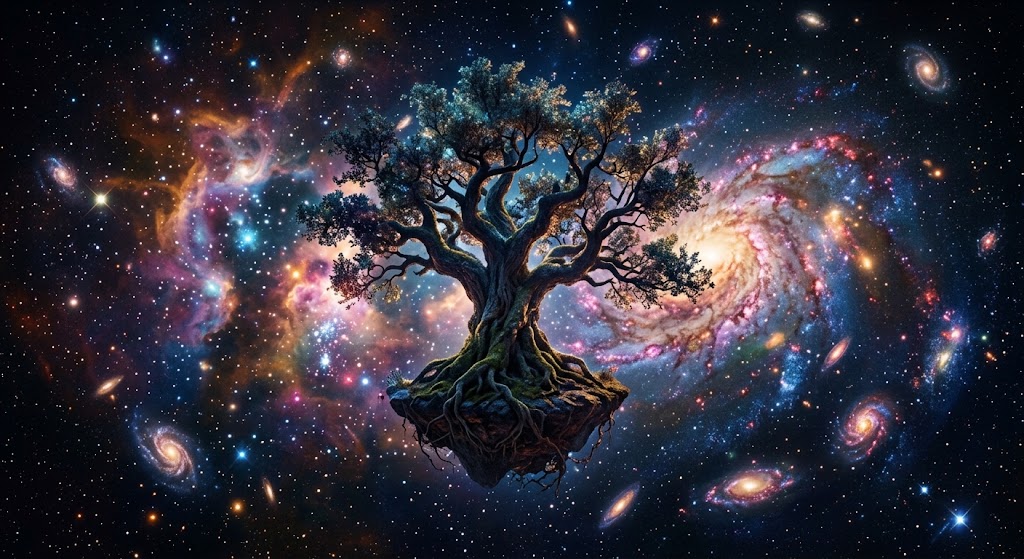
Is wood one of the rarest things in the universe? In one important sense, it may be. Wood is extremely common on Earth, yet there is currently no confirmed evidence of naturally occurring wood anywhere beyond our planet. The distinction matters because wood is not simply a collection of common atoms. It is a biological material produced by living organisms, especially trees and other woody plants.
Carbon, oxygen, hydrogen and other elements that make up wood are not unique to Earth. NASA explains that the elements found in trees and other terrestrial materials originated from earlier generations of stars.
The unusual part is therefore not the chemistry alone. It is the chain of conditions required to turn ordinary elements into a living organism capable of producing wood.
That makes the claim more interesting than a simple comparison between wood, gold and diamonds. Gold is chemically rare, but it exists as a naturally occurring element in the universe. Wood is different. Its existence depends on biology.
Why Wood Is Unusual on a Cosmic Scale
Wood is a structural tissue created by plants. It is largely made from organic compounds such as cellulose, hemicellulose and lignin. These materials allow plants to grow vertically, transport water and maintain structural strength.
None of these ingredients requires exotic elements. Carbon and oxygen, for example, are widespread cosmic elements. NASA’s educational material on cosmic abundances shows that carbon and oxygen are far more abundant than extremely heavy elements such as gold.
The rarity comes from biological organisation.
For wood to exist elsewhere, there would need to be life capable of producing something functionally comparable to terrestrial wood. That requires much more than the presence of carbon. It requires a suitable environment, available energy, liquid or otherwise biologically useful solvents, chemical building blocks and a long enough period for complex life to develop.
NASA notes that the ingredients associated with life appear in many places across the cosmos, but that does not establish that life itself is common.
Wood Versus Gold and Diamonds
| Material | Basic origin | Known beyond Earth? | Why it is unusual |
| Wood | Biological | No confirmed extraterrestrial example | Requires complex life |
| Gold | Stellar and cosmic processes | Yes | Element is naturally scarce |
| Diamond | Carbon under suitable conditions | Yes | Requires specific pressure and temperature |
| Water ice | Chemical/geological | Yes | Common in many cosmic environments |
This comparison reveals an important distinction. Gold and diamonds are physical materials that can form through non-biological processes. Wood requires biology.
That does not prove that wood is rarer than gold or diamonds throughout the entire universe. We simply do not have enough observations to make that measurement.
The Missing Ingredient: Life
Earth’s biosphere is currently the only confirmed example of a global system of life. The European Space Agency describes the biosphere as a feature that, so far as we know, makes Earth unique in the universe.
Plants are one component of that system. Trees represent an even more specialised evolutionary development.
This creates a useful hierarchy:
Elements → molecules → planets → life → complex organisms → woody plants → wood
Each stage requires additional conditions. Carbon may be widespread, but a tree is not simply carbon. A tree is the result of billions of years of biological evolution interacting with Earth’s atmosphere, water cycle, soil and climate.
Wood therefore has a kind of ecological rarity that cannot be measured using the periodic table alone.
What Science Can Actually Confirm
A careful scientific answer should avoid saying that wood has been proven to be the rarest material in existence. No astronomical survey has counted wood across the universe.
Scientists have confirmed that many of the elements needed for life are widespread. NASA explains that carbon, oxygen and other heavier elements were produced through earlier generations of stars and later incorporated into planetary systems.
Scientists also know of thousands of exoplanets, including rocky worlds that may have environments broadly comparable with Earth in some respects. However, potentially habitable does not mean inhabited, and inhabited does not necessarily mean covered with forests.
The uncertainty is the central point.
A Better Way to Understand the Claim
Calling wood “rare” is most defensible when the word refers to biological complexity rather than elemental abundance.
A block of timber contains common atoms. What is unusual is the biological history behind it. Those atoms had to become part of a living system, and that system had to evolve structures capable of producing woody tissue.
This also explains why the statement can sound surprising. On Earth, wood feels ordinary because humans live inside a biosphere where plants are widespread. From a cosmic perspective, however, our everyday experience may be misleading.
Structured Insight
| Question | Evidence-based answer |
| Are wood’s elements rare? | No. Carbon, oxygen and hydrogen are widespread. |
| Is extraterrestrial wood confirmed? | No confirmed example is known. |
| Is extraterrestrial life confirmed? | No. Earth remains the only confirmed home of life. |
| Could wood exist elsewhere? | It is possible, but unproven. |
| Is wood scientifically proven to be the rarest material? | No. That claim cannot currently be measured. |
The Future of Wood in the Universe in 2027
By 2027, the most important development is unlikely to be the discovery of a literal piece of extraterrestrial wood. The more realistic advance will be improved methods for identifying biological activity on distant worlds.
Astronomers are increasingly interested in atmospheric signatures that could indicate life. Yet individual gases are not enough to establish biology because some can be produced through non-biological processes. NASA has specifically warned that oxygen on an exoplanet would not, by itself, prove the presence of life.
If future observations identify Is Wood One of the Rarest Things in the Universe convincing evidence of extraterrestrial ecosystems, the idea of wood being exceptionally rare could change dramatically. Until then, Earth remains our only confirmed example.
Key Takeaways
- Wood is biologically unusual, not chemically exotic.
- Its constituent elements are widespread throughout the cosmos.
- No extraterrestrial wood has been confirmed.
- Trees require complex biological and environmental conditions.
- Comparing wood directly with gold or diamonds can be misleading because they form through different processes.
- The rarity of wood depends largely on how common complex life is beyond Earth.
Conclusion
So, is wood one of the rarest things in the universe? The most responsible answer is: possibly, but science has not proved it.
Wood is not rare because its atoms are unusual. Carbon, oxygen and hydrogen are widespread products of cosmic evolution. What makes wood special is that it is the product of a sophisticated biological system. It represents an evolutionary pathway from basic chemistry to living organisms and, eventually, to plants capable of producing durable structural tissue.
Earth currently provides the only confirmed example of life, and therefore the only confirmed natural source of wood.
That makes wood genuinely remarkable on a cosmic scale. A material that appears ordinary in a forest may actually represent an extraordinary combination of chemistry, planetary conditions and biological evolution.
The claim should Is Wood One of the Rarest Things in the Universe therefore be treated as a fascinating scientific perspective rather than a measured astronomical fact.
Frequently Asked Questions
Is wood rarer than gold in the universe?
There is no reliable cosmic inventory that allows scientists to make that direct comparison. Gold is chemically rare but exists through known cosmic processes, while wood requires biology.
Could there be wood on another planet?
Possibly. If extraterrestrial life evolved organisms capable of producing woody structural tissue, something resembling wood could exist. No such example has been confirmed.
Why is wood considered rare?
Its rarity comes from its biological origin. The elements in wood are common, but producing wood requires complex living organisms.
Are trees unique to Earth?
Trees are currently known only from Earth. Scientists have no confirmed evidence of trees or tree-like organisms elsewhere.
Is gold rarer than wood?
Not necessarily. Gold can form through non-biological cosmic processes, while wood requires life. However, the universe contains too little observational evidence to rank their overall abundance confidently.
Methodology
This article Is Wood One of the Rarest Things in the Universe treats the supplied keyword claim as a conceptual question rather than an established scientific measurement. The analysis was checked against NASA and ESA material concerning cosmic elemental abundance, the origins of elements and the status of life beyond Earth. The principal limitation is observational: humanity has confirmed life only on Earth, so the abundance of extraterrestrial biological materials cannot currently be calculated. The distinction between elemental rarity and biological rarity is therefore essential to the conclusion.
References
European Space Agency. (n.d.). Overview: The biosphere. ESA.
NASA. (2025, April 28). How are we made of star stuff? We asked a NASA expert. NASA.
NASA Science. (2026). What are the sources of life’s building blocks within the Earth? NASA.
NASA Science. (2021, March 9). Life in the universe: What are the odds? NASA.
NASA Science. (2015, September 9). Oxygen on exoplanets isn’t proof of life. NASA.