
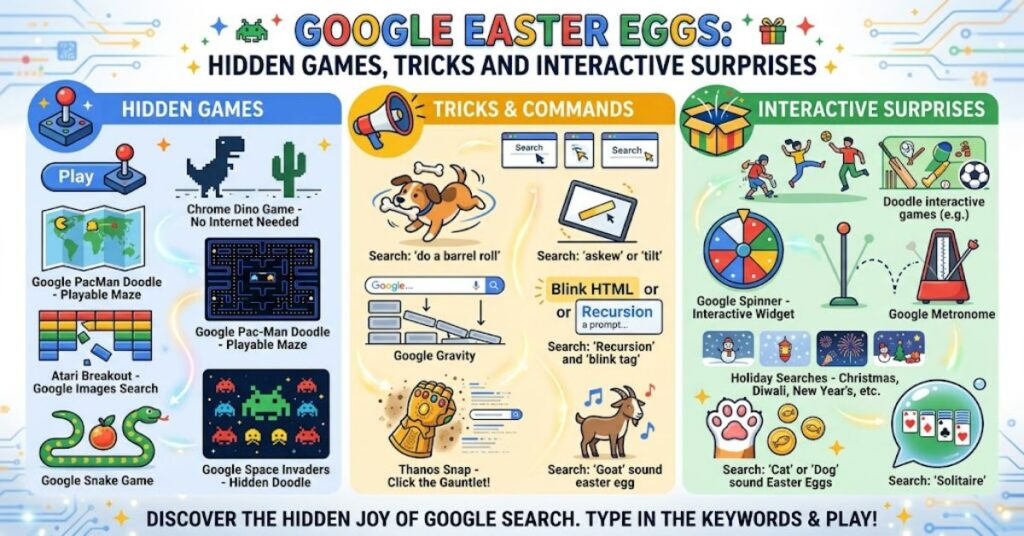
Google Easter eggs are hidden interactive features, mini-games, animations and unusual responses that appear when users search particular words or phrases. Instead of returning only conventional web results, Google sometimes makes the search page itself respond to the query.
The tradition goes back years. Google says one of its early Search Easter eggs appeared in 2003, returning the answer to “the answer to life, the universe and everything”. Since then, the company has used animations, games, visual effects and references to popular culture to make Search more playful (Google, 2023).
Some of the best-known examples include searching for “do a barrel roll”, which causes the results page to rotate, and “askew”, which tilts the page. Other experiments have turned Search into playable experiences, including Pac-Man and Solitaire.
The important detail is that there is no permanent master list covering every Google Easter egg. Google introduces some as temporary events, retires others and occasionally changes how they appear. Its own Search history describes Easter eggs as part of the product’s development, while more recent launches have used them to accompany cultural events and major search trends.
That makes Google Easter eggs less like a fixed feature catalogue and more like a changing layer of Google’s product culture.
What Counts as a Google Easter Egg?
A conventional Search feature helps users complete a task. An Easter egg is different because the surprise itself is part of the experience.
| Type | Typical behaviour | Example |
| Animation | The results page visually changes | “do a barrel roll” |
| Interface joke | Search behaves unexpectedly | “askew” |
| Mini-game | Search becomes playable | Pac-Man or Solitaire |
| Cultural reference | A query triggers themed content | Film, music or fandom-related effects |
| Historical feature | Search recreates an older experience | “Google in 1998” |
| Temporary event | A feature appears for a limited period | Anniversary or major cultural event |
The distinction is useful because not every unusual Google result is technically an Easter egg. Search also contains calculators, conversions, sports information, knowledge panels and other built-in tools designed primarily for utility.
An Easter egg generally adds an element of discovery or entertainment rather than simply answering the query.
Notable Google Easter Eggs to Try
One of the classic examples is “do a barrel roll”. Google has documented it alongside other playful Search behaviours, including Atari Breakout, Zerg Rush and Pac-Man. Some of these experiences have changed or may no longer operate exactly as they once did (Google, 2018).
Another long-running reference is “42”, connected to Douglas Adams’ The Hitchhiker’s Guide to the Galaxy. Searching for the answer to life, the universe and everything has historically produced 42.
Other familiar examples include:
- Askew: produces a slightly tilted Search page.
- Google in 1998: recreates an older-looking Google Search experience.
- Solitaire: provides a playable card game through Search.
- Pac-Man: has been available as an interactive Search experience.
- Flip a coin: provides a digital coin toss.
- Roll a die: produces a digital dice-rolling tool.
- Blink HTML: references the old HTML blink element.
- Metronome: turns Search into a simple musical timing tool.
The last group sits close to the boundary between Easter eggs and utility features. Google has itself described Search as containing both useful tools and playful surprises, which explains why lists of “hidden Google tricks” often combine the two.
Why Some Easter Eggs Stop Working
One of the biggest problems with online lists of Google Easter eggs is that they age badly.
A search effect can be connected to a particular campaign, anniversary, product experiment or technical implementation. Once that event ends, Google may remove the feature. Browser changes, mobile interfaces and regional differences can also affect availability.
Google demonstrated this temporary approach with its 2026 America 250th anniversary Easter egg. Beginning on 12 January 2026, searches related to the anniversary triggered a special animation, with Google stating that the effect would continue only until after 4 July 2026 (Google, 2026).
That example illustrates an important distinction: a Google Easter egg can be real without being permanent.
Availability Insight Table
| Situation | What it means | Best interpretation |
| Effect appears immediately | Feature is currently supported in that environment | Working Easter egg |
| Search returns normal results | Feature may be retired or unavailable | Do not assume the query is wrong |
| Works on desktop but not mobile | Interface or platform difference | Try another supported environment |
| Appeared during an event | Likely campaign-specific | Availability may have ended |
| Third-party page says it works | Historical evidence only | Verify directly before publishing |
Easter Eggs, Games and Google’s Product Culture
The popularity of these features says something about how Google has historically treated Search as more than a utility.
In 2018, Google published a playful catalogue of Search surprises that mentioned games, animations, visual effects and unusual responses. This was not an isolated experiment. Google’s own 25-year Search timeline later described Easter eggs as a recurring part of Search history, dating back to 2003 (Google, 2018; Google, 2023).
Google has also used interactive experiences around major trends. In December 2023, the company launched the Most Searched Playground, an interactive environment based on 25 years of Search trends. Google said the experience contained more than 1,700 figures and additional hidden Easter eggs (Google, 2023).
A separate 2023 Taylor Swift Search experience demonstrated another approach. Users could search for “Taylor Swift”, open a blue vault and solve word puzzles. Google said users collectively solved 33 million puzzles to unlock the vault-track titles associated with the experience (Google, 2023).
These examples show that Easter eggs can function as product experiences, marketing events and cultural references rather than simple jokes.
Three Practical Insights
Search results are not a permanent software interface. An Easter egg can disappear without the underlying search query becoming invalid. This is why dated documentation matters when reporting whether a feature exists.
Temporary Easter eggs can be more sophisticated than classic tricks. The Taylor Swift vault and Most Searched Playground demonstrate that modern interactive Search experiences can involve puzzles, collective participation and substantial visual design rather than a single animation.
The best verification method is direct testing. Community lists are useful for discovery, but they can contain retired features. A published article should distinguish historically documented Easter eggs from those confirmed to work at the time of writing.
The Future of Google Easter Eggs in 2027
Google’s recent history suggests that Easter eggs will continue to appear alongside cultural events, major anniversaries, entertainment releases and Search experiments, although their exact form is difficult to predict.
The 2023 Most Searched Playground showed how Google can combine Search history, interactive exploration and hidden discoveries. The 2026 anniversary animation showed that the company still uses temporary Search effects for major events.
The technical direction may also become more interactive. Google’s Search products increasingly combine text, images, interactive tools and AI-driven experiences. That creates more possible places for playful interfaces to appear, but it also makes the classic “type a phrase and watch the page change” Easter egg less central than it once was.
The infrastructure constraint is simple: temporary features need to work across browsers, mobile devices and regions. As Search becomes more complex, maintaining old hidden effects may become less valuable than creating short-lived experiences tied to current events.
Key Takeaways
- Google Easter eggs have been part of Search culture since at least 2003.
- “Do a barrel roll” remains one of the best-known examples.
- Search has hosted games including Pac-Man and Solitaire.
- Google has used Easter eggs for cultural campaigns and major events.
- Temporary experiences can disappear after their associated event ends.
- Historical lists should not be treated as proof that every Easter egg still works.
- Direct verification is essential before publishing a current list.
Conclusion
Google Easter eggs occupy an unusual position within modern Search. They are not essential utilities, yet they have helped make Google feel less like a static database and more like an evolving digital environment.
Their history also reflects changes in Google’s approach to interaction. Early tricks such as page rotations and visual jokes were technically simple and easy to discover. Later experiences became larger, more visual and more closely connected to entertainment, cultural events and Search trends.
The biggest lesson for anyone looking for Google Easter eggs is that availability matters. A feature documented years ago may have been retired, while a newer one may exist only for a limited campaign. Google’s own history confirms that the company has repeatedly introduced and removed such experiences.
For that reason, the most useful way to approach Google Easter eggs is as a changing collection of digital curiosities. Some become classics. Others last for a season, an anniversary or a single campaign. The surprise is part of the design.
Frequently Asked Questions
What are Google Easter eggs?
Google Easter eggs are hidden or playful features built into Search or other Google products. They can include animations, games, jokes, visual effects and references to popular culture.
What is the most famous Google Easter egg?
“Do a barrel roll” is among the most recognisable Search Easter eggs. Entering the phrase has historically caused the results page to rotate.
Are all Google Easter eggs still available?
No. Some have been retired, while others were created for temporary events. Availability can also vary by device, region and date.
Can you play games through Google Search?
Google has offered interactive games including Pac-Man and Solitaire through Search. The exact games available can change as Google updates its products.
Why does a Google Easter egg not work for me?
The feature may have been retired, replaced, limited to a particular platform or tied to an event that has ended. Historical articles do not guarantee current availability.
Does Google have an official list of every Easter egg?
There is no single permanent public catalogue covering every historical and current Easter egg. Google’s own Search history documents selected examples, while other features have been announced through individual product posts.
Methodology
This article was researched using Google’s own published material, including its Search history, official Search product posts and documentation describing historical Easter eggs and interactive experiences. No independent software testing was conducted across multiple devices or regions.
Because Easter eggs can be temporary, the article avoids presenting a historical feature as permanently available unless Google’s documentation supports that status. Examples are separated from ordinary Search utilities where appropriate.
The main limitation is that Google’s Search interface can change without notice. Browser, device, language, region and campaign timing may affect whether a particular feature appears.
This article was drafted with AI assistance and should be reviewed and verified by the RubbleMagazine.co.uk editorial team before publication. The editor should independently confirm current Easter egg availability and all reference details.
References
Google. (2018, 11 September). 20 things you didn’t know you could do with Search. Google Blog.
Google. (2018, 26 September). Oh, the things you’ll find. Google Blog.
Google. (2023, 6 September). 25 biggest moments in Search, from helpful images to AI. Google Blog.
Google. (2023, 12 December). Exploring the Most Searched Playground. Google Blog.
Google. (2023, 19 September). “1989 (Taylor’s Version)” vault titles come to Search. Google Blog.
Google. (2026, 12 January). Google Search is celebrating 250 years of America. Google Blog.