Searches for map 2.0 post assessment answers often come from students, parents or educators trying to understand what happens after a MAP-style test. The important point is simple: there is no reliable public answer key for a secure adaptive assessment, and trying to find one is the wrong way to prepare.
MAP Growth, the best-known MAP assessment from NWEA, is designed to measure academic achievement and growth across subjects such as math, reading, language usage and science. NWEA describes MAP Growth as a computer-adaptive assessment, which means question difficulty changes based on how the student responds during the test. That structure makes a fixed “answer sheet” unrealistic for live testing and risky for learning.
This article follows the uploaded Postcard.fm production brief, which specifies the core keyword, required structure, E-E-A-T expectations, SEO metadata, visual strategy and editorial review checklist. The goal here is not to publish test answers. It is to explain what the search term usually means, how MAP-style post assessments work and how students can prepare without compromising the value of the score.
For related education coverage on Postcard.fm, the site’s Education archive is the most relevant internal destination currently visible in search.
What “Map 2.0 Post Assessment Answers” Usually Means
The phrase map 2.0 post assessment answers is not a clear official product name in the public NWEA materials reviewed for this article. In most search behavior, it likely refers to one of three things: students looking for answers after a test, teachers looking for post-assessment review support or parents trying to understand a score report.
That distinction matters. A public practice worksheet may include answers. A secure school assessment should not. NWEA’s public support materials point students toward practice tests and videos for familiarity with the test environment, not answer memorization.
In plain terms, the ethical version of this search is: “How do I review after a MAP-style assessment?” The unsafe version is: “How do I get the live test answers?” This article addresses the first question.
How MAP-Style Assessments Work
MAP Growth is commonly described as an interim, responsive, computer-based K–12 assessment. NWEA explains that it helps measure what students know and how they are growing academically over time.
The key technical feature is adaptive testing. If a student answers correctly, the next question may become more difficult. If the student answers incorrectly, the next question may become easier. This helps the assessment estimate the student’s instructional level rather than simply grade a fixed quiz.
That is why map 2.0 post assessment answers is a misleading search. Two students in the same grade can see different question paths. A copied answer list may not match the test, may be from an unrelated worksheet or may come from a third-party practice page rather than a secure assessment.
Ethical Review vs Answer-Key Searching
| Approach | What it does | Benefit | Risk |
| Reviewing score reports | Uses RIT score bands and learning areas to identify strengths and gaps | Supports real growth | Requires patience and teacher guidance |
| Taking official practice tests | Builds comfort with navigation and item format | Reduces test anxiety | Does not reveal live answers |
| Practicing weak skills | Targets math, reading or language standards | Improves future performance | Needs consistent effort |
| Searching for answer keys | Tries to bypass the learning process | Feels fast | Can violate test integrity and distort placement |
| Using random online worksheets | Provides extra practice | Helpful when aligned | Quality and relevance vary |
The strongest strategy is not to chase map 2.0 post assessment answers. It is to use the post-assessment moment to ask better questions: Which skill areas were weak? Did the student rush? Were there vocabulary barriers? Did anxiety affect performance?
What Students Should Do After a MAP-Style Assessment
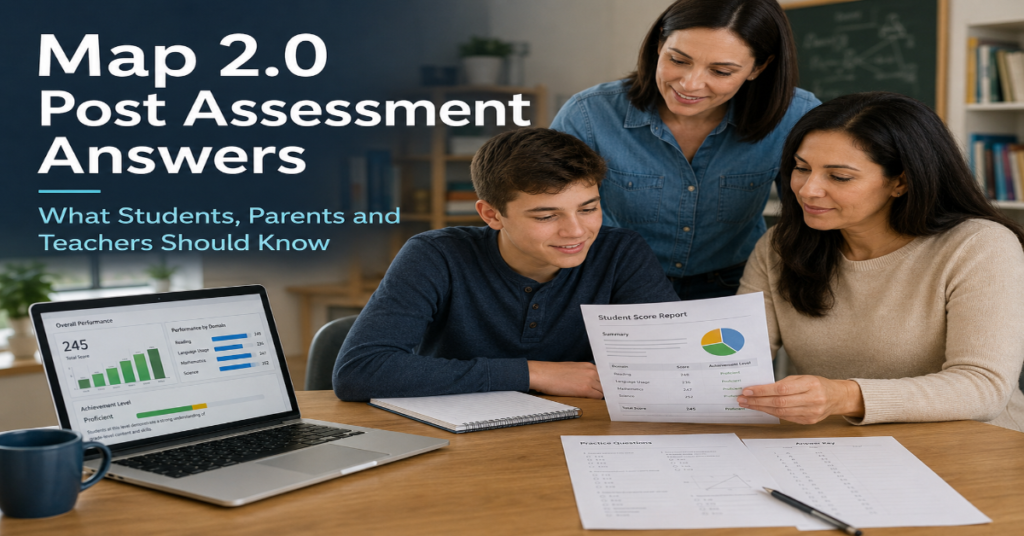
A student should first understand that a MAP-style test is not usually a pass-or-fail event. Schools use results to track growth, group instruction, identify readiness and guide academic support. NWEA’s family materials explain that MAP Growth uses a RIT score to show performance and growth over time.
A practical post-assessment review should include:
| Review Area | What to Check | Practical Action |
| Score trend | Did the score rise, fall or stay flat? | Compare with prior testing windows |
| Subject pattern | Math, reading, language or science | Focus study time on the weakest area |
| Test behavior | Rushing, guessing or fatigue | Practice pacing and breaks |
| Skill gap | Vocabulary, computation, inference or problem solving | Use targeted lessons |
| Confidence | Did anxiety affect performance? | Use practice tests to reduce uncertainty |
NWEA’s proctor guidance also references rapid guessing and test engagement, which shows that behavior during the test can affect score usefulness.
Risks and Trade-Offs
The biggest risk in searching for map 2.0 post assessment answers is that students may treat a growth assessment like a memorization contest. That defeats the purpose.
A MAP-style score is meant to help teachers understand what a student is ready to learn next. If a student uses leaked answers, outside help or copied responses, the score can place them too high. That creates a real academic problem: the student may then receive work they are not ready for.
There is also a school-level integrity issue. NWEA has published guidance on maintaining test integrity because districts use these assessments for instructional planning and sometimes for higher-stakes decisions. A compromised result does not only affect one student. It can distort classroom grouping, intervention planning and program placement.
Practical Preparation Without Cheating
Students can prepare ethically by using official practice resources, reviewing core academic skills and learning how the test interface works. NWEA points students to practice tests and videos through student resources, and its support page lists the practice-test username and password as “grow” for practice access.
A useful study workflow looks like this:
- Take a short practice test to understand question format.
- Review the subject area that felt hardest.
- Practice two or three targeted skills each week.
- Read score reports with a teacher or parent.
- Track growth across testing windows rather than obsessing over one score.
Postcard.fm already publishes practical education material, including coverage of exam-style study topics such as RN Fundamentals 2016 70 Questions in its Education archive. That kind of study-guide framing is more useful than answer chasing.
Real-World Impact
The real-world impact of MAP-style testing is instructional. A teacher can use score data to group students, identify learning gaps and measure academic growth across the year. A parent can use the report to understand whether a child needs enrichment, review or support.
The cultural problem is different. Search demand for “answers” reflects pressure. Students may feel judged by scores. Parents may misunderstand what the test measures. Schools may not always explain the difference between a classroom quiz and an adaptive growth assessment.
That is why the phrase map 2.0 post assessment answers needs careful handling. The responsible answer is not a leaked key. It is a clearer explanation of what the assessment is for.
Original Insights for Editors
| Insight | Why It Matters |
| Answer-key searches often signal poor score communication | Students and parents may search for shortcuts when they do not understand how RIT scores work |
| Adaptive testing weakens the value of static answer lists | A fixed answer key does not match individualized question paths |
| Post-assessment review should focus on behavior as well as content | Rapid guessing, fatigue and pacing can affect score quality |
| Practice-test familiarity is ethical preparation | Interface comfort can reduce anxiety without compromising test security |
| Misplaced score pressure can produce worse instruction | Inflated or invalid scores may put students into the wrong learning group |
The Future of MAP-Style Post Assessment Review in 2027
By 2027, the most useful change will not be public answer keys. It will be better reporting. Schools are likely to continue using adaptive assessments because they help measure growth across different achievement levels. NWEA’s current public materials already emphasize growth over time, teacher insight and family understanding.
The likely trend is more parent-friendly reporting, better student dashboards and clearer links between scores and next-step practice. The risk is over-automation. If schools rely too heavily on score bands without teacher judgment, they may miss context such as language background, test anxiety, attendance or disability accommodations.
A balanced 2027 model should combine adaptive data with human review. Scores can show patterns. Teachers still need to interpret them.
Takeaways
- MAP-style post assessments are designed to measure growth, not reward memorized answers.
- A fixed answer key is usually unreliable because adaptive tests change by student response.
- Official practice resources are appropriate for test familiarity.
- Post-assessment review should focus on skill gaps, pacing and score trends.
- Parents should ask what the score means for instruction, not whether it is “good” in isolation.
- Teachers should explain score reports clearly to reduce answer-key searching.
- Ethical preparation protects both student learning and school data quality.
Conclusion
The search for map 2.0 post assessment answers reveals a real need, but not the one it appears to show. Students do not need secret answer keys. Parents do not need suspicious PDFs. Teachers do not need more pressure around scores. What they need is a clear, honest way to interpret results and prepare for future growth.
MAP-style assessments work best when they are treated as diagnostic tools. The score should guide instruction, reveal patterns and help students understand what to work on next. When answer hunting enters the process, the value of the assessment drops. A student may gain a temporary advantage, but the long-term result is weaker placement, less accurate support and less trust in the data.
The better path is skill-based review, official practice resources and transparent score conversations between students, parents and teachers.
FAQ
Is there a real answer key for MAP 2.0 post assessments?
For secure school assessments, students should not expect a public answer key. MAP-style adaptive tests can vary by student, so answer lists found online may be unrelated, outdated or from practice worksheets.
Why do people search for map 2.0 post assessment answers?
Most searches come from test anxiety, score pressure or confusion about what post-assessment review means. In many cases, the better search is how to understand MAP scores or how to prepare ethically.
Can students practice before a MAP Growth test?
Yes. NWEA provides public practice tests and videos so students can become familiar with the testing experience. These resources support readiness without revealing secure test content.
What does a RIT score mean?
A RIT score is a scale score used to measure academic performance and growth over time. It helps compare progress across testing windows rather than simply labeling a student as passing or failing.
Are online MAP answer PDFs safe to use?
They should be treated with caution. Some may be ordinary worksheets, some may be inaccurate and some may encourage academic misconduct. Official practice materials and teacher-approved resources are safer.
What should parents ask after a MAP-style assessment?
Parents should ask which skills need support, how the score compares with past results and what classroom actions will follow. The score matters most when it leads to better instruction.
Methodology
This article was prepared by reviewing the uploaded Postcard.fm production brief, official NWEA MAP Growth resources, NWEA family guidance, public practice-test guidance and available Postcard.fm internal search results. The analysis avoids secure test content and does not provide live assessment answers. The main limitation is that “MAP 2.0” is not clearly verified as an official public NWEA product label in the sources reviewed, so the article treats the phrase as a user search term connected to MAP-style post-assessment intent.
References
NWEA. (2025). Family guide to MAP Growth.
NWEA. (2026). MAP Growth.
NWEA. (2024). MAP Growth 101: Everything families need to know.
NWEA. (2025). Proctor guide.
NWEA. (n.d.). Practice tests and videos for MAP Growth.
NWEA Connection. (n.d.). Practice tests for MAP Growth.
Postcard.fm. (2026). Education archive.