
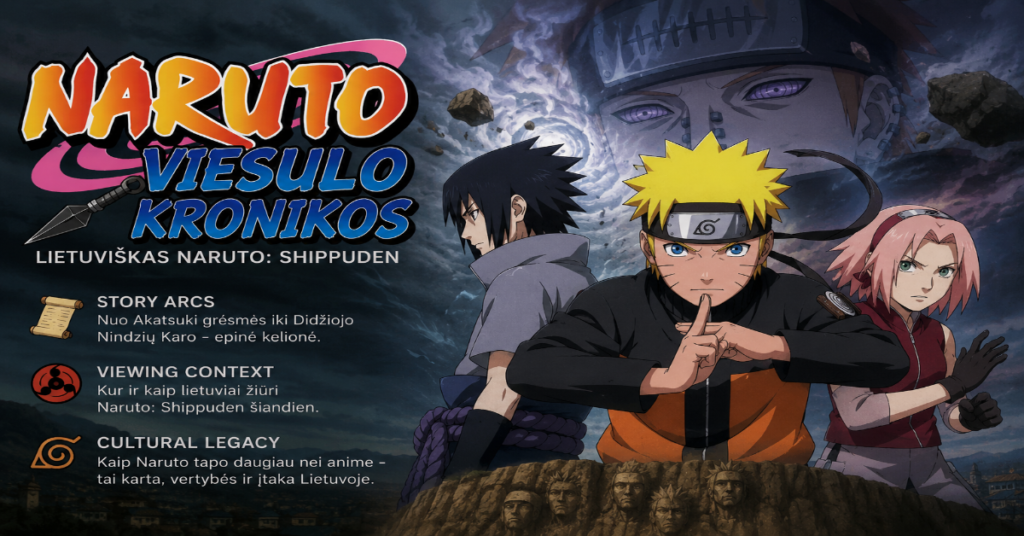
Narutas Viesulo Kronikos is the Lithuanian title most commonly associated with Naruto: Shippuden, the long-running Japanese anime continuation of Naruto. The story begins after Naruto Uzumaki returns to the Hidden Leaf Village following roughly two and a half years of training with Jiraiya, only to face stronger enemies, fractured friendships and the growing threat of Akatsuki. The official Naruto site describes Shippuden as beginning with Naruto’s return after that training journey and his reunion with Sakura, Kakashi and his village peers.
For searchers, the phrase usually points to three overlapping questions. First, what is the title? Second, how does it connect to Naruto: Shippuden? Third, where does it fit in the wider Naruto franchise? Those questions matter because localized anime titles often become detached from their original Japanese and English branding.
The Lithuanian title is especially interesting because it shows how global anime culture travels through translation, television scheduling, fan archives and unofficial online circulation. A local viewer may remember the phrase from broadcast television. A newer fan may encounter it while searching for Lithuanian-language anime pages. A parent may simply want to know whether this is the same Naruto series their child is watching.
This article follows the production guidance in the uploaded Postcard.fm article prompt, including the required structure, SEO metadata, tables, FAQ, visual strategy and methodology.
What narutas viesulo kronikos Means
The phrase translates closely to “Naruto: Hurricane Chronicles” or “Naruto: Wind Chronicles,” depending on how literally one renders “viesulo.” In practical media use, it refers to Naruto: Shippuden, the second major anime series in the Naruto franchise.
The official English branding is Naruto: Shippuden. The Japanese title uses “Shippūden,” a term often associated with strong wind or hurricane-like motion. Lithuanian localization keeps the storm imagery, which makes the title feel less like a direct copy and more like a natural-language adaptation.
That matters. Localized titles are not just labels. They shape how audiences remember a show. In Lithuania, narutas viesulo kronikos can function as a nostalgia keyword, a search shortcut and a cultural marker for viewers who encountered anime through dubbed or voiced-over television rather than global streaming platforms.
Core Series Context
Naruto: Shippuden is the sequel to the original Naruto anime. It follows Naruto as an older teenager and shifts the story from school-age ninja missions toward war, revenge, grief, political instability and inherited trauma.
The series is officially tied to Masashi Kishimoto’s Naruto franchise. VIZ describes Naruto as the story of a young shinobi with a mischievous personality and a serious goal of becoming the world’s greatest ninja. Crunchyroll summarizes Shippuden as following Naruto Uzumaki as a teenage ninja striving to protect his village and become Hokage.
The shift from Naruto to Shippuden is structural. The first series is built around growth, team formation and village-scale conflict. Shippuden widens the frame. The emotional center remains Naruto, Sasuke, Sakura and Kakashi, but the world around them becomes far more dangerous.
Structured Insight Table
| Element | Original Naruto | Naruto: Shippuden / narutas viesulo kronikos |
| Main stage | Academy, Chunin Exams, early missions | Akatsuki conflict, global war, ideological battles |
| Naruto’s age phase | Child and early teen | Older teen |
| Central emotional question | Can Naruto be accepted? | Can Naruto save others without losing himself? |
| Conflict scale | Village and regional threats | International and existential threats |
| Tone | Adventure, rivalry, comedy, early trauma | Darker drama, grief, vengeance, war strategy |
| Best viewer fit | New franchise viewers | Viewers who know the original series |
Episode Count, Dates and Broadcast Context
Naruto: Shippuden began airing in Japan on February 15, 2007 and concluded on March 23, 2017. Public episode lists document it as a 500-episode series produced by Pierrot and TV Tokyo.
For Lithuanian-language viewers, LTMedia Wiki identifies Narutas. Viesulo kronikos as the Lithuanian voice-over of Naruto: Shippuden and notes that it previously aired on BTV, with a listed release around 2013. That source should be treated carefully because fan-maintained archives can preserve useful local broadcast details but may not carry the same verification weight as official distributor pages.
Data Table: Key Facts
| Fact | Detail | Source strength |
| Original anime title | Naruto: Shippuden | Official franchise and distributor pages |
| Lithuanian title | Narutas: Viesulo kronikos | Lithuanian anime and media archive pages |
| Japanese broadcast period | 2007 to 2017 | Episode documentation and official references |
| Total episode count | 500 episodes | Widely documented episode listings |
| Story placement | After Naruto’s training with Jiraiya | Official Naruto synopsis |
| Lithuanian broadcast link | BTV voice-over history reported | Fan archive, useful but limited |
Story Systems and Narrative Architecture
The strongest feature of narutas viesulo kronikos is not simply the number of fights. It is the way the series builds systems around loyalty, power, trauma and political inheritance.
Naruto’s central system is chakra, but Shippuden turns chakra into more than combat fuel. It becomes a language of bloodlines, national identity, tailed beasts, forbidden techniques and institutional failure. The story repeatedly asks whether power can be used without repeating the violence that created it.
Akatsuki is the clearest example. At first, the organization appears to be a villain network. Over time, it becomes a critique of war economies and abandoned children. Many of its members are not random criminals. They are products of conflict zones, failed villages and personal grief.
This gives the series a more adult structure than its early episodes suggest. The battles are spectacular, but the real machinery is political. Villages claim to protect peace while training children as weapons. Leaders speak about stability while hiding unethical decisions. Heroes inherit systems they did not create but still must answer for.
Strategic and Practical Viewing Implications
For new viewers, the biggest strategic question is whether to watch the original Naruto first. The answer is yes for most people. Shippuden assumes emotional knowledge of Naruto’s bonds with Sasuke, Sakura, Kakashi, Jiraiya, Iruka and the Hidden Leaf Village.
Watching Shippuden without the original series is possible, but the emotional weight is weaker. Sasuke’s choices feel less painful. Naruto’s stubborn loyalty feels less earned. Sakura’s growth is harder to measure. Kakashi’s quiet grief loses context.
For viewers who are returning after many years, narutas viesulo kronikos works best when approached by arc rather than as one uninterrupted block. A 500-episode series can exhaust casual viewers. Arc-based viewing helps preserve momentum.
Viewing Options
| Viewing path | Best for | Strength | Trade-off |
| Full Naruto then Shippuden | First-time viewers | Maximum emotional context | Long time commitment |
| Shippuden only | Returning fans | Faster access to major arcs | Lost early relationship context |
| Arc-based viewing | Busy viewers | Better pacing control | Requires a guide |
| Legal streaming route | Safety-focused viewers | Better quality and fewer risks | Availability varies by region |
| Unofficial upload route | Viewers seeking local language versions | May surface rare dubs or subtitles | Legal, privacy and malware risks |
For broader digital safety context, Postcard.fm’s guide to streaming safety and legal alternatives is relevant because anime searches often lead users into unofficial streaming ecosystems. Its yt to mp4 safety guide is also useful for understanding why video-download tools carry quality, legal and privacy trade-offs.
Risks and Trade-Offs
The first risk is piracy exposure. Search results for localized anime titles often include unofficial streaming sites, fan uploads and subtitle portals. Some may be harmless fan references. Others may expose users to intrusive ads, tracking scripts, malware prompts or misleading download buttons.
The second risk is translation quality. Localized titles, fan subtitles and voice-over releases can vary widely. A viewer may assume every Lithuanian page represents the same version, but translation differences can change tone, names, jokes and even plot clarity.
The third risk is filler fatigue. Naruto: Shippuden is famous for long storytelling, but not every episode contributes equally to the core manga plot. Some viewers appreciate the expanded character moments. Others find that pacing weakens the main story’s urgency.
The fourth risk is age suitability. Shippuden is more mature than early Naruto. It includes war violence, death, trauma, manipulation and morally complicated revenge arcs. Parents should not assume it is the same tone as a light children’s cartoon.
Market, Cultural and Real-World Impact
The Naruto franchise is one of the clearest examples of anime becoming a global language rather than a niche import. Local titles like narutas viesulo kronikos show how that process worked outside the biggest English-language markets.
Lithuanian use of the title points to a wider pattern. Anime did not globalize only through official streaming. It moved through television blocks, voice-over studios, DVD circulation, forums, fan sites, archive pages and search habits. Each country developed its own naming memory.
That is why the title still has search value. It is not only a translation. It is a digital breadcrumb. It connects a Japanese franchise, Lithuanian viewing culture and a generation of viewers who remember anime through local television rather than platform menus.
Postcard.fm’s article on dojen moe culture offers a useful adjacent lens because it explains how Japanese visual culture spreads through independent communities, emotional character design and international fan adaptation.
Three Original Analytical Insights
First, localized anime titles create search fragmentation. A viewer searching “Naruto Shippuden” and another searching narutas viesulo kronikos may be looking for the same work but receive different search results. This affects discoverability, legal access and the quality of information available.
Second, Lithuanian voice-over history is a preservation problem. Official platforms often preserve current distribution rights, not older broadcast memory. Fan-maintained databases may become the only visible record of local TV versions, even when their details are incomplete.
Third, Shippuden’s long format is both its strength and its biggest modern friction point. In 2007 to 2017 television culture, long serialization built habit. In 2026 streaming culture, the same length can become a barrier unless viewers use arc guides, filler lists or curated watch orders.
The Future of narutas viesulo kronikos in 2027
By 2027, the future of narutas viesulo kronikos will likely depend less on new Shippuden episodes and more on localization, catalog access and franchise revival cycles. The core Shippuden anime is complete. Its continued relevance comes from rewatching, streaming availability, fan editing, anniversary content and renewed interest in Boruto-related material.
A likely development is better regional metadata. Streaming platforms increasingly need stronger multilingual search because users search in local titles, English titles and transliterated Japanese titles. A platform that recognizes narutas viesulo kronikos as Naruto: Shippuden gives Lithuanian users a smoother discovery path.
Another likely development is continued debate over filler and pacing. Recent entertainment coverage has noted fan interest in tighter Naruto-related storytelling and reduced filler in future franchise adaptations. That does not rewrite Shippuden, but it changes how newer viewers judge it.
The uncertainty is rights availability. Anime catalogs shift by country. A title can be available legally in one region and absent in another. By 2027, the best viewer experience will depend on whether distributors invest in local-language metadata, subtitles and archived dub information.
Key Takeaways
- narutas viesulo kronikos is best understood as the Lithuanian title for Naruto: Shippuden.
- The series continues Naruto’s story after his training journey and shifts the franchise toward darker, larger-scale conflict.
- Its 500-episode structure rewards committed viewers but creates pacing challenges for modern audiences.
- Lithuanian broadcast and voice-over references are culturally valuable but should be verified carefully.
- Legal streaming is safer than unofficial anime sites, especially for younger viewers and family devices.
- The title’s long-term value lies in localization, fan memory and anime preservation.
- In 2027, discovery and metadata may matter more than new Shippuden content.
Conclusion
narutas viesulo kronikos remains a meaningful search term because it sits at the intersection of anime storytelling, Lithuanian localization and global fan memory. At the simplest level, it points to Naruto: Shippuden, the 500-episode sequel that follows Naruto Uzumaki into a darker and more politically complex stage of his journey.
Its deeper value is cultural. The title shows how anime becomes local. Viewers do not only remember official Japanese or English names. They remember the words used on television, fan pages, subtitle sites and community discussions. That memory deserves careful treatment.
For new viewers, the best approach is to understand the title, watch the original Naruto first where possible and use legal platforms whenever available. For returning fans, the phrase is a reminder of how far Naruto traveled, from manga pages and Japanese broadcast television into the language of audiences around the world.
FAQ
What is narutas viesulo kronikos?
narutas viesulo kronikos is the Lithuanian title commonly used for Naruto: Shippuden, the sequel anime to Naruto. It follows Naruto Uzumaki after his training with Jiraiya and focuses on Akatsuki, Sasuke, the tailed beasts and the Fourth Great Ninja War.
Is narutas viesulo kronikos the same as Naruto: Shippuden?
Yes. In practical use, the phrase refers to Naruto: Shippuden. Lithuanian-language anime pages and fan archives connect the title with the Shippuden series and its local viewing history.
How many episodes does Naruto: Shippuden have?
Naruto: Shippuden has 500 episodes. The series began airing in Japan in 2007 and ended in 2017.
Should I watch Naruto before narutas viesulo kronikos?
Yes, preferably. Shippuden depends heavily on relationships, rivalries and emotional conflicts established in the original Naruto series. You can start with Shippuden, but many character decisions will feel less powerful.
Is narutas viesulo kronikos suitable for children?
It depends on age and sensitivity. Shippuden includes fantasy violence, death, war themes, trauma and revenge. It is more mature than early Naruto, so parents should review episodes or platform ratings before younger viewers watch.
Where can I watch Naruto: Shippuden legally?
Availability depends on region. Crunchyroll lists Naruto: Shippuden, while VIZ maintains official Naruto franchise pages and home-video listings. Regional catalogs can change, so viewers should check current legal platforms in their country.
Why do people search for narutas viesulo kronikos instead of Naruto: Shippuden?
Many viewers remember the localized Lithuanian title from TV, subtitles, fan pages or local anime sites. Localized titles often survive as nostalgia keywords even when official streaming platforms use English or Japanese branding.
Methodology
This article was prepared by identifying the core keyword from the uploaded Postcard.fm production prompt and applying its required structure, including category selection, front block, tables, future section, FAQ, visual strategy and SEO metadata.
The factual base was checked against the official Naruto site, VIZ, Crunchyroll, episode documentation and Lithuanian-language archive pages. Official franchise and distributor sources were prioritized for story description and legal viewing context. Fan-maintained Lithuanian sources were used only for local title and broadcast context, with their limitations clearly noted.
Known limitations: I did not conduct new interviews, inspect original BTV broadcast logs or verify Lithuanian voice-over credits from primary broadcaster records. Any publication version should manually verify broadcast dates, local licensing history and APA references before going live.
References
Crunchyroll. (n.d.). Naruto Shippuden. Crunchyroll.
LTMedia Wiki. (n.d.). Narutas. Viesulo kronikos. Fandom.
Naruto Official Site. (n.d.). Naruto: Shippuden. Naruto Official.
VIZ Media. (n.d.). Naruto. VIZ.
VIZ Media. (n.d.). Naruto Shippuden video TV series products. VIZ.
Wikipedia contributors. (n.d.). List of Naruto: Shippuden episodes. Wikipedia. Used only for episode-date cross-checking, not as a sole authority.