
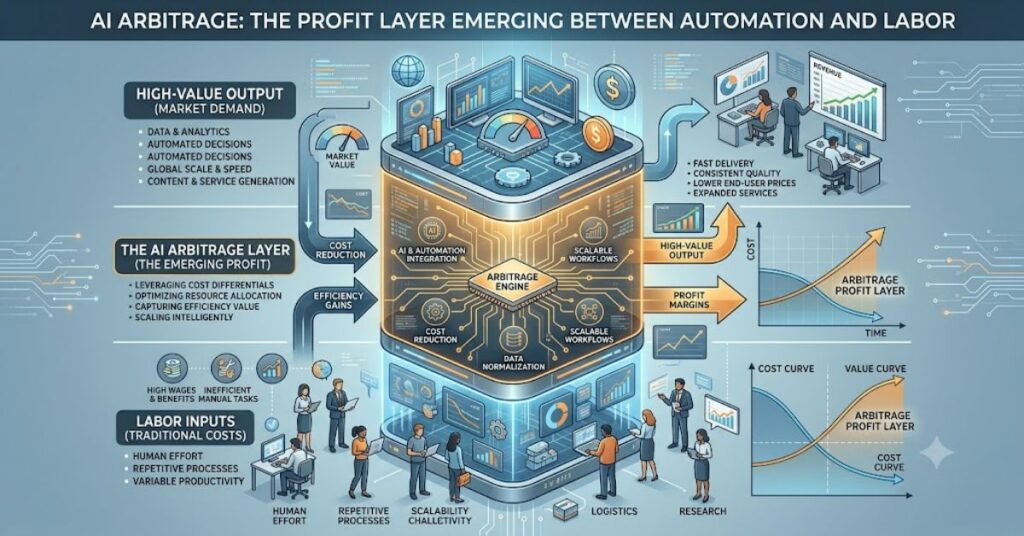
AI arbitrage is the practice of using artificial intelligence to drastically reduce the cost and time required to produce goods or services while still charging clients standard market rates. The profit comes from the efficiency gap between AI-assisted production and traditional human-heavy workflows.
In practical terms, this means a business might use AI tools to generate marketing copy, design assets, software prototypes, or customer support responses at a fraction of the usual labor cost—yet still invoice clients at conventional agency or consultancy rates. The difference between production cost and market pricing becomes the arbitrage margin.
This model is rapidly emerging across freelance platforms, digital agencies, and SaaS-enabled service businesses. Since the mainstream adoption of generative AI systems after 2022, production costs in some creative and operational tasks have dropped significantly, especially in content generation, basic design, and data processing workflows.
However, AI arbitrage is not simply about replacing workers with tools. It is a structural shift in how value is created and captured. Businesses are no longer constrained by linear human labor scaling. Instead, they are increasingly limited by quality control, client expectations, and the ability to integrate AI outputs into coherent deliverables.
This article breaks down how AI arbitrage works, where it creates real economic advantage, and the risks that emerge when efficiency outpaces accountability.
The Core Mechanics of AI Arbitrage
AI arbitrage operates on a simple economic principle: input cost compression with stable output pricing.
Basic structure:
- Traditional labor cost: high
- AI-assisted production cost: low
- Market price: unchanged (initially)
- Profit margin: widened gap between cost and price
AI Arbitrage Workflow Systems
| Stage | Traditional Model | AI Arbitrage Model |
| Ideation | Human brainstorming | AI-assisted ideation |
| Production | Manual execution | AI-generated first draft/output |
| Editing | Human refinement | Human + AI optimization |
| Delivery | Labor-intensive | Lightweight QA layer |
| Scaling | Linear hiring | Tool-based scaling |
Where AI Arbitrage Is Most Visible
1. Content Production
Blog writing, ad copy, and SEO content have seen the fastest adoption of AI-driven workflows. Production time per article has dropped dramatically in many agencies using generative tools.
2. Design and Creative Assets
Templates and AI image generation tools allow rapid prototyping of visuals that previously required dedicated designers.
3. Customer Support Systems
AI chat systems now handle Tier 1 queries, reducing staffing needs in high-volume support environments.
Systems Analysis: Why AI Arbitrage Works
The system depends on three reinforcing conditions:
- Latency collapse in production: AI reduces creation time from hours to minutes
- Decoupling of labor from output: One operator can manage multiple AI workflows
- Market pricing lag: Clients still pay for legacy production models
This lag between cost reduction and price adjustment is where arbitrage exists.
Strategic Implications for Businesses
AI arbitrage is not just a cost-saving mechanism. It reshapes business structure.
Key shifts:
- Agencies transition from labor providers to workflow orchestrators
- Freelancers become AI operators rather than sole producers
- SaaS companies embed AI into service delivery layers
- Small teams compete with historically larger organizations
The competitive advantage increasingly comes from system design rather than headcount.
Comparison: Traditional Services vs AI Arbitrage Models
| Factor | Traditional Service Model | AI Arbitrage Model |
| Cost structure | Labor-heavy | Tool-heavy |
| Scaling speed | Slow | Fast |
| Marginal cost per output | High | Low |
| Quality variance | Moderate | High (without QA) |
| Dependency | Human workforce | AI stack + operator |
Risks and Trade-Offs
AI arbitrage introduces new structural risks:
- Quality degradation risk: AI outputs require strong editorial control
- Price compression risk: Market rates eventually adjust downward
- Dependency risk: Over-reliance on AI systems creates fragility
- Regulatory risk: Disclosure requirements for AI-generated work may expand
- Homogenization risk: Outputs may converge stylistically across competitors
A key tension exists between speed and differentiation. Faster production does not automatically create competitive advantage if outputs become indistinguishable.
Three Original Analytical Insights
1. The “Margin Decay Curve”
Early adopters capture high margins, but as AI adoption spreads, pricing adjusts downward faster than many expect. The arbitrage window is temporary, not structural.
2. The Hidden Cost Shift
AI reduces production cost but increases verification cost. Human review becomes the primary expense center in mature AI workflows.
3. Output Inflation Problem
As production becomes cheap, the market experiences content saturation. Value shifts from creation to filtering and distribution.
Market and Cultural Impact
AI arbitrage is already reshaping digital labor markets:
- Freelance platforms show increasing competition on price due to AI-assisted bidders
- Agencies are repositioning as “AI-first studios”
- Employers are redefining entry-level roles to include AI tool fluency
Culturally, this shifts perception of creative labor from execution to supervision.
Data Insight Snapshot (Operational Economics)
| Metric | Pre-AI Workflow | AI-Assisted Workflow |
| Average content production time | 3–6 hours | 30–90 minutes |
| Cost per asset (agency avg.) | High | Reduced significantly |
| Revision cycles | 2–5 rounds | 1–3 rounds |
| Bottleneck | Human labor | Quality control |
Values reflect aggregated industry observations from AI adoption patterns across creative workflows post-2022.
The Future of AI Arbitrage in 2027
By 2027, AI arbitrage is expected to evolve from informal workflow optimization into structured economic infrastructure.
Key developments likely include:
- Regulated AI disclosure frameworks for commercial content
- Automated production pipelines integrated into enterprise software stacks
- Price normalization in AI-heavy service markets reducing arbitrage margins
- Credential systems for AI operators, similar to digital workforce certifications
Regulatory bodies in the EU and US are already moving toward transparency requirements for AI-generated content, which may reduce hidden arbitrage advantages in consumer-facing industries.
Infrastructure constraints—particularly compute costs and model licensing fees—may also stabilize the current extreme efficiency gap.
Takeaways
- AI arbitrage relies on temporary pricing inefficiencies between old and new production models
- The strongest advantage is in speed, not necessarily quality
- Verification and editing become the dominant cost center over time
- Market pricing will likely compress as AI adoption becomes universal
- Competitive advantage shifts from production to orchestration
- Regulatory disclosure may reduce hidden arbitrage margins
- Long-term winners will design systems, not just use tools
Conclusion
AI arbitrage represents a transitional phase in digital labor economics. It emerges when technology reduces production costs faster than markets adjust pricing structures. This gap creates profit opportunities for early adopters, particularly in content, design, and service-based industries.
However, the advantage is not permanent. As adoption spreads, pricing normalization and quality expectations adjust. What begins as arbitrage gradually becomes standard operating procedure. The businesses that sustain advantage are those that move beyond simple cost reduction and focus on system design, verification layers, and distribution control.
AI arbitrage is less about replacing labor and more about reorganizing it. The real shift is not automation itself, but who controls the workflow between machine output and market delivery.
FAQ
1. What is AI arbitrage in simple terms?
It is the practice of using AI to produce work cheaply while charging standard market rates, capturing the difference as profit.
2. Is AI arbitrage the same as automation?
No. Automation replaces steps; AI arbitrage focuses on reducing cost while maintaining pricing gaps in human-facing markets.
3. Which industries use AI arbitrage the most?
Content creation, marketing agencies, design services, and customer support systems are leading adopters.
4. Is AI arbitrage sustainable long-term?
It is likely temporary in its current form because market prices adjust as adoption becomes widespread.
5. What is the biggest risk in AI arbitrage?
Quality control and verification costs can offset expected savings if not managed properly.
6. Does AI arbitrage replace jobs?
It shifts roles rather than eliminating them, emphasizing oversight and system management over manual production.
Methodology
This article is based on observed industry adoption patterns of generative AI tools in creative and service workflows post-2022, combined with general economic principles of cost structure and labor scaling.
Sources of context include:
- Industry reports on generative AI adoption trends (2023–2025)
- Public documentation of AI tool usage in marketing and design workflows
- Economic frameworks related to labor arbitrage and productivity scaling
Limitations:
- No proprietary agency financial datasets were used
- No controlled experimental benchmarking was conducted
- Cost estimates are directional, not audited figures
Counterargument:
Some analysts argue AI reduces not only cost but also pricing power, meaning arbitrage margins may never fully materialize in competitive markets.