
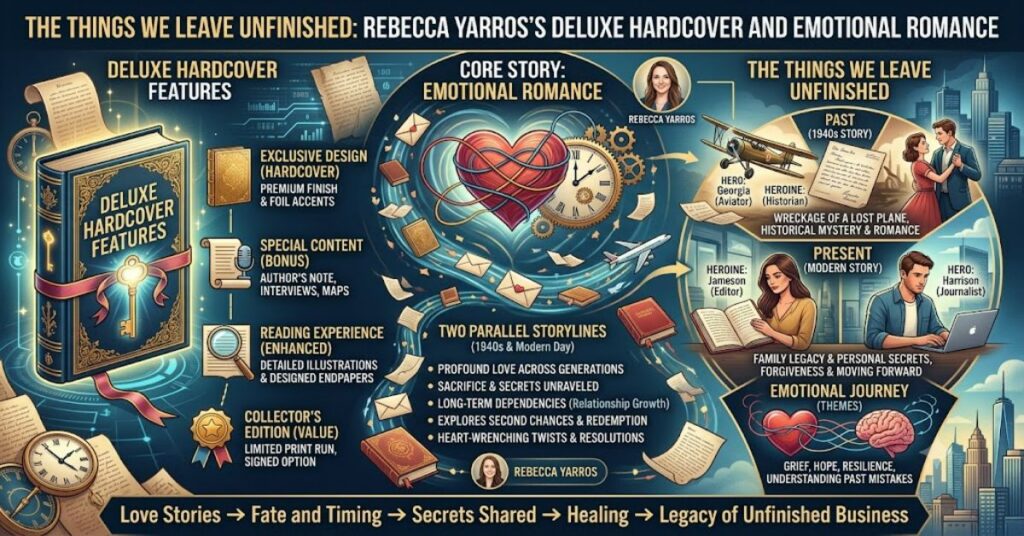
Rebecca Yarros’s The Things We Leave Unfinished is a dual-timeline romance that connects a present-day relationship with a World War II love story. Originally published in 2021, the novel has since received renewed attention, including a deluxe hardcover edition released in January 2026.
The new edition gives readers more than a standard format change. It features a jacket-less foiled hardcase, stencilled edges, custom endpapers with original artwork by Felu and a new letter from Yarros. The author has described the novel as one of her favourites, making the edition particularly interesting for readers who have followed her career from contemporary romance into the global success of Fourth Wing.
At its heart, however, the appeal of The Things We Leave Unfinished remains the story itself. The novel explores love, grief, sacrifice, second chances and the emotional consequences of unfinished stories.
What Is The Things We Leave Unfinished About?
The Things We Leave Unfinished follows Georgia Stanton, a woman returning to Colorado after a difficult divorce. At her late great-grandmother’s estate, she becomes involved with an unfinished manuscript that contains a deeply personal wartime love story.
The other central character is Noah Harrison, a successful romance author brought in to complete the manuscript. Georgia does not want him changing the story simply to create a commercially satisfying ending.
That conflict creates the bridge between the two timelines.
The historical storyline centres on Scarlett and Jameson, whose relationship unfolds during the Second World War. Their romance gives the novel its historical weight, while Georgia and Noah’s present-day relationship provides a more contemporary perspective on love, loss and starting again.
Publisher information confirms that the book was published by Entangled: Amara on 23 February 2021 and contains 400 pages.
Why the Dual Timeline Matters
The structure is one of the novel’s defining features.
Instead of presenting the historical romance as background decoration, Yarros uses it to influence the decisions made by the contemporary characters. The two stories gradually begin to echo one another.
| Story element | Present timeline | Historical timeline |
| Main characters | Georgia and Noah | Scarlett and Jameson |
| Setting | Contemporary Colorado | Europe during World War II |
| Central conflict | Completing an unfinished manuscript | Surviving separation and wartime uncertainty |
| Romantic theme | Second chances | Sacrifice and enduring love |
| Narrative purpose | Personal recovery | Historical emotional foundation |
This structure also gives the novel a different rhythm from a conventional contemporary romance. Readers move between periods, characters and emotional circumstances before seeing how the stories connect.
Kirkus Reviews described the book as a dual-timeline romance and highlighted its exploration of ambition, grief, family conflict and self-esteem alongside its romantic themes.
The Emotional Core of the Novel
The phrase “the things we leave unfinished” works as more than a title. It reflects the book’s central concern with unresolved relationships and stories.
Georgia begins the novel carrying the consequences of a painful divorce. The unfinished manuscript introduces another kind of incompleteness into her life. She is not simply deciding what should happen to an old book; she is confronting questions about truth, memory and whether every story needs the ending people expect.
Noah approaches the manuscript differently. As a commercially successful romance writer, he understands the expectations surrounding romantic fiction. Georgia, however, believes the historical story deserves an ending grounded in what really happened.
That disagreement gives the contemporary romance a practical conflict rather than relying entirely on attraction.
The historical storyline adds another layer. Scarlett and Jameson’s relationship is shaped by wartime conditions, where separation and uncertainty make ordinary romantic expectations impossible.
The 2026 Deluxe Hardcover Edition
The 2026 hardcover is particularly notable because its appeal is strongly physical.
Rebecca Yarros’s official description identifies several differences from an ordinary edition: the book has a jacket-less foiled hardcase, stencilled edges, custom endpapers featuring original art and a new letter from the author.
The edition was published on 20 January 2026, with the hardcover carrying ISBN 9781682816523.
| Edition feature | What readers receive |
| Format | Hardcover |
| Publication | January 2026 |
| Cover construction | Jacket-less foiled hardcase |
| Page edges | Stencilled |
| Endpapers | Custom artwork |
| Artwork | Original art by Felu |
| New material | Letter from Rebecca Yarros |
| Novel text | The existing story |
One important distinction is that the new letter is the principal textual addition. Yarros explicitly states that the only new content is her letter to readers.
That makes the edition more of a presentation-focused collectible than a substantially expanded version of the novel.
Rebecca Yarros’s Connection to the Book
The book occupies an interesting position in Yarros’s publishing career.
It predates the enormous commercial success of Fourth Wing, but the author has since spoken warmly about the novel. In her letter accompanying the hardcover edition, Yarros calls it her favourite book she has written.
That perspective gives the new edition additional context.
Readers discovering the novel after Fourth Wing may approach it expecting fantasy or romantasy. It is important to recognise that The Things We Leave Unfinished belongs to a different part of Yarros’s catalogue. It is a romance built around contemporary and historical settings rather than dragons, magical systems or fantasy warfare.
That difference can be a strength for readers interested in seeing how her storytelling developed across genres.
What Makes the Book Different From a Standard Romance?
Several features distinguish the novel from a straightforward contemporary love story.
First, the two timelines create a larger emotional framework. The reader is not following one relationship in isolation.
Second, the unfinished manuscript provides a narrative device that makes storytelling itself part of the plot. Georgia and Noah are effectively arguing over what makes a love story truthful.
Third, the historical setting gives the novel stakes beyond romantic compatibility. Scarlett and Jameson’s relationship exists within the pressures of wartime separation.
These elements allow Yarros to explore the difference between a satisfying ending and an honest one.
Collector Appeal of the New Edition
The 2026 edition also reflects the growing importance of special physical editions in modern publishing.
Features such as decorative edges, foil treatment and custom artwork can turn a familiar novel into a display object. For established authors with large readerships, this can appeal to collectors who already own an earlier paperback or standard hardcover.
The economics of such editions are different from ordinary reading copies. A reader buying primarily for the story may not need the additional physical features, while a collector may consider those details central to the purchase.
That distinction is important because the deluxe edition does not fundamentally change the novel. Its value is largely tied to presentation, collectability and the author’s additional letter.
The Future of The Things We Leave Unfinished in 2027
The novel’s position could become even more visible as Rebecca Yarros’s wider profile continues to expand.
A significant development came in 2026 when a film adaptation was reported to be moving forward, with Thea Sharrock attached to direct and Arash Amel adapting the novel.
If the adaptation progresses, interest in the original novel could increase among readers who discover the story through film.
However, the effect of an adaptation is difficult to predict. Production schedules can change, and a reported development does not guarantee a completed release.
For the book itself, the 2026 deluxe edition provides a durable physical format that may remain attractive to collectors even if the wider adaptation timeline changes.
Key Takeaways
- The novel originally appeared in 2021 as a 400-page romance from Entangled: Amara.
- Its central structure alternates between contemporary and World War II storylines.
- Georgia and Noah’s relationship is connected to an unfinished historical manuscript.
- Scarlett and Jameson’s wartime romance gives the novel much of its emotional intensity.
- The 2026 hardcover focuses heavily on physical presentation and collectability.
- The new edition includes a letter from Rebecca Yarros but does not substantially rewrite the original novel.
- Any future screen adaptation could introduce the story to a wider audience.
Conclusion
The Things We Leave Unfinished remains an important part of Rebecca Yarros’s romance catalogue because it demonstrates a different side of her storytelling from the fantasy-driven success of Fourth Wing. Its dual-timeline structure allows contemporary and historical romance to influence one another, while its themes of grief, sacrifice, second chances and unresolved stories give the novel emotional depth.
The 2026 deluxe hardcover adds another dimension for readers and collectors. Its foiled hardcase, stencilled edges, custom endpapers and original artwork create a more distinctive physical edition, while Yarros’s new letter offers additional insight into her connection with the story.
For existing fans, the edition offers a refined way to own a favourite novel. For new readers, it provides an opportunity to revisit one of Yarros’s earlier romances at a point when her literary profile is considerably larger.
Frequently Asked Questions
What is The Things We Leave Unfinished about?
It is a dual-timeline romance following Georgia and Noah in the present while exploring Scarlett and Jameson’s love story during World War II.
When was The Things We Leave Unfinished published?
The original edition was published on 23 February 2021 by Entangled: Amara. The book is 400 pages.
Is The Things We Leave Unfinished a fantasy novel?
No. It is primarily a contemporary and historical romance. Unlike Yarros’s Fourth Wing series, it does not use a fantasy setting or magical system.
What is included in the 2026 hardcover?
The deluxe hardcover includes a jacket-less foiled hardcase, stencilled edges, custom endpapers with original artwork by Felu and a new letter from Rebecca Yarros.
Does the deluxe edition contain a new ending?
No. Yarros states that the only new textual content in the hardcover is her letter to readers. The novel itself remains the same story.
Why is the book called The Things We Leave Unfinished?
The title reflects the novel’s focus on unfinished relationships, unresolved stories and the emotional consequences of events that do not receive simple or expected endings.
Methodology
This article was prepared by comparing the publisher’s bibliographic information with Rebecca Yarros’s official description of the 2026 hardcover edition and independent publishing and review records. The author’s own statement was treated as the primary source for the physical specifications of the new edition and the additional letter.
The original publication date, publisher and page count were cross-checked against publisher and bibliographic records. Independent review material was used for contextual discussion of the novel’s dual-timeline structure and themes.
Claims concerning future screen adaptation remain subject to change because development announcements do not guarantee a completed film or release date.
Editorial Disclosure: This article was drafted with AI assistance and requires human editorial verification before publication. Named claims, publication details and edition specifications should be checked against the original publisher and author records before the article goes live.
References
Entangled Publishing. (2021). The Things We Leave Unfinished by Rebecca Yarros.
Google Books. (2021). The Things We Leave Unfinished. Entangled Publishing.
Kirkus Reviews. (2021). The Things We Leave Unfinished by Rebecca Yarros.
Yarros, R. (2026). The Things We Leave Unfinished: Rebecca’s letter to readers.
AbeBooks. (2026). The Things We Leave Unfinished — Hardcover.