
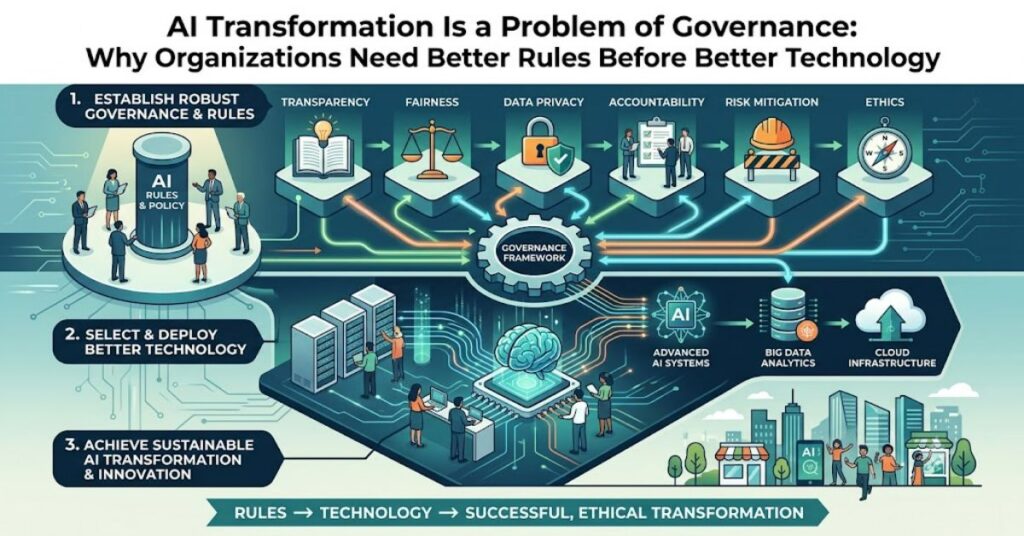
AI transformation is a problem of governance because the biggest barriers to successful artificial intelligence adoption are often organizational rather than technical. Businesses today have access to advanced AI models, automation tools, and cloud infrastructure, yet many struggle to move beyond small pilot projects. The reason is simple: technology can create possibilities, but governance determines how those possibilities are controlled and scaled.
Organizations implementing AI must answer critical questions. Who is responsible when an automated decision causes harm? Which teams can approve AI deployment? How should sensitive data be managed? What level of human oversight is required?
Without clear answers, AI initiatives can become fragmented. Different departments may adopt separate tools, create inconsistent processes, or introduce compliance risks. Governance provides the structure needed to ensure that AI systems align with business objectives, ethical standards, and regulatory expectations.
The challenge is not stopping AI innovation. It is creating operating models where innovation can happen safely. Companies that build strong governance frameworks are better positioned to gain value from AI while reducing operational and reputational risks.
Why AI Adoption Depends on Governance More Than Technology
Many organizations initially approach AI transformation as a technology project. They invest in machine learning platforms, large language models, automation software, and data infrastructure. However, these investments alone do not guarantee success.
AI systems influence decisions, workflows, and customer experiences. Unlike traditional software, AI models can generate unpredictable outputs, learn from changing data, and create decisions that are difficult to explain.
This creates a governance challenge.
A company may have an advanced AI model, but without defined responsibilities, employees may not know when human approval is required. A marketing team might use AI-generated content without understanding copyright risks. A financial department might automate analysis without considering bias in training data.
Governance creates the framework that connects technology with responsible business practices.
The Missing Elements in Many AI Strategies
Research from organizations including the National Institute of Standards and Technology (NIST) and the Organisation for Economic Co-operation and Development (OECD) highlights the importance of accountability, transparency, and risk management in AI systems.
Several governance gaps appear frequently:
| Governance Challenge | Business Impact |
| Unclear ownership | No single team manages AI risks or decisions |
| Poor data governance | AI outputs become unreliable or biased |
| Limited monitoring | Problems remain unnoticed after deployment |
| Weak policies | Employees use AI tools inconsistently |
| Lack of training | Teams misunderstand AI capabilities and limitations |
These problems show why AI transformation requires more than technical investment. Organizations must create structures that define how AI operates inside the business.
Building Clear Accountability for AI Decisions
One of the biggest governance issues is responsibility. Traditional software usually follows predictable rules created by developers. AI systems can produce outcomes based on complex patterns that are harder to interpret.
Businesses need clear accountability models.
A strong AI governance structure typically includes:
Executive ownership: Senior leaders define AI strategy and risk tolerance.
Technical oversight: Data scientists and engineers monitor model performance, security, and reliability.
Business accountability: Department leaders ensure AI applications support operational goals.
Compliance review: Legal and risk teams evaluate regulatory requirements.
This approach prevents AI from becoming an isolated experiment managed only by technical teams.
The Strategic Impact of AI Governance
Organizations with mature governance systems can scale AI more effectively. Governance does not need to slow innovation; it can create confidence.
For example, companies operating in healthcare, finance, and government sectors often require strict controls before deploying automated systems. Clear governance allows these organizations to introduce AI while meeting regulatory expectations.
The European Union’s AI Act, approved in 2024, demonstrates the growing importance of AI oversight. The legislation introduces requirements based on risk levels, requiring organizations to manage transparency, documentation, and accountability.
Businesses operating internationally will increasingly need governance frameworks that can adapt to different legal environments.
Risks of Poor AI Governance
Weak governance creates several risks.
Compliance Exposure
Governments worldwide are introducing AI regulations. Organizations without documented processes may struggle to demonstrate responsible AI use.
Security Threats
AI systems can expose sensitive information if data controls are inadequate. Poor governance may lead to unauthorized access or accidental data leakage.
Decision-Making Errors
AI recommendations can influence hiring, lending, healthcare decisions, and customer interactions. Without monitoring, biased or inaccurate outputs may affect real people.
Loss of Trust
Customers and employees expect organizations to use AI responsibly. Poor transparency can damage brand reputation.
Governance Frameworks Compared
| Approach | Strength | Limitation |
| Technology-first strategy | Faster experimentation | Higher operational risks |
| Governance-first strategy | Better control and accountability | Requires planning |
| Balanced AI operating model | Combines innovation and oversight | Needs continuous management |
The strongest organizations are moving toward balanced approaches where governance becomes part of AI development rather than an afterthought.
The Future of AI Transformation in 2027
By 2027, AI governance is expected to become a standard business capability rather than a specialist function. Companies will likely create dedicated AI oversight teams, similar to cybersecurity and compliance departments.
Regulatory requirements will continue shaping adoption. Organizations will need stronger documentation, model monitoring, and accountability systems as AI becomes embedded into everyday operations.
Technical progress will also increase the need for governance. More autonomous AI agents capable of completing tasks independently will require clearer boundaries around permissions and decision-making authority.
The companies that succeed will not necessarily be those with the most advanced AI tools. They will be those that understand how to manage AI responsibly at scale.
Key Takeaways
- AI success depends on governance structures as much as technological capability.
- Clear ownership prevents confusion about AI responsibilities.
- Data quality, compliance, and monitoring are essential parts of AI operations.
- Regulations are increasing pressure for transparent AI management.
- Governance enables organizations to innovate with greater confidence.
Conclusion
AI transformation is a problem of governance because organizations must determine how technology should be managed before they can fully benefit from it. AI tools continue to improve, but their value depends on the systems surrounding them.
Businesses that establish clear accountability, strong data practices, and responsible oversight will have a stronger foundation for long-term AI adoption. Governance should not be viewed as a restriction on innovation. Instead, it provides the structure needed to make innovation sustainable.
As AI becomes more integrated into business operations, effective governance will become one of the defining factors separating successful AI strategies from unsuccessful experiments.
FAQ
Why is AI transformation considered a governance issue?
AI transformation requires decisions about accountability, oversight, data usage, and risk management. Technology alone cannot determine how AI should be used responsibly.
What does AI governance include?
AI governance includes policies, roles, monitoring processes, compliance requirements, and decision-making frameworks that control AI usage.
Can companies innovate while maintaining AI governance?
Yes. Effective governance creates clear boundaries that allow teams to experiment while reducing unnecessary risks.
What happens when AI lacks proper governance?
Poor governance can lead to compliance problems, security risks, biased decisions, and loss of stakeholder trust.
Why is human oversight important in AI systems?
Human oversight ensures that AI decisions are reviewed, corrected, and aligned with ethical and business requirements.
Methodology
This article AI Transformation Is a Problem of Governance was developed using publicly available research from recognized AI governance organizations, regulatory publications, and industry analysis. Sources were reviewed to understand current governance challenges, regulatory trends, and enterprise adoption patterns. The analysis focuses on organizational structures rather than specific AI products. Limitations include the rapidly changing nature of AI regulation and the continuing development of governance best practices.
References
- National Institute of Standards and Technology. (2023). Artificial Intelligence Risk Management Framework (AI RMF 1.0). U.S. Department of Commerce.
- Organisation for Economic Co-operation and Development. (2023). OECD AI Principles and Policy Observatory.
- European Union. (2024). Artificial Intelligence Act.