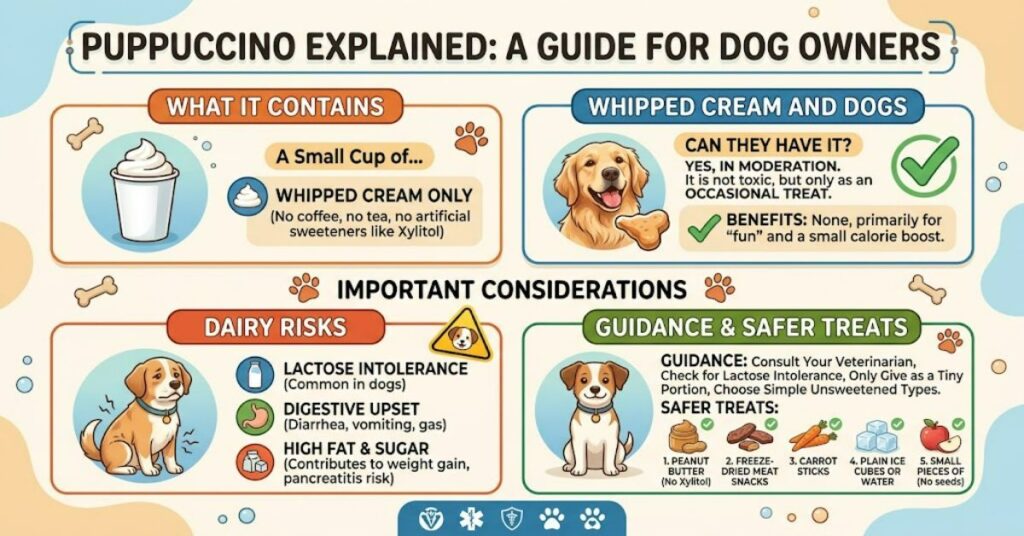
A puppuccino is a small serving of whipped cream given to a dog, usually in a café setting. It is also commonly called a “pup cup”. Despite its coffee-shop name, the traditional treat does not mean giving a dog a miniature cappuccino or espresso. The idea is simply to give the dog a small portion of whipped cream while its owner enjoys a drink.
The concept has become closely associated with Starbucks, where the company itself has documented customers ordering cups of whipped cream for their dogs. In a 2026 Starbucks story about regular drive-through customers, two dogs were given “pup cups of whipped cream”, showing that the treat remains part of the real-world café experience.
However, “dog-friendly” does not automatically mean nutritionally appropriate for every dog. Dairy tolerance varies between animals, and high-fat dairy products can cause gastrointestinal problems or contribute to more serious issues in susceptible dogs. The American Kennel Club notes that many adult dogs have some degree of lactose intolerance and that high-fat dairy can be associated with pancreatitis.
That makes the important question less about whether dogs can ever have whipped cream and more about whether an individual dog should have it, how much is appropriate and how frequently it should be offered.
What Is a Puppuccino?
A traditional puppuccino is essentially a small portion of whipped cream served in a cup. Unlike a normal coffee beverage, it should not contain espresso, coffee, tea or other caffeinated ingredients.
The name is playful rather than a description of the recipe. Its appeal comes from giving dogs their own small café-style treat, particularly during car trips, walks or visits to dog-friendly businesses.
| Feature | Puppuccino | Regular coffee drink |
| Main ingredient | Whipped cream | Coffee, milk or both |
| Espresso | No | Often yes |
| Caffeine | None when made as plain whipped cream | Often present |
| Intended consumer | Dogs as an occasional treat | Humans |
| Main dietary concern | Dairy, fat and portion size | Caffeine, sugar, dairy and other ingredients |
Starbucks’ published ingredient information shows that its standard whipped cream is a dairy-containing product. The company also advises customers to consult ingredient information because products are prepared using shared equipment.
Can Dogs Have Whipped Cream?
Some healthy dogs can tolerate a small amount of whipped cream, but tolerance is not universal.
Dogs can become less capable of digesting lactose after weaning. PetMD explains that lactose intolerance can result in vomiting, diarrhoea, gas, bloating and abdominal discomfort in affected dogs.
The fat content is another consideration. The American Kennel Club warns that high-fat dairy products can cause gastrointestinal upset and may contribute to pancreatitis in dogs.
This creates an important distinction: the absence of caffeine does not make a dairy treat automatically healthy.
For a dog that has previously reacted badly to dairy, has a history of pancreatitis, is on a veterinary diet or has another condition affected by dietary fat, a whipped-cream treat may be inappropriate. Owners should follow veterinary advice in those situations.
Puppuccino Ingredients and Safety
The simplest version contains whipped cream and little else. The problem begins when owners assume that every café cream topping is interchangeable.
Flavoured cream, syrups, chocolate, sauces and other toppings can introduce additional ingredients that are unnecessary for dogs. A plain treat is easier to assess than a customised dessert containing multiple sweeteners or flavourings.
| Consideration | Why it matters |
| Dairy | Some dogs struggle to digest lactose |
| Fat | High-fat foods can cause digestive problems and may contribute to pancreatitis |
| Added flavourings | Extra ingredients may create unnecessary dietary risks |
| Portion size | A small treat contributes fewer calories than a large serving |
| Frequency | Occasional treats are different from daily additions |
This is one of the less obvious points about the trend: the safest version is generally the least elaborate one. A dog does not need syrups, chocolate, sprinkles or flavoured sauces to make the experience special.
Three Practical Insights for Dog Owners
1. “No caffeine” is only one part of the safety question.
The common description of a puppuccino often focuses on what it does not contain. That is useful, but dairy tolerance and fat content deserve equal attention. A caffeine-free treat can still cause digestive problems.
2. Portion size changes the risk profile.
A tiny occasional serving is fundamentally different from a large dessert. The larger the portion, the more dairy, fat and calories a dog consumes. This matters particularly for smaller dogs.
3. The trend works because the ritual matters as much as the food.
The modern pup cup is partly a social experience. Starbucks’ 2026 account of customers bringing dogs through the drive-through illustrates how the treat has become part of the café ritual rather than simply a nutritional product.
Puppuccino vs Other Dog Treats
Owners do not have to choose whipped cream simply because it is available at a café. A familiar dog treat may be easier to portion and may have ingredients specifically formulated for canine diets.
| Treat | Main advantage | Main consideration |
| Plain puppuccino | Simple café experience | Dairy and fat |
| Commercial dog treat | Designed for dogs | Calories and ingredients vary |
| Small piece of suitable food | Convenient | Human foods are not always appropriate |
| Dog-safe frozen treat | Can provide enrichment | Check ingredients and portion |
For dogs with sensitive digestion, a veterinarian-approved treat is a more controlled option.
The Future of Puppuccino in 2027
The pup-cup trend is likely to remain part of the broader pet-friendly hospitality culture through 2027, but the important shift may be towards clearer ingredient awareness.
Starbucks has expanded the amount of ingredient and nutritional information available through its website and app, reflecting a wider consumer expectation for transparency.
For pet owners, that means the practical future of the café treat is unlikely to depend on making it more elaborate. Simplicity, portion control and ingredient transparency are more useful developments than adding extra toppings.
There is also room for more genuinely canine-focused alternatives, particularly products designed around lower fat content or specific dietary requirements. Whether individual cafés introduce them will depend on demand, food-handling practices and local policies.
Key Takeaways
- A puppuccino is primarily a small serving of whipped cream.
- The traditional version contains no coffee or caffeine.
- Dairy can cause digestive problems for some dogs.
- High-fat treats require additional caution.
- Plain versions are preferable to heavily customised desserts.
- Portion size matters, especially for smaller dogs.
- Dogs with medical or dietary issues should follow veterinary guidance.
Conclusion
A puppuccino is best understood as an occasional indulgence rather than a necessary part of a dog’s diet. Its popularity comes from the experience: a dog gets its own small treat while its owner enjoys a café visit.
The simple recipe also explains why the treat can be relatively straightforward. Plain whipped cream contains no coffee or caffeine, but that does not remove every dietary concern. Dairy intolerance, fat content, calories and individual health conditions all matter.
For a healthy dog that tolerates dairy, a very small amount may be an occasional treat. For another dog, particularly one with digestive sensitivity or a history of pancreatitis, it may be better avoided.
The key distinction is between “dog-friendly” as a marketing or social concept and “appropriate for this particular dog”. Responsible treat choices depend on the animal, the ingredients and the portion rather than the novelty of the café experience.
FAQ
What is a puppuccino?
A puppuccino is a small serving of whipped cream given to a dog, usually at a café. It is also commonly called a pup cup.
Does a puppuccino contain coffee?
A traditional puppuccino is simply whipped cream and does not contain espresso or coffee. Owners should still check the exact ingredients when ordering a customised version.
Can puppies have a puppuccino?
Puppies have different nutritional needs from adult dogs. A dairy treat is not necessary for their diet, so owners should ask a veterinarian before introducing unfamiliar treats.
Is a puppuccino safe for dogs?
Some dogs tolerate small amounts of whipped cream, but others may experience digestive upset because of lactose or dietary fat. Individual health conditions also matter.
Can dogs have whipped cream from Starbucks?
A small amount may be tolerated by some dogs, but Starbucks whipped cream is dairy-based. Owners should consider their dog’s tolerance and avoid giving it to dogs that have dietary restrictions.
How often can a dog have a pup cup?
It is better treated as an occasional indulgence rather than a daily food. The appropriate frequency depends on the dog’s overall diet, size, health and calorie needs.
References
American Kennel Club. (n.d.). Can dogs eat ice cream? American Kennel Club.
American Kennel Club. (n.d.). Pancreatitis in dogs: Symptoms, causes and treatment. American Kennel Club.
PetMD. (2023). Can dogs drink milk? PetMD.
PetMD. (2026). Food allergies in dogs. PetMD.
Starbucks Coffee Company. (2025). Ways to customize your beverage at Starbucks. Starbucks Stories.
Starbucks Coffee Company. (2026). Refreshers, refills and drive thru pugs: What afternoon at Starbucks reveals about community and connection. Starbucks Stories.
Methodology
This article was prepared using current information from Starbucks and veterinary-oriented sources including the American Kennel Club and PetMD. Starbucks material was used to establish how the pup-cup experience is represented in the company’s current café environment and to verify information about its whipped cream and ingredient transparency. Veterinary sources were used to assess lactose tolerance, dairy-related digestive reactions and the risks associated with high-fat foods.
The analysis does not claim that every dog will react identically to whipped cream. Individual tolerance varies, and a general article cannot replace veterinary assessment for a dog with an existing medical condition.
The article was drafted with AI assistance. A human editor should independently verify all named claims, source details, ingredient information and veterinary guidance before publication.