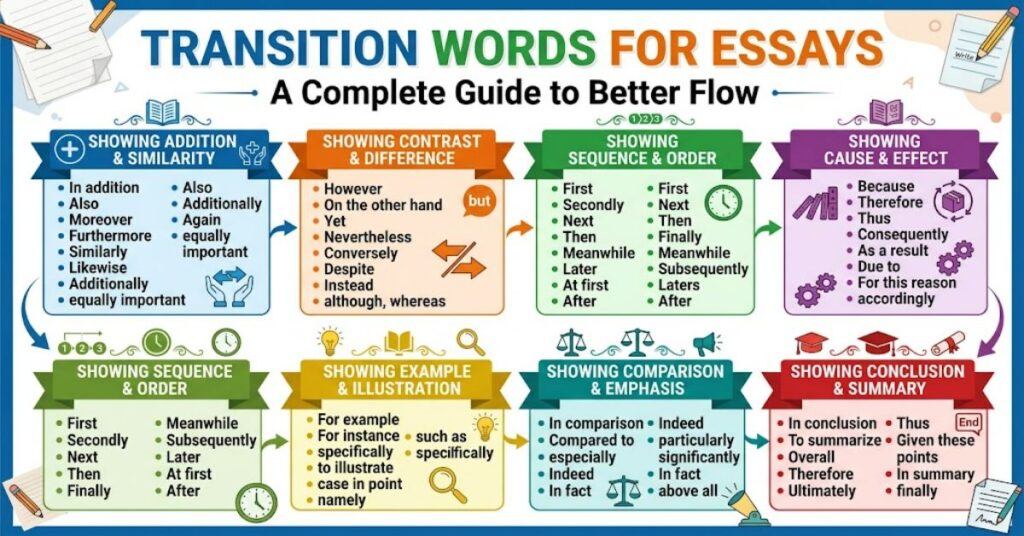
Transition words for essays are connecting tools that help sentences and paragraphs move logically from one idea to another. Words such as “however”, “therefore”, “similarly”, “for example”, “in addition” and “consequently” tell readers how the next point relates to what came before it.
Their purpose is not simply to make writing sound more sophisticated. A well-chosen transition can show that an argument is changing direction, explain a cause-and-effect relationship, introduce supporting evidence or signal that a conclusion is approaching. University writing guidance from Purdue OWL and George Mason University describes transitions as important tools for coherence and cohesion because they help readers identify relationships between ideas.
The most effective use of transitions begins with logic. If two paragraphs present contrasting arguments, a contrast marker may be appropriate. If the second paragraph provides evidence for the first, an additive or explanatory transition may work better.
That distinction matters because adding transition words to poorly organised writing does not automatically make an essay coherent. The underlying argument still needs a clear thesis, focused paragraphs and an appropriate sequence.
For students, the goal is therefore not to memorise a huge list. It is to understand what each type of transition communicates and select the expression that accurately describes the relationship between ideas.
What Are Transition Words?
Transition words and phrases are linguistic signals that show how one statement connects to another. They can operate within a sentence, between sentences or between paragraphs.
For example:
The evidence appears convincing. However, the sample size was relatively small.
“However” tells the reader that the second sentence qualifies or contrasts with the first.
Compare that with:
The evidence appears convincing. Furthermore, the sample size was relatively large.
“Furthermore” creates an additive relationship rather than a contrast.
The difference is small in wording but significant in meaning. A transition should therefore describe the relationship that actually exists between ideas.
Purdue OWL identifies transitions as tools for linking ideas between sentences and recommends using different connectors for processes such as comparison, contrast, cause and effect, and chronological sequence.
Main Types of Transition Words for Essays
Different transitions perform different jobs. Choosing them according to function is more reliable than selecting impressive-sounding words at random.
| Purpose | Useful transitions | Typical function |
| Addition | furthermore, moreover, additionally, in addition | Adds related information |
| Contrast | however, nevertheless, conversely, in contrast | Shows difference or qualification |
| Cause | because, since, owing to | Explains why something happens |
| Effect | therefore, consequently, as a result | Shows an outcome |
| Example | for example, for instance, specifically | Introduces evidence or illustration |
| Similarity | similarly, likewise, in the same way | Connects comparable ideas |
| Sequence | first, next, subsequently, finally | Shows order |
| Emphasis | notably, particularly, importantly | Highlights significance |
| Conclusion | overall, ultimately, therefore, in summary | Signals synthesis or closure |
The important distinction is between function and decoration. A transition is useful when it clarifies meaning. It is unnecessary when the relationship between two sentences is already obvious.
Transition Words for Adding Ideas
Additive transitions help writers extend an argument without changing its direction.
Common examples include:
- furthermore
- moreover
- additionally
- in addition
- also
- likewise
- similarly
- besides
Consider the difference:
Online learning can increase flexibility. In addition, recorded lectures allow students to revisit difficult material.
The second sentence adds another benefit.
However, “moreover” should not automatically appear whenever a new paragraph begins. If the new paragraph introduces an entirely different argument, a stronger topic sentence may be more useful than a generic connector.
This leads to a practical insight: the strongest transition is sometimes no transition word at all. A clearly written topic sentence can establish the relationship without an obvious signpost.
Transition Words for Contrast
Contrast transitions are especially valuable in argumentative and analytical essays because they help introduce limitations, opposing views and qualifications.
Useful choices include:
- however
- nevertheless
- nonetheless
- in contrast
- on the other hand
- conversely
- whereas
- although
- despite this
- by comparison
For example:
Social media can help organisations reach new audiences. However, high engagement does not necessarily indicate strong customer loyalty.
The transition makes the qualification explicit.
Academic essays often benefit from this type of movement because strong analysis rarely depends on one-sided claims. Introducing a counterargument and then explaining its limitations can make the central position more convincing.
Purdue OWL specifically identifies “however”, “nevertheless”, “conversely” and related expressions as useful for comparison and contrast structures.
Transition Words for Cause and Effect
Cause-and-effect transitions explain relationships between events, decisions and outcomes.
Useful examples include:
- because
- therefore
- consequently
- thus
- accordingly
- as a result
- for this reason
- hence
For example:
The company reduced delivery times. As a result, customer satisfaction improved.
The connector makes the relationship between the two statements explicit.
But writers should be careful with causal claims. “Therefore” does not prove that one event caused another. It merely signals the relationship the writer is asserting.
That means evidence still matters. A transition can clarify an argument, but it cannot substitute for research, statistics or reasoning.
Transition Words for Examples and Evidence
Academic writing frequently moves from a general claim to specific evidence.
Useful transitions include:
- for example
- for instance
- specifically
- in particular
- to illustrate
- such as
Example:
Urban green spaces can provide several environmental benefits. For example, trees can provide shade and contribute to local cooling.
The transition prepares the reader for a specific illustration.
There is also a useful distinction between an example and evidence. An example demonstrates what a claim might look like, while evidence is used to substantiate the claim. Treating every example as proof can weaken an essay’s analytical quality.
Transition Words for Sequence and Process
Sequence transitions are particularly useful when explaining a process, historical development or ordered argument.
Examples include:
- first
- second
- next
- then
- subsequently
- afterwards
- meanwhile
- finally
- ultimately
Purdue OWL recommends chronological transitions such as “first”, “next”, “then”, “subsequently” and “finally” when explaining processes.
However, sequence markers should not be forced into every paragraph. An essay organised around three arguments may not need “firstly”, “secondly” and “thirdly” repeatedly. Clear topic sentences can often create a more natural structure.
How to Choose the Right Transition
A useful editing technique is to identify the relationship between two ideas before selecting a word.
| Relationship | Question to ask | Suitable transition |
| Addition | Am I adding another related point? | Furthermore |
| Contrast | Does the next point qualify or oppose the previous one? | However |
| Cause | Am I explaining why something happened? | Because |
| Effect | Am I describing an outcome? | Therefore |
| Example | Am I moving from a general idea to a specific case? | For example |
| Similarity | Are the two ideas comparable? | Similarly |
| Sequence | Does the order matter? | Subsequently |
| Conclusion | Am I synthesising the discussion? | Overall |
This approach prevents one of the most common mistakes: choosing a transition because it sounds academic rather than because it expresses the correct relationship.
George Mason University’s writing guidance makes the same underlying point: writers should consider how the new idea relates to the preceding one and what relationship they want the reader to recognise.
Common Mistakes With Essay Transitions
Using Too Many
An essay can become repetitive when every sentence begins with “however”, “therefore”, “moreover” or “furthermore”.
Transitions should guide readers, not announce every movement.
Choosing the Wrong Relationship
Using “therefore” when the second statement merely provides another example creates a logical problem. The vocabulary may sound formal, but the argument becomes less precise.
Replacing Structure With Connectors
Adding transitions cannot repair an essay with an unclear thesis or disorganised paragraphs. Purdue’s guidance stresses that effective essays require clear organisation, focused arguments and supporting evidence alongside appropriate transitions.
Repeating the Same Word
If every paragraph starts with “however”, the writing can feel mechanical. Varying sentence structure and using alternatives where appropriate creates a more natural rhythm.
Starting Every Paragraph With a Transition
Not every paragraph needs “Furthermore” or “In addition”. Sometimes a strong topic sentence provides a more meaningful bridge.
The Future of Transition Words for Essays in 2027
Academic writing is unlikely to stop relying on transitions, even as students increasingly use digital writing and AI-assisted editing tools.
The more important issue will be distinguishing mechanical fluency from genuine coherence. Automated systems can suggest “however”, “therefore” or “moreover”, but the writer still needs to determine whether the underlying relationship is one of contrast, consequence or addition.
Recent university writing guidance continues to emphasise coherence, paragraph organisation and logical relationships rather than treating transitions as isolated vocabulary exercises. Purdue’s 2024 revision material, for example, advises writers to use transitions to connect ideas and maintain logical paragraph development.
By 2027, effective academic writing will therefore depend less on collecting longer lists of sophisticated connectors and more on using them precisely. Students who understand argument structure will generally have an advantage over those who simply insert formal-sounding phrases.
Key Conclusions
- Transition words signal relationships between ideas.
- Different connectors communicate addition, contrast, cause, effect, sequence and conclusion.
- A transition should accurately describe the logical relationship between statements.
- Strong topic sentences can sometimes provide better transitions than standalone linking words.
- Excessive use can make essays repetitive or artificial.
- Transitions cannot compensate for weak evidence or poor organisation.
- The best academic writing combines transitions with clear reasoning, paragraph structure and supporting evidence.
Conclusion
Transition words are small components of academic writing, but they have a significant role in helping readers follow an argument. They show whether a writer is adding information, changing direction, explaining a consequence, introducing an example or bringing an argument towards a conclusion.
The most effective approach is not to memorise hundreds of alternatives. Instead, writers should identify the relationship between ideas and choose a transition that communicates that relationship accurately. “However” should signal genuine contrast, while “therefore” should introduce a logical consequence rather than simply mark the next sentence.
Good essays also use transitions selectively. When every sentence contains a connector, the prose can become predictable. When none are used where relationships are complex, readers may struggle to follow the argument.
Ultimately, transitions work best as part of a larger structure. A clear thesis, focused paragraphs, relevant evidence and logical sequencing provide the foundation; transition words help make those connections visible to the reader.
Frequently Asked Questions
What are the best transition words for essays?
Useful choices depend on purpose. “However” works for contrast, “furthermore” for addition, “therefore” for consequence, “for example” for illustration, “similarly” for comparison and “finally” for sequence. The best word is the one that accurately represents the relationship between ideas.
How do I start a new paragraph in an essay?
Begin with a topic sentence that identifies the paragraph’s main idea. Add a transition when the relationship with the previous paragraph needs clarification. A strong topic sentence is often more effective than automatically beginning with “Furthermore” or “However”.
What are good transition words for argumentative essays?
Argumentative essays often benefit from “however”, “nevertheless”, “in contrast”, “therefore”, “consequently”, “for example”, “furthermore” and “ultimately”. Use them according to the logical function of each paragraph rather than as a fixed sequence.
Can you use too many transition words?
Yes. Excessive transitions can make writing sound repetitive and formulaic. If the connection between two ideas is already obvious, a transition may not be necessary. Varying sentence structures can also improve flow.
What transition words show contrast?
Common contrast transitions include “however”, “nevertheless”, “nonetheless”, “in contrast”, “conversely”, “whereas” and “on the other hand”. The choice depends on the grammatical structure and strength of the contrast.
What words show cause and effect in an essay?
Common cause-and-effect expressions include “because”, “therefore”, “consequently”, “thus”, “as a result”, “for this reason” and “accordingly”. Make sure the evidence supports the causal relationship being claimed.
Methodology
This article Transition words for essays was developed from established academic writing guidance, prioritising university writing resources and documented instructional material. Purdue University’s Online Writing Lab was used to validate the functions of transition words across comparison, contrast, cause and effect, sequence and essay organisation. George Mason University’s Writing Center was used to validate the relationship between transitions, coherence and cohesion.
No independent student experiment, classroom test or survey was conducted for this article. Consequently, it does not present fabricated grades, improvement percentages or claims based on firsthand testing. The practical recommendations are derived from documented academic-writing guidance and analytical comparison of transition functions.
A key limitation is that effective transitions vary by discipline, assignment type and sentence structure. A phrase that improves a persuasive essay may be unnecessary in a scientific report. Writers should therefore prioritise logical precision over the appearance of academic sophistication.
This article Transition words for essays was drafted with AI assistance and should be reviewed and verified by the Postcard.fm editorial team before publication. All named sources and claims should be checked against the original publications during final editorial review.
References
George Mason University Writing Center. (2026). Transitions. George Mason University.
George Mason University Writing Center. (2026). Cohesion and coherence. George Mason University.
Purdue Online Writing Lab. (2024). Document organization. Purdue University.
Purdue Online Writing Lab. (2026). On paragraphs and paragraphing. Purdue University.
Purdue Online Writing Lab. (2026). Essays for exams. Purdue University.
Purdue Online Writing Lab. (2026). Expository essays. Purdue University.
Purdue Online Writing Lab. (2026). Sentence clarity. Purdue University.