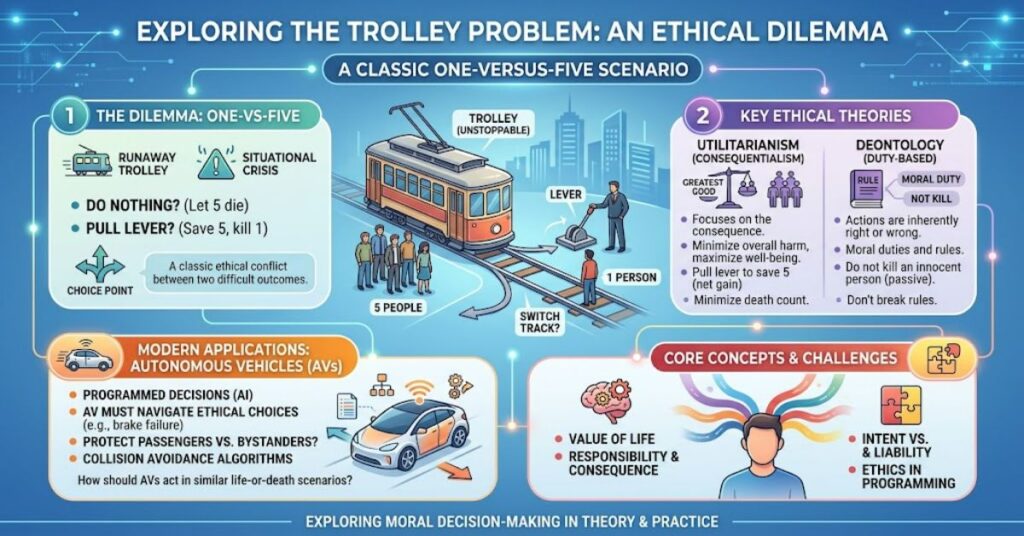
The trolley problem is a famous thought experiment in moral philosophy that asks whether it is right to sacrifice one person to save five others. In its familiar form, a runaway trolley is heading towards five people on a railway track. You can pull a lever to divert it onto another track, where one person will be killed instead. Should you intervene?
The arithmetic appears simple: one death instead of five. Yet the decision feels more complicated than choosing the smaller number. Pulling the lever makes you an active participant in redirecting danger towards someone who would otherwise survive. Doing nothing also has consequences, because the five people remain in the trolley’s path.
First introduced in a form developed by philosopher Philippa Foot in 1967, the dilemma became a central example in discussions about moral responsibility. Philosopher Judith Jarvis Thomson later expanded the debate, including with a version in which a person could stop a trolley by pushing a large man from a bridge. Many people judge the two situations differently, despite their similar outcomes.
That difference is the point. The scenario tests whether morality depends primarily on consequences, on the nature of the action, on a person’s intention or on the distinction between causing harm and allowing harm to occur.
The problem has also influenced debates about medical ethics, autonomous vehicles and artificial intelligence. These applications are not identical to the original thought experiment, but they raise related questions about how decisions should be made when risks cannot be eliminated entirely.
Understanding the trolley problem means examining not only which choice seems right, but also why different ethical frameworks reach different conclusions.
The Two Main Versions of the Trolley Problem
The original lever scenario is only one version. Variations change the way a person intervenes, making it easier to see which moral principles influence a judgement.
The lever dilemma
A runaway trolley is heading towards five people. Pulling a lever diverts it onto a side track, where one person will die.
A consequentialist may argue that pulling the lever is justified because it saves more lives overall. Someone who believes there are strict limits on intentionally causing harm may disagree, or may regard the case as morally permissible only under particular conditions.
The footbridge dilemma
In the footbridge version, a person stands on a bridge above the track. A large man beside them could be pushed onto the track to stop the trolley, saving the five people below but killing him.
Many people who accept pulling the lever reject pushing the man. The difference raises questions about physical force, personal responsibility and whether the man’s body is being used as a means to achieve an outcome.
Philosopher Judith Jarvis Thomson explored these distinctions in her 1976 paper, “Killing, Letting Die, and the Trolley Problem”. Her work helped make the scenario a sustained debate about what separates permissible harm from impermissible harm.
Comparing the ethical questions
| Scenario | Central question | Ethical tension |
| Lever | Should you redirect the trolley? | Saving more people versus causing harm through intervention |
| Footbridge | Should you push one person to stop the trolley? | Saving lives versus using a person as a means |
| No intervention | Should you allow the trolley to continue? | Responsibility for action versus responsibility for omission |
| Uncertain outcome | Should you act when the result is not guaranteed? | Expected benefit versus risk and uncertainty |
These versions reveal an important limitation: changing a single detail can change how people judge the same basic trade-off. The problem is therefore not just about counting lives. It is also about the moral significance of how an outcome is achieved.
Which Ethical Theories Explain the Choices?
The trolley scenario is useful because it places competing ethical frameworks under pressure.
Consequentialism
Consequentialism evaluates actions by their outcomes. In a simple version of the lever problem, diverting the trolley is preferable because one death is less harmful than five.
Utilitarianism is a well-known form of consequentialism. It aims to maximise overall welfare or minimise suffering, though utilitarian theories differ over how welfare should be measured and whose interests count.
The strength of this approach is its attention to preventable harm. Its difficulty is that aggregate benefits may appear to justify imposing severe costs on an individual who has done nothing wrong.
Deontological ethics
Deontological approaches focus on duties, rights and constraints on permissible action. Some actions may be wrong even if they produce a better overall outcome.
From this perspective, the question is not simply how many people survive. It is whether redirecting danger or deliberately using another person violates a moral duty.
Deontological theories are diverse. They do not all reach the same conclusion about the lever scenario, and they need not treat every act of intervention as forbidden.
The doctrine of double effect
The doctrine of double effect distinguishes between an intended outcome and a harmful side effect that is foreseen but not intended. In simplified terms, an action may be permissible when the harmful effect is not the means by which the good effect is achieved, subject to further conditions.
Philippa Foot discussed related moral distinctions in her 1967 paper, “The Problem of Abortion and the Doctrine of the Double Effect”. The trolley debate helps illustrate why intention and the causal route to an outcome can matter, even when the number of deaths appears unchanged.
The doctrine is contested and can be difficult to apply. Critics may question whether the distinction between intended and foreseen harm is always clear in real decisions.
What the Trolley Problem Reveals About Human Judgement
The dilemma can expose inconsistencies in moral reasoning, but inconsistent answers do not automatically mean people are irrational. They may be responding to morally relevant differences that a simplified scenario leaves open to interpretation.
Three insights are particularly useful.
First, outcomes do not tell the whole story. Two choices may produce the same number of survivors while differing in intention, physical involvement and the use of another person. A purely numerical analysis misses these features.
Second, framing affects judgement. Asking whether someone should “save five people” can lead to a different response from asking whether they should “kill one person”. The wording directs attention towards different aspects of the same decision. Philosophical thought experiments are most useful when readers examine this framing rather than assuming the first reaction settles the matter.
Third, certainty makes the classic problem easier than real life. The standard scenario assumes the trolley’s path and the consequences of each choice are known. Real decisions involve uncertain evidence, incomplete information and the possibility that an intervention will fail. The Stanford Encyclopedia of Philosophy discussion of moral decision-making under uncertainty highlights the difficulty of moving from idealised cases to decisions where outcomes are probabilistic.
This final point matters beyond philosophy. Real policy decisions rarely offer a guaranteed choice between exactly one death and five deaths. They involve competing risks, evidence quality and responsibilities that extend beyond a single moment.
The Trolley Problem in Artificial Intelligence and Autonomous Vehicles
The thought experiment is often used to discuss how autonomous vehicles should respond to unavoidable collisions. Should a system prioritise its passengers, pedestrians or the option expected to cause the least harm?
The comparison is useful, but it should not be taken too literally. Road-safety engineering is largely concerned with preventing crashes, reducing risk and meeting safety requirements before a collision becomes unavoidable. A system should not be designed around a simplistic choice between deliberately harming one person and allowing five others to die.
Research nevertheless shows why moral preferences matter. In a study published in Nature on 24 October 2018, Awad and colleagues reported the results of the Moral Machine experiment. The online platform collected approximately 40 million decisions from millions of participants across 233 countries and territories. The researchers found both shared preferences and meaningful differences between cultural groups.
The findings are evidence that public preferences vary; they are not a ready-made moral code for autonomous vehicles. A majority preference does not necessarily establish what is ethically justified, and online responses do not automatically translate into safe engineering policy.
For developers and policymakers, the more practical questions concern how to reduce risk, how to distribute unavoidable risk fairly, who is accountable for system design and how safety decisions should be reviewed. These issues require technical evidence and public governance, not only hypothetical voting.
The Future of the Trolley Problem in 2027
By 2027, the trolley problem is likely to remain a familiar way to introduce moral philosophy and debate the ethical design of automated systems. Its continuing value lies less in providing a final answer than in helping people identify the principles behind difficult decisions.
Three developments may shape its use:
- AI governance: Organisations developing automated systems will continue to face questions about responsibility, transparency and risk. Ethical thought experiments can help frame these questions, but they cannot replace safety testing or formal governance.
- Public participation: Research such as the Moral Machine experiment shows that moral preferences differ across populations. Future discussions may place greater emphasis on how public input is collected and represented.
- Real-world uncertainty: Researchers and policymakers will need to move beyond scenarios with guaranteed outcomes towards decisions involving probabilities, changing conditions and multiple forms of harm.
These directions are plausible, not guaranteed. There is no single agreed moral formula for all automated decisions, and public preference alone cannot resolve questions of rights, responsibility or fairness.
Key Takeaways
- The trolley problem tests whether saving a greater number of people can justify an action that harms someone else.
- The lever and footbridge versions differ in ways that challenge purely numerical reasoning.
- Consequentialism, deontological ethics and the doctrine of double effect offer different ways to assess the decision.
- A person’s intention and the means used to achieve an outcome may matter as much as the final result.
- Real-world decisions include uncertainty and practical constraints that the classic thought experiment removes.
- Research on autonomous vehicles demonstrates variation in moral preferences, not a universal ethical rule.
- The scenario is best used to clarify competing principles rather than to claim that one answer settles every moral dilemma.
Frequently Asked Questions
What is the trolley problem in simple terms?
It is a moral thought experiment in which a runaway trolley will kill five people unless someone diverts it onto another track, where one person will die. It asks whether intervening is morally justified.
Who created the trolley problem?
Philippa Foot discussed the original form in her 1967 paper on the doctrine of double effect. Judith Jarvis Thomson expanded the debate in a 1976 paper and developed influential variations, including the footbridge scenario.
What is the difference between the lever and footbridge versions?
The lever version involves redirecting a trolley towards one person to save five. The footbridge version involves pushing a person onto the track to stop it. Many people judge these actions differently because of how harm is caused.
Does the trolley problem have a correct answer?
There is no universally accepted answer. Different ethical theories emphasise outcomes, duties, rights and intention. The purpose is to examine these principles rather than to produce a simple numerical solution.
How does the trolley problem relate to self-driving cars?
It provides a framework for discussing unavoidable harm and automated decisions. Real vehicle safety, however, also depends on preventing crashes, reducing risk, technical performance and accountable governance.
What is the utilitarian answer to the trolley problem?
A straightforward utilitarian analysis often favours diverting the trolley because one death is fewer than five. More complex utilitarian approaches may also consider long-term effects, uncertainty and the consequences of adopting a general rule.
Conclusion
The trolley problem remains influential because it makes a difficult moral conflict easy to understand without making it easy to resolve. Saving five people instead of one appears to minimise harm, yet the method of intervention raises questions about intention, individual rights and responsibility. The lever and footbridge versions demonstrate how those details can alter a judgement even when the basic numbers remain the same.
The dilemma does not prove that one ethical theory is always correct. Consequentialism draws attention to preventable suffering, while deontological approaches emphasise duties and limits on what may be done to an individual. The doctrine of double effect adds another question: whether harm is intended or arises as a side effect.
In practical settings, including autonomous vehicle design, decisions are more uncertain than the classic scenario suggests. Preventing danger, distributing risk fairly and establishing accountability matter alongside moral reasoning. The lasting value of the thought experiment is therefore its ability to expose assumptions and sharpen debate. It offers a starting point for ethical analysis, not a substitute for evidence, careful judgement or responsible policy.
References
Awad, E., Dsouza, S., Kim, R., Schulz, J., Henrich, J., Shariff, A., Bonnefon, J.-F., & Rahwan, I. (2018). The Moral Machine experiment. Nature, 563, 59–64.
Foot, P. (1967). The problem of abortion and the doctrine of the double effect. Oxford Review, 5, 5–15.
Stanford Encyclopedia of Philosophy. (2024). Moral decision-making under uncertainty.
Thomson, J. J. (1976). Killing, letting die, and the trolley problem. The Monist, 59(2), 204–217.
Methodology
This article was prepared from established philosophical papers and research on moral decision-making and autonomous systems. Foot’s 1967 paper provides historical context for the dilemma; Thomson’s 1976 work supports the discussion of its variations; the Stanford Encyclopedia of Philosophy provides context on uncertainty; and Awad and colleagues’ 2018 study documents cross-cultural variation in moral preferences. No original interviews or experiments were conducted, and none are claimed. The autonomous-vehicle discussion is illustrative rather than a technical assessment of any specific system. The philosophical interpretations remain contested, and the cited research should be checked against the original publications before publication.
Editorial disclosure: This article was drafted with AI assistance and requires human editorial review. References and claims should be independently verified before publication.