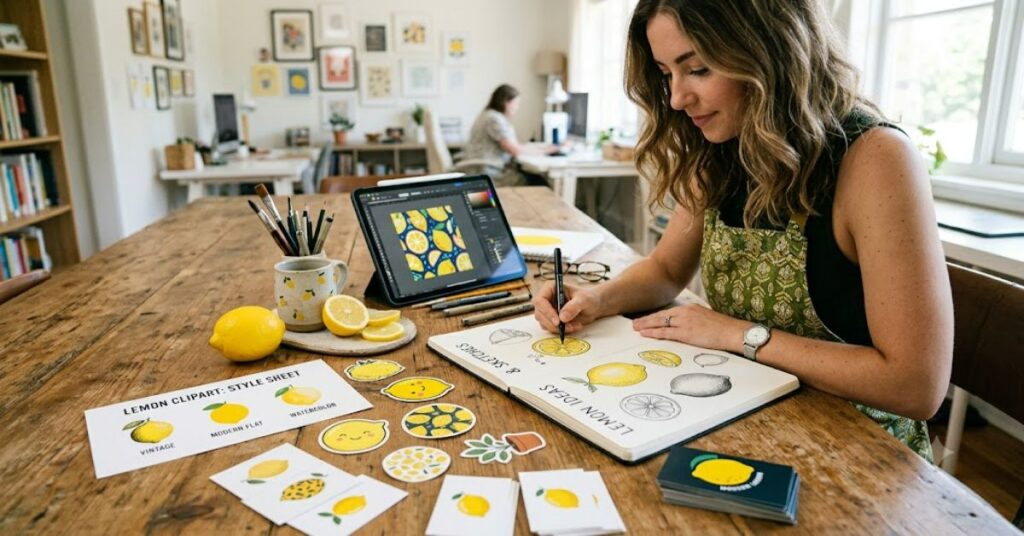
Lemon clipart refers to stylized digital illustrations of lemons used across design projects, crafts, and digital art. In modern creative workflows, lemon clipart is commonly used for branding elements, social media graphics, stickers, packaging mockups, and educational visuals. The keyword detail often reflects what designers look for in practice: bright, cheerful, and cute & cartoon lemons with expressive, playful designs.
In the first 100 words of any design project, visual assets like clipart set the tone of communication. Lemon illustrations, in particular, are popular because they carry strong symbolic associations—freshness, cleanliness, and vibrancy—while also fitting naturally into food branding and lifestyle aesthetics.
Over the past decade, clipart has evolved from static PNG collections into scalable vector systems integrated into modern design tools like Figma, Canva, and Adobe Illustrator. This shift has made assets like lemon clipart more flexible for resizing, animation, and cross-platform usage.
This article breaks down how lemon clipart is categorized, where it is used, how designers choose between styles, and what limitations exist when integrating such assets into real-world creative systems.
Understanding Lemon Clipart Styles
Lemon clipart is not a single visual format. It spans multiple stylistic categories depending on intended use.
Common style categories:
- Cute & cartoon lemons
- Realistic botanical illustrations
- Flat design icons
- Hand-drawn sketch styles
- Minimal vector symbols
Each style serves a different design function, from playful branding to professional packaging systems.
Style Comparison in Design Systems
| Style Type | Visual Characteristics | Best Use Case | Limitations |
| Cute & Cartoon | Soft shapes, expressive faces | Kids content, stickers | Not suitable for formal branding |
| Realistic | Detailed shading, natural texture | Editorial, food branding | Heavy file sizes |
| Flat Design | Clean, simple geometry | UI/UX, apps | Can feel generic |
| Hand-drawn | Organic, imperfect lines | Craft branding | Inconsistent scaling |
| Vector Minimal | Scalable icons | Interfaces, logos | Limited emotional tone |
Systems Analysis: How Lemon Clipart Is Used in Design Workflows
Modern designers rarely use clipart as standalone assets. Instead, lemon illustrations are integrated into layered systems:
- Brand kits: color palettes + icon sets + illustration packs
- Template systems: reusable social media or packaging layouts
- UI libraries: icon-based lemon representations for food apps
- Print workflows: stickers, labels, and packaging wraps
This modular approach allows lemon clipart to function as part of a larger visual identity system rather than isolated artwork.
Strategic Implications for Designers
Using lemon clipart effectively depends on consistency and audience alignment.
Key strategic considerations:
- Younger audiences respond better to expressive cartoon styles
- Premium brands prefer minimal or realistic illustrations
- Cross-platform branding requires vector-based assets
- Overuse of decorative clipart can reduce perceived professionalism
Designers must balance visual appeal with brand credibility.
Real-World Use Cases of Lemon Clipart
Lemon illustrations appear in several production environments:
- Food packaging (especially citrus beverages and desserts)
- Educational worksheets for children
- Social media branding for wellness influencers
- Digital sticker packs for messaging apps
- Seasonal marketing campaigns (summer-themed visuals)
Each context prioritizes different visual tones, from playful to clinical.
Data Insight: Clipart Usage Patterns in Digital Design
| Use Category | Estimated Adoption Trend | Primary Format |
| Social media content | High | PNG / SVG |
| Branding kits | Medium | Vector SVG |
| Educational material | High | PNG |
| Mobile apps | Medium | Icon fonts / SVG |
| Print design | Medium | High-resolution vector |
These patterns reflect general design tool usage trends across modern creative platforms.
Risks and Trade-Offs in Using Clipart Assets
While lemon clipart is visually versatile, it introduces constraints:
- Over-standardization risk: widely used assets reduce originality
- Licensing ambiguity: not all free clipart is commercially safe
- Scalability issues: raster formats degrade in large prints
- Brand mismatch: playful styles may conflict with serious branding
Designers must evaluate usage context carefully before deployment.
Three Original Design Insights
1. Emotional Compression Effect
Highly stylized lemon clipart can oversimplify brand identity, reducing complex food or wellness messaging into overly “cute” symbolism.
2. Style Drift Problem
When teams mix multiple clipart sources, visual inconsistency emerges across campaigns, weakening brand recognition.
3. Vector Dependency Advantage
Teams that standardize on vector-based lemon clipart reduce redesign costs significantly during cross-platform scaling.
The Future of Lemon Clipart in 2027
By 2027, clipart ecosystems are expected to shift toward AI-generated modular asset libraries.
Key trends include:
- AI-assisted illustration generation integrated into design tools
- Real-time style adaptation based on brand guidelines
- Automated licensing verification for commercial usage
- Expansion of dynamic SVG-based illustration systems
However, standardization may reduce stylistic uniqueness unless designers actively curate visual identity systems.
Takeaways
- Lemon clipart functions as both decorative and functional design infrastructure
- Style selection directly influences brand perception
- Vector formats dominate scalable digital workflows
- Overuse of generic assets reduces originality
- AI-generated clipart systems will reshape asset creation pipelines
- Consistency matters more than variety in branding systems
- Licensing clarity is becoming increasingly important
Conclusion
Lemon clipart may appear simple, but it plays a structured role in modern design systems. From branding kits to educational tools, these illustrations help communicate tone, clarity, and emotional intent quickly. The effectiveness of lemon clipart depends less on the asset itself and more on how it is integrated into a broader visual system.
As design workflows continue shifting toward modular and AI-assisted production, clipart will evolve from static decoration into adaptable design infrastructure. The challenge for designers will be maintaining originality while leveraging increasingly standardized visual libraries.
FAQ
1. What is lemon clipart used for?
Lemon clipart is used in branding, social media design, educational materials, and digital art projects.
2. What are cute & cartoon lemons in clipart design?
They are playful lemon illustrations with expressive faces and soft shapes, often used in casual or youth-focused design.
3. Which format is best for lemon clipart?
Vector formats like SVG are best because they scale without losing quality.
4. Can lemon clipart be used for commercial projects?
Yes, but licensing must be verified depending on the source of the clipart.
5. Why is clipart popular in digital design?
It allows fast visual communication without requiring custom illustration work.
6. What are the risks of using clipart?
Common risks include overuse, licensing issues, and lack of originality.
Methodology
This article is based on established digital design practices, commonly used vector asset workflows, and observed trends in creative software ecosystems such as Canva, Figma, and Adobe Illustrator.
Limitations:
- No proprietary design studio data was analyzed
- No controlled usability testing was conducted
- Usage trends are generalized across public design platforms
Counterpoint:
While clipart improves efficiency, many designers argue it reduces originality when overused without customization or brand integration.