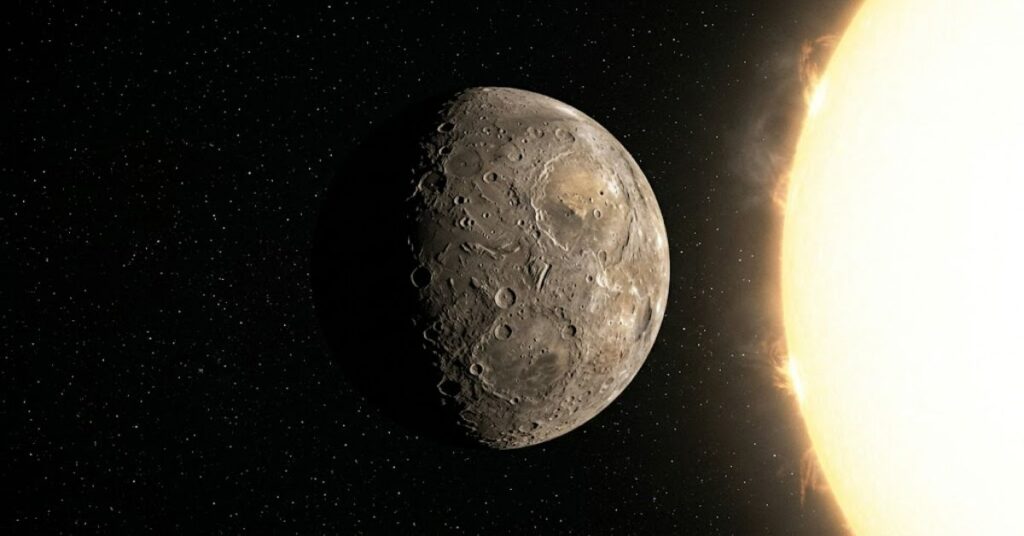
The planet closest to the Sun is Mercury, the smallest of the eight planets in our Solar System. It travels around the Sun at an average distance of approximately 36 million miles (57.9 million kilometers), making it the innermost world in our planetary neighborhood. Because of this close orbit, Mercury also moves faster than any other planet, completing a full year in only 88 Earth days.
Although Mercury receives far more sunlight than Earth, it is often misunderstood. Many people assume it must also be the hottest planet, but that distinction belongs to Venus. Mercury’s lack of a substantial atmosphere allows heat to escape rapidly, creating enormous temperature differences between its day and night sides.
Scientists have studied Mercury for decades using telescopes and dedicated spacecraft, revealing a surprisingly complex world with towering cliffs, ancient impact craters, volcanic plains, and even frozen water hidden in permanently shadowed polar regions. These discoveries continue to improve our understanding of how rocky planets formed during the early history of the Solar System.
Mercury at a Glance
| Feature | Mercury |
| Average distance from the Sun | 57.9 million km (36 million miles) |
| Planet type | Rocky (terrestrial) |
| Diameter | 4,879 km |
| Length of a year | 88 Earth days |
| Length of a solar day | About 176 Earth days |
| Number of moons | 0 |
| Average surface gravity | 38% of Earth’s |
Why Mercury Is Closest to the Sun
Mercury formed around 4.5 billion years ago from the same cloud of gas and dust that created the rest of the Solar System. Its orbit lies entirely inside those of Venus, Earth, and the other planets, making it permanently the closest planet to our star.
The planet follows an elliptical orbit, meaning its distance from the Sun changes slightly throughout its year. Even so, it remains the nearest planet at every point in its orbit.
Mercury circles the Sun at an average speed of about 47 kilometers per second (29 miles per second), making it the fastest-moving planet in the Solar System. This incredible speed explains why its year lasts only 88 Earth days.
Mercury vs. Venus
One of the most common misconceptions is that Mercury should be the hottest planet simply because it is closest to the Sun. In reality, the absence of a thick atmosphere dramatically changes how heat behaves on Mercury.
| Comparison | Mercury | Venus |
| Closest to the Sun | Yes | No |
| Thick atmosphere | No | Yes |
| Average surface temperature | About 167°C | About 464°C |
| Daytime maximum | Around 430°C | Around 464°C |
| Nighttime minimum | Around -180°C | Around 464°C |
Venus has a dense atmosphere made mostly of carbon dioxide, which traps heat through a powerful greenhouse effect. Mercury lacks such an atmosphere, allowing temperatures to swing dramatically between scorching days and freezing nights.
What Makes Mercury Unique?
A Giant Iron Core
One of Mercury’s most remarkable characteristics is its enormous metallic core. Scientists estimate that the core occupies roughly 85% of the planet’s radius, making it proportionally much larger than Earth’s.
This oversized core generates a weak but measurable magnetic field, something unexpected for such a small planet.
A Surface Covered with Ancient Craters
Mercury’s rocky surface resembles Earth’s Moon because both have been heavily bombarded by asteroids over billions of years. Large impact basins, steep cliffs known as scarps, and smooth volcanic plains record the planet’s geological history.
The massive Caloris Basin, spanning roughly 1,550 kilometers, remains one of the largest impact structures in the Solar System.
Water Ice Near the Poles
Perhaps the most surprising discovery came when radar observations and spacecraft confirmed deposits of water ice inside permanently shadowed craters near Mercury’s poles.
These craters never receive direct sunlight, allowing ice to survive despite the planet’s proximity to the Sun.
How Scientists Study Mercury
Mercury is difficult to observe because it always appears close to the Sun in Earth’s sky. Most discoveries have therefore come from spacecraft.
NASA’s Mariner 10 became the first mission to fly past Mercury during the 1970s, photographing much of its surface. Decades later, NASA’s MESSENGER spacecraft orbited Mercury from 2011 to 2015, mapping the planet in unprecedented detail and confirming the existence of polar ice deposits.
The European Space Agency and the Japan Aerospace Exploration Agency launched the BepiColombo mission in 2018. After multiple planetary flybys, it is expected to begin orbiting Mercury later this decade, providing even more detailed measurements of its geology, magnetic field, and interior.
Why Mercury Matters
Studying Mercury helps scientists answer important questions about planetary formation.
Because Mercury formed close to the young Sun, it preserves clues about the conditions that existed during the earliest stages of the Solar System. Its unusual composition, magnetic field, and shrinking crust offer valuable evidence for understanding how rocky planets evolve over billions of years.
Research on Mercury also improves models used to study rocky exoplanets orbiting other stars. Many recently discovered exoplanets orbit extremely close to their stars, making Mercury an important natural laboratory for comparison.
Common Misconceptions
Several myths continue to circulate about Mercury.
One misconception is that Mercury is always the hottest planet. As explained earlier, Venus holds that record because of its dense atmosphere.
Another misunderstanding is that Mercury is always visible. In reality, it is one of the most challenging planets to observe because it never strays far from the Sun in Earth’s sky.
Some people also believe Mercury has no atmosphere at all. Technically, it possesses an extremely thin exosphere composed of atoms blasted from its surface by solar wind and tiny meteoroid impacts. However, this exosphere is far too thin to behave like Earth’s atmosphere.
The Future of Mercury Research in 2027
By 2027, scientists expect BepiColombo to be delivering extensive new data from orbit around Mercury. Researchers hope to improve measurements of the planet’s magnetic field, determine the exact structure of its enormous core, and better understand how solar wind interacts with its surface.
These observations could reshape current theories about the formation of rocky planets and provide new insights into planetary evolution across our galaxy. While many questions remain, future discoveries are expected to build upon decades of successful exploration rather than overturn existing knowledge.
Key Takeaways
- Mercury is the closest planet to the Sun.
- It completes one orbit in only 88 Earth days.
- Venus, not Mercury, is the hottest planet.
- Mercury’s massive iron core makes it scientifically unusual.
- Water ice exists inside permanently shadowed polar craters.
- Modern spacecraft continue to reveal new information about this small but fascinating world.
Conclusion
Mercury may be the smallest planet in the Solar System, but it continues to surprise scientists with its remarkable characteristics. From its incredibly fast orbit and oversized iron core to its ancient cratered landscape and hidden polar ice, Mercury offers important clues about how rocky planets form and change over time.
Although it lies closest to the Sun, Mercury demonstrates that distance alone does not determine a planet’s climate. Its lack of a substantial atmosphere creates dramatic temperature extremes, while Venus’s thick atmosphere produces far hotter conditions. As new missions continue exploring this unique world, our understanding of Mercury will only deepen, helping scientists unlock more secrets about the origins of our Solar System and similar planetary systems throughout the universe.
Frequently Asked Questions
Why is Mercury not the hottest planet?
Mercury has almost no atmosphere to trap heat. Venus is hotter because its dense carbon dioxide atmosphere creates an intense greenhouse effect.
How long is a year on Mercury?
A single year on Mercury lasts just 88 Earth days, making it the shortest planetary year in the Solar System.
Does Mercury have moons?
No. Mercury has no natural moons or ring system.
Is there water on Mercury?
Yes. Water ice exists inside permanently shadowed craters near the planet’s north and south poles.
Methodology
This article was prepared using information from NASA, the European Space Agency, Encyclopaedia Britannica, and peer-reviewed planetary science research. Facts were cross-checked across multiple authoritative sources, with preference given to official mission data and recent scientific findings. Future projections are based on published mission objectives rather than speculation.
References
European Space Agency. (2024). BepiColombo mission. https://www.esa.int
National Aeronautics and Space Administration. (2024). Mercury overview. https://science.nasa.gov/mercury/
National Aeronautics and Space Administration. (2024). MESSENGER mission. https://science.nasa.gov/mission/messenger/
Encyclopaedia Britannica. (2024). Mercury (planet). https://www.britannica.com/science/Mercury-planet