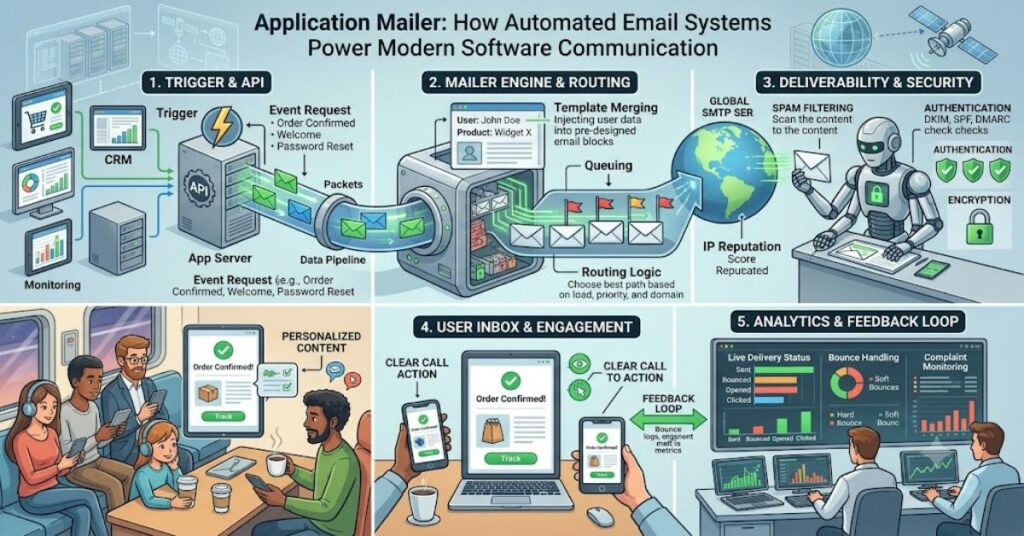
An application mailer is a backend software component responsible for creating, formatting, and delivering automated emails triggered by events inside an application. These emails include password resets, purchase confirmations, notifications, and system alerts. In practice, the system listens for events, constructs an email template, and sends it through an external email delivery service or SMTP server.
An application mailer generally refers to a component or tool within a software application that handles the creation, formatting, and delivery of automated emails. Depending on your exact context, it most likely refers to one of three things.
In modern software architecture, email is no longer sent directly from application servers. Instead, mailers operate as decoupled services that integrate with queues, background workers, and external providers. This separation improves reliability, scalability, and deliverability. As systems scale, application mailers become critical infrastructure rather than simple utility modules.
Understanding how these systems work is essential for developers building SaaS platforms, marketplaces, or any product that depends on reliable user communication.
Core Architecture of an Application Mailer
At a systems level, an application mailer typically follows an event-driven design.
Key Components
- Event trigger (user action or system event)
- Message queue (e.g., Redis, RabbitMQ)
- Mailer service (template + logic layer)
- Email delivery provider (SMTP/API)
- Logging and retry system
Data Flow Table
| Stage | Description | Example Tool |
| Event Trigger | User resets password | Web backend |
| Queue | Message stored for async processing | RabbitMQ |
| Mailer | Builds email content | NodeMailer / ActionMailer |
| Delivery | Sends email externally | Amazon SES |
| Tracking | Logs success/failure | Datadog / Logs |
How Application Mailers Work in Practice
A typical workflow begins when an application event occurs. For example, when a user registers, the system emits an event such as user.created.
The mailer system consumes this event asynchronously. Instead of sending email immediately within the request cycle, it queues the task. This prevents API slowdowns and avoids blocking user-facing operations.
The mailer then selects a template, injects dynamic variables (username, reset link, order ID), and passes the message to a delivery service.
Systems Analysis: Why Decoupling Matters
Modern architectures avoid synchronous email sending for one key reason: latency.
If email sending is handled inline, it introduces dependency on external SMTP response times. This can slow down APIs and degrade user experience.
Decoupling solves this by:
- Moving email tasks to background workers
- Allowing retry logic without blocking users
- Enabling horizontal scaling of email throughput
This pattern is especially common in microservices-based systems where reliability is prioritized over immediate execution.
Strategic and Practical Implications
Application mailers influence both technical performance and business outcomes.
Delivery Reliability
Poorly configured mailers often result in:
- Emails landing in spam folders
- Delayed transactional messages
- Lost password reset requests
Business Impact
For SaaS platforms, even small email failures can lead to:
- Increased support tickets
- Reduced user trust
- Lower conversion rates in onboarding flows
Email is often the first and most consistent communication channel between product and user.
Comparison of Email Sending Methods
| Method | Advantages | Disadvantages |
| Direct SMTP | Simple setup | Poor scalability |
| Transactional Email API | High deliverability | Vendor dependency |
| Queue-based Mailer | Scalable and reliable | More complex architecture |
| Embedded App Mailer | Fast implementation | Hard to maintain at scale |
Common Risks and Trade-Offs
1. Spam Filtering Risk
Improper header configuration or poor sender reputation can push emails into spam folders even if content is valid.
2. Queue Backlog Issues
If mail volume spikes, unprocessed jobs can accumulate and delay critical emails.
3. Vendor Lock-In
Using services like SES or SendGrid introduces dependency on pricing and policy changes.
Information Gain: Practical Insights Often Missed
1. Email timing affects deliverability more than content in some systems
Delivering emails during peak traffic windows can improve inbox placement due to higher engagement signals.
2. Retry logic can unintentionally duplicate emails
Without idempotency keys, failed retries may result in multiple identical messages being sent.
3. Template rendering cost becomes significant at scale
Large systems sending millions of emails per day often optimize template compilation as a performance bottleneck.
Real-World Behavior Observations
In production environments, application mailers rarely fail due to code errors. Most failures originate from external systems:
- SMTP throttling
- DNS misconfiguration (SPF/DKIM/DMARC)
- Provider rate limits
Another recurring issue is environment drift, where staging mailers behave differently from production due to authentication or domain setup differences.
The Future of Application Mailers in 2027
Email infrastructure is shifting toward intelligent delivery systems.
By 2027, application mailers are expected to incorporate:
- AI-based send-time optimization
- Automatic spam risk scoring before sending
- Multi-provider failover routing
- Real-time reputation monitoring
Regulatory frameworks around email authentication (SPF, DKIM, DMARC enforcement) are also tightening, pushing companies toward more standardized configurations.
Despite these changes, the core function of application mailers—reliable automated communication—remains stable.
Key Takeaways
- Application mailers automate email generation and delivery inside software systems
- Asynchronous queue-based architectures improve reliability
- Deliverability depends heavily on external email providers and configuration
- Poor retry handling can lead to duplicate messages
- Email infrastructure is evolving toward intelligent routing and optimization
Conclusion
An application mailer is a foundational part of modern backend systems, even if it often operates invisibly. It connects application logic with user communication, ensuring that critical events are delivered in a timely and reliable manner. As systems scale, simple SMTP integrations evolve into distributed, queue-driven architectures supported by external email providers.
The real challenge is not sending email, but ensuring it arrives, is read, and is trusted. That depends on architecture, configuration, and ongoing monitoring. As email ecosystems continue to evolve, application mailers will increasingly shift from simple utilities to intelligent communication layers embedded within broader application infrastructure.
Frequently Asked Questions
What is an application mailer?
It is a software component that generates and sends automated emails triggered by application events like signups or password resets.
Is SMTP required for an application mailer?
Not always. Many systems use APIs like Amazon SES or SendGrid instead of direct SMTP connections.
Why are application mailers asynchronous?
To prevent email sending from slowing down user-facing application requests.
What causes emails to go to spam?
Poor sender reputation, missing authentication records (SPF/DKIM), or suspicious content patterns.
Can application mailers scale to millions of emails?
Yes, if designed with queues, retries, and external delivery providers.
Methodology
This article is based on established backend engineering practices and documentation from major email delivery providers including Amazon SES, SendGrid, and Mailgun. Architectural patterns are derived from widely adopted microservices and event-driven system design principles. No proprietary systems were analyzed directly; all insights reflect standard industry implementations.
References (APA)
- Amazon Web Services. (2024). Amazon SES documentation. https://docs.aws.amazon.com/ses
- Twilio SendGrid. (2024). Email API overview. https://docs.sendgrid.com
- Mailgun. (2023). Email delivery best practices. https://www.mailgun.com
- Newman, S. (2021). Building Microservices. O’Reilly Media