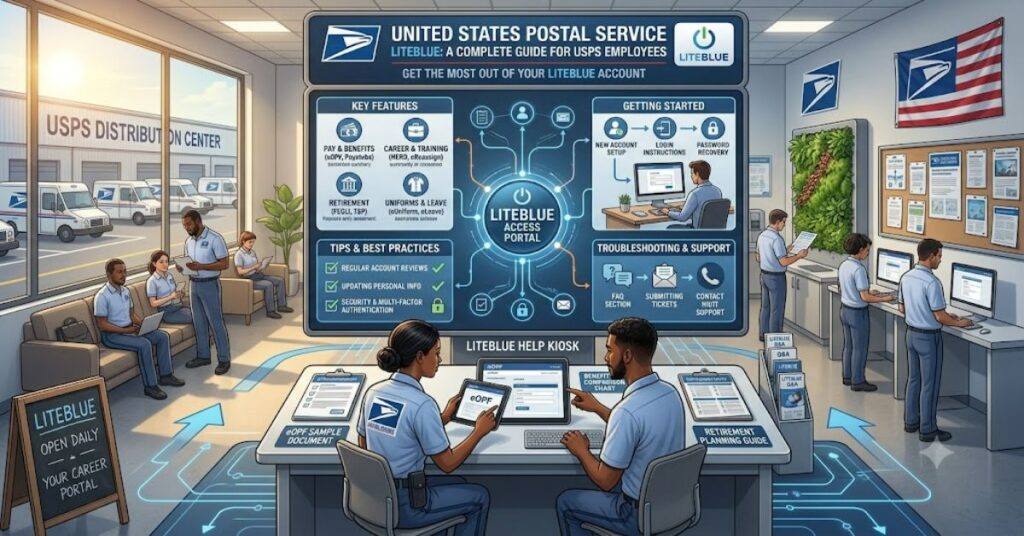
The United States Postal Service LiteBlue portal is the official USPS web application created specifically for employees to manage their careers, access workplace information, and stay connected with organisational services. Unlike public USPS tracking tools used by customers, LiteBlue serves as an internal platform for postal workers.
The portal provides access to essential resources including employee profiles, payroll-related information, benefits details, retirement planning tools, job opportunities, and internal communications. For a workforce spread across thousands of locations throughout the United States, having a centralised digital system helps simplify routine administrative tasks.
USPS introduced LiteBlue as part of its broader transition toward digital employee management. The system reflects a wider trend across large organisations: replacing fragmented workplace processes with secure online platforms that allow employees to access information whenever needed.
For postal employees, understanding how LiteBlue works can make everyday employment tasks easier. However, like any large enterprise system, the platform has limitations involving accessibility, authentication challenges, and dependence on reliable digital infrastructure.
What Is United States Postal Service LiteBlue?
LiteBlue is an online employee portal operated by the United States Postal Service for its workforce. It is not designed for customers or general public use.
The portal connects employees with several internal services through a single login environment. USPS employees can use LiteBlue to review employment details, access benefits information, explore career opportunities, and receive workplace updates.
The system is especially important because USPS employs hundreds of thousands of workers across processing facilities, delivery operations, administrative offices, and support roles. A centralised portal allows information to reach employees consistently regardless of location.
Core Functions Available Through LiteBlue
| Service Area | Purpose |
| Employee profile management | Allows workers to review employment information |
| Payroll resources | Provides access to salary and payment-related details |
| Benefits access | Helps employees review available programmes and coverage information |
| Career development | Displays opportunities and employment resources |
| Internal communication | Shares USPS workplace updates |
How USPS Employees Use LiteBlue
The portal operates as a self-service workplace platform. Employees typically access LiteBlue through secure authentication using their USPS employee credentials.
Common uses include:
- Checking employment information
- Reviewing benefits details
- Managing career-related activities
- Accessing retirement and compensation resources
- Reading internal announcements
A major advantage of this approach is reduced dependency on supervisors or administrative departments for routine questions. Employees can independently retrieve information that previously required additional steps.
However, access depends on maintaining secure login credentials. Employees who forget passwords or experience authentication issues may need to follow USPS account recovery procedures before regaining access.
LiteBlue Compared With Other USPS Employee Systems
USPS uses several digital systems, and LiteBlue is only one part of the organisation’s wider technology environment.
| Platform | Primary Purpose | Main Users |
| LiteBlue | Employee information and career management | USPS employees |
| USPS.com | Public postal services and tracking | Customers |
| PostalEASE | Employee benefits and payroll elections | USPS employees |
| ePayroll | Digital pay statement access | USPS employees |
The difference between these systems is important. Many users searching online confuse public USPS services with employee-only platforms. LiteBlue exists specifically for workforce administration rather than package tracking or customer support.
Practical Benefits of LiteBlue for USPS Workers
One of LiteBlue’s biggest benefits is convenience. A postal employee working in a remote delivery area or processing centre can access important employment information without visiting a human resources office.
The system also supports organisational efficiency by reducing paperwork. Large employers often face administrative challenges when managing workforce information manually. Digital employee portals help improve consistency and reduce processing delays.
Structured Insight: How Employee Portals Create Value
| Area | Traditional Process | Digital Portal Approach |
| Information access | Requires manual requests | Available online |
| Communication | Depends on local distribution | Centralised updates |
| Record management | Paper-heavy workflows | Digital records |
| Employee independence | Limited self-service | Greater control |
A less discussed benefit is workforce transparency. When employees can directly view employment information, they have greater visibility into their benefits, career options, and workplace records.
Challenges and Limitations of LiteBlue
Although digital employee portals provide advantages, they also create new challenges.
Authentication and Security Issues
Because LiteBlue contains sensitive employment information, security requirements must remain strict. Strong authentication protects employee data but may create frustration when workers experience login difficulties.
Large organisations must balance convenience with cybersecurity. A simpler login process could improve accessibility but increase security risks.
Digital Accessibility Concerns
Not every employee interacts with technology regularly. Some USPS workers spend most of their working day outdoors or in operational environments rather than behind computers.
This creates an important implementation challenge: digital systems must remain accessible to employees with different levels of technical experience.
Dependence on System Reliability
When employee services move online, technical outages can interrupt access to important information. Enterprise platforms require ongoing maintenance, monitoring, and infrastructure investment.
Real-World Context and USPS Digital Transformation
USPS has increasingly adopted digital tools to modernise operations and improve employee services. The organisation’s workforce management approach reflects broader changes affecting government agencies and large employers.
The shift toward digital employee platforms became especially significant after 2020, when many organisations accelerated remote access capabilities and online administrative processes.
LiteBlue represents one part of this transformation by connecting employees with workplace resources through a central digital environment.
The Future of United States Postal Service LiteBlue in 2027
By 2027, employee portals such as LiteBlue are likely to become more integrated with automated workplace systems, improved security technologies, and personalised employee dashboards.
Government agencies and large employers are increasingly investing in digital identity management, cloud-based services, and self-service tools. However, future development will depend on balancing innovation with cybersecurity requirements.
Potential improvements may include:
- More personalised employee experiences
- Better mobile accessibility
- Faster account recovery systems
- Increased integration between workplace applications
The main challenge will remain protecting sensitive employee information while ensuring that workers across different environments can easily access essential services.
Key Takeaways
- LiteBlue provides USPS employees with a central location for career, payroll, and workplace resources.
- The portal improves efficiency by reducing dependence on manual administrative processes.
- Digital employee systems require strong security and reliable infrastructure.
- Accessibility remains important for large workforces with different technology experiences.
- Future improvements will likely focus on integration, security, and user experience.
Conclusion
The United States Postal Service LiteBlue portal plays an important role in helping USPS employees manage workplace information digitally. By bringing career tools, benefits resources, and communication services together, the platform supports a more efficient employee experience.
Like many large-scale digital systems, LiteBlue must balance convenience with security and accessibility. Its long-term success depends on maintaining reliable performance while adapting to changing expectations around workplace technology.
As USPS continues modernising its operations, employee platforms will remain essential tools for connecting a large and geographically distributed workforce with the information they need.
Frequently Asked Questions
What is United States Postal Service LiteBlue used for?
LiteBlue is used by USPS employees to access employment information, benefits resources, career tools, and internal workplace services.
Who can access USPS LiteBlue?
Only authorised USPS employees can access LiteBlue using their employee credentials.
Is LiteBlue the same as USPS tracking?
No. LiteBlue is an employee portal, while USPS tracking services are designed for customers monitoring packages.
Can employees view payroll information through LiteBlue?
Yes, USPS employees can access payroll-related resources through connected employee services.
Why is USPS LiteBlue important for employees?
It provides a central digital location for managing workplace information and reduces the need for manual administrative requests.
Methodology
This article was prepared using publicly available information about USPS employee services, digital workplace systems, and government technology practices. Sources were reviewed to confirm the purpose and general functionality of LiteBlue.
Limitations include the fact that LiteBlue is an internal employee system, meaning some operational details are not publicly available. The analysis focuses on documented employee-facing functions rather than private system architecture.
A balanced view was maintained by considering both the advantages of digital employee portals and common challenges involving security, accessibility, and system reliability.
References (APA Style)
United States Postal Service. (2024). About the United States Postal Service. United States Postal Service.
United States Postal Service Office of Inspector General. (2023). Digital transformation and technology management reports. USPS OIG.
National Institute of Standards and Technology. (2024). Cybersecurity framework and digital identity guidance. U.S. Department of Commerce.
United States Government Accountability Office. (2023). Federal workforce technology and digital service management reports. GAO.