
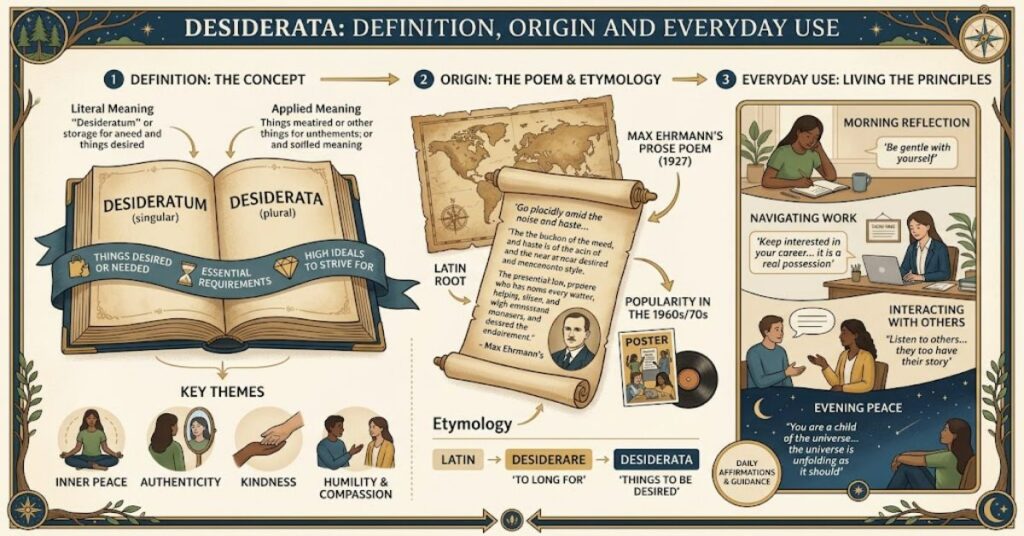
The desiderata meaning is relatively straightforward: it refers to things that are wanted, needed, required or considered desirable. The word is usually used when discussing a collection of requirements, wishes, goals or essential conditions.
For example, a company planning a new project may prepare a list of desiderata before development begins. That list could include affordability, reliability, accessibility and ease of use. Each of those qualities represents something the organisation wants or needs from the final result.
Although desiderata may sound unusual in everyday conversation, it remains useful because it expresses a specific idea efficiently. Instead of saying “the things that are considered necessary or desirable,” a writer can use one word to describe the entire group.
The term is most common in formal writing, education, business discussions, planning documents and intellectual debates. Understanding the desiderata meaning can therefore help readers interpret texts where requirements, priorities or desired outcomes are being discussed.
The Latin Origin of Desiderata
Desiderata comes from Latin. Its singular form is desideratum, which broadly refers to something desired or needed. The plural form, desiderata, refers to multiple desired or required things.
The movement of Latin words into English has given the language many formal terms that are still used in law, science, education and literature. Desiderata belongs to that tradition. While its origins are ancient, the concept remains highly relevant.
People constantly identify what they want from a situation. A student may have desiderata for a university. A traveller may have desiderata for accommodation. A business may have desiderata for new software. The vocabulary is formal, but the underlying idea is part of ordinary decision-making.
Is Desiderata Singular or Plural?
One of the most important points to understand is that desiderata is traditionally plural. The singular form is desideratum.
Here is a simple comparison:
| Form | Meaning | Example |
| Desideratum | One desired or required thing | Affordability is an important desideratum. |
| Desiderata | Multiple desired or required things | The team identified several desiderata for the project. |
In modern usage, however, language sometimes becomes more flexible. Some writers may treat desiderata as the name of a general collection or concept. For careful formal writing, it is usually best to remember its traditional plural meaning.
This distinction can be particularly useful in academic and professional contexts, where precise language matters.
How Is Desiderata Used in a Sentence?
The easiest way to understand the word is through examples. Because desiderata refers to desired or necessary things, it often appears when people are setting priorities.
Consider these examples:
- The researchers identified accuracy and transparency as key desiderata.
- Before choosing a new office, the company listed its main desiderata.
- Safety, affordability and accessibility were among the project’s most important desiderata.
- The committee discussed which desiderata were essential and which were merely preferable.
These examples show that the word often introduces a group of standards. It can refer to practical requirements, personal preferences or broader ideals.
The main advantage of the term is that it encourages clear thinking. When someone identifies their desiderata, they are separating what they genuinely need from what they simply find attractive.
Desiderata and the Difference Between Needs and Wants
The meaning of desiderata can cover both needs and wants, which makes the word broader than either term alone. Context determines how essential the items are.
For instance, the desiderata for emergency medical equipment would likely involve genuine necessities. Reliability and safety would not simply be preferences. By contrast, the desiderata for a holiday might include preferences such as a sea view, a swimming pool or proximity to restaurants.
This creates an important practical distinction:
| Type | Nature | Example |
| Essential desiderata | Necessary for success or safety | Security, legal compliance |
| Preferred desiderata | Highly desirable but not essential | Extra features, premium design |
| Personal desiderata | Based on individual priorities | Location, style, convenience |
| Strategic desiderata | Support long-term objectives | Scalability, sustainability |
A useful planning method is to rank desiderata according to importance. Not every desirable outcome can be achieved at once, especially when money, time or resources are limited.
Why the Word Is Useful in Planning
The desiderata meaning becomes particularly valuable when a person or organisation must make choices. Most decisions involve trade-offs. You may want something to be cheap, fast, high-quality and easy to obtain, but achieving every goal simultaneously may not be possible.
Creating a list of desiderata makes those trade-offs visible.
Imagine a small business choosing new accounting software. Its initial list might include:
- Low cost
- Strong security
- Easy staff training
- Reliable customer support
- Compatibility with existing systems
The business may then discover that no single option satisfies every requirement. At that point, it must decide which desiderata are essential and which can be compromised.
This is where the concept becomes more than a vocabulary lesson. It becomes a practical framework for decision-making.
Common Contexts Where Desiderata Appears
The word is flexible and can be used across many fields.
Education
Students may have desiderata when choosing courses, universities or learning resources. These could include cost, teaching quality, location and career opportunities.
Business
Organisations often establish requirements before selecting suppliers, technologies or strategic partners. A formal list of desiderata can improve consistency during evaluation.
Technology
Software and product teams regularly balance performance, usability, security and cost. These competing priorities can all be described as desiderata.
Research and Academia
Researchers may discuss the desiderata of a theory, model or methodology. In this context, the term can describe the qualities an ideal approach should possess.
Everyday Life
Even ordinary decisions involve desiderata. Choosing a home, job or holiday often requires comparing a personal list of desired features.
A Common Mistake: Confusing the Word with “Desiderata”
Some readers also encounter Desiderata as the title of the famous prose poem by Max Ehrmann. In that context, the capitalised word functions as a title and carries a broader sense connected with desirable ideals or things worth seeking.
This can create confusion because the literary title and the dictionary meaning are related but not identical in use. When discussing vocabulary, grammar or requirements, desiderata generally refers to multiple desired or necessary things.
Context is therefore important. A capital letter, a literary reference or the surrounding sentence can change how the word should be interpreted.
The Future of Desiderata in 2027
By 2027, formal vocabulary such as desiderata is likely to remain most useful in professional and specialist communication rather than everyday speech. As workplaces rely increasingly on structured planning, requirement gathering and decision frameworks, the underlying concept may become even more relevant.
The word itself is unlikely to replace simpler expressions such as “requirements” or “priorities.” However, it continues to offer a useful distinction when a writer wants to discuss a collection of things that are desirable without claiming that every item is strictly mandatory.
Its strongest future role may therefore be in analytical writing, research, product planning and other situations where people need to compare competing goals carefully.
Key Takeaways
- Desiderata means things that are desired, needed or considered desirable.
- It is traditionally the plural form of desideratum.
- The term is useful for describing requirements, goals and priorities.
- Context determines whether the desiderata are essential needs or preferred features.
- A ranked list of desiderata can make complex decisions easier.
- The word remains particularly useful in formal, academic and professional writing.
Conclusion
Understanding the desiderata meaning gives you a useful way to describe the things people want, need or hope to achieve. Although the word has Latin roots and a formal tone, its central idea is familiar: successful decisions often depend on knowing what matters most.
Whether you are planning a project, choosing a product, evaluating a career opportunity or setting personal goals, identifying your desiderata can bring structure to the process. It helps separate essential requirements from attractive extras and makes trade-offs easier to understand.
The singular form, desideratum, refers to one desired thing, while desiderata traditionally refers to several. Remembering that distinction can help you use the term accurately. More importantly, the concept encourages thoughtful prioritisation, which is valuable in both professional and everyday life.
FAQ
What is the simple meaning of desiderata?
Desiderata means things that are wanted, needed or considered desirable. It is commonly used to describe a group of requirements, goals or preferred conditions.
Is desiderata singular or plural?
Traditionally, desiderata is plural. The singular form is desideratum.
What is an example of desiderata?
A company might identify affordability, security and ease of use as its desiderata when choosing new software.
Is desiderata an English word?
Yes. It is used in English, although it originated from Latin and has a more formal tone than common alternatives such as “requirements” or “wants.”
What is the difference between desiderata and requirements?
Requirements are often mandatory, while desiderata can include both essential needs and desirable preferences. The exact distinction depends on the context.
Can I use desiderata in everyday conversation?
You can, but the word sounds formal and may be unfamiliar to some listeners. In casual conversation, “priorities,” “needs” or “preferences” may be clearer.
Methodology
This article follows the supplied Postcard.fm editorial framework, which requires the core keyword to guide the article structure and requires clear search-intent coverage, structured insights, FAQs, a future section and methodology. The analysis focuses on the definition and grammatical use provided in the keyword detail, while avoiding unsupported claims or fabricated firsthand experience.