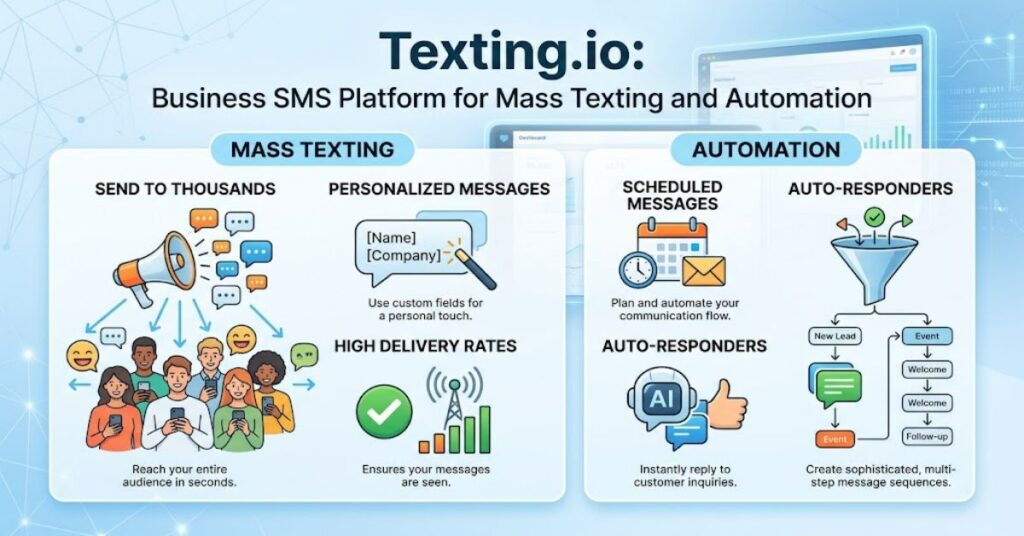
Texting.io is a business SMS platform built around three common communication needs: sending messages to groups, automating reminders, and handling two-way conversations with customers. For businesses that still rely heavily on email or manual phone calls, an SMS platform can create a more immediate communication channel for appointment confirmations, service updates, promotions, follow-ups, and customer support.
The platform’s stated entry pricing starts at $25 per month for 500 SMS credits. It also offers a no-credit-card free trial that includes 50 SMS credits and a free toll-free number, giving prospective users an opportunity to assess the service before committing to a paid plan.
The important question, however, is not simply whether a business needs text messaging. It is whether its message volume, customer consent process, automation requirements, and budget align with the platform’s credit model. That distinction matters because the cost of business SMS can change significantly depending on message frequency and workflow design.
How the Platform Fits Into a Business Messaging Workflow
A business messaging system normally sits between customer data and day-to-day communication. Staff may upload or manage contacts, create message campaigns, schedule automated reminders, and respond to incoming texts from a shared conversation environment.
Texting.io appears to address this workflow through a combination of mass texting, automated appointment reminders, and two-way messaging. These functions serve different purposes.
| Feature | Primary Use | Business Value |
| Mass texting | Send updates or campaigns to many contacts | Faster outreach |
| Appointment reminders | Notify customers automatically | Fewer manual follow-ups |
| Two-way conversations | Receive and answer replies | More direct customer service |
| SMS credits | Pay for message usage | Scales according to plan limits |
The strongest practical use case is often operational rather than promotional. A clinic, salon, service business, property manager, or local business may gain more value from reducing missed appointments and manual confirmation work than from sending frequent marketing campaigns.
That is one of the less obvious distinctions when evaluating business SMS tools: message volume is not the only metric. The quality and purpose of each message also affect the return on the platform.
Pricing and the SMS Credit Model
According to the supplied pricing detail, plans begin at $25 per month for 500 SMS credits. At a simple starting calculation, that works out to an advertised base cost of $0.05 per available credit before considering any additional plan conditions, message types, taxes, carrier fees, or other usage rules that may apply.
| Plan Element | Stated Detail |
| Starting monthly price | $25 |
| Included SMS credits | 500 |
| Free trial | Available |
| Trial requirement | No credit card |
| Trial SMS credits | 50 |
| Included trial number | Free toll-free number |
The free trial is useful because SMS platforms can be difficult to judge from a feature list alone. A business needs to see whether its staff can manage conversations efficiently and whether the platform fits existing customer workflows.
The credit model also creates a practical threshold. A company sending only occasional reminders may find 500 credits sufficient for a long period, while a business sending several campaigns each month could exhaust that allowance quickly. Before subscribing, users should estimate their monthly message requirements rather than selecting a plan based only on its entry price.
Texting.io Compared With Common Business Messaging Approaches
| Approach | Best For | Main Limitation |
| Business SMS platform | Ongoing customer communication | Requires consent and message management |
| Email marketing | Longer content and newsletters | May receive slower attention |
| Phone calls | Complex or sensitive discussions | Labour-intensive |
| Manual texting | Very small contact volumes | Difficult to scale |
| Automated reminders | Appointments and repeat services | Needs accurate customer data |
Text messaging is most effective when it is connected to a clear workflow. Sending a large number of messages without segmentation can create unnecessary opt-outs and reduce trust.
A better approach is to separate operational messages from marketing communications. Appointment reminders, delivery updates, and requested service information generally serve a different purpose from promotional offers. Businesses should reflect that distinction in both their messaging strategy and their consent processes.
The Real Advantages of Automated Appointment Reminders
Automated reminders can reduce repetitive administrative work. Instead of asking staff to contact every customer manually, a business can schedule messages around appointments or service dates.
The benefit is not limited to time savings. Reminder systems can also make communication more consistent. Customers receive information at a planned point in the journey, while staff can focus on exceptions or customers who require personal assistance.
However, automation creates its own dependency: customer records must be accurate. An incorrect phone number, outdated appointment time, or poorly configured message can create confusion at scale.
This leads to a useful operational insight. The best SMS automation is usually not the system that sends the most messages. It is the one with the fewest unnecessary messages and the clearest trigger conditions.
Two-Way Messaging and Customer Response
Two-way conversations distinguish a business messaging platform from a simple broadcast tool. Customers may need to confirm an appointment, ask a question, request a change, or respond to an offer.
For smaller teams, the main challenge is ownership. If multiple employees can access customer conversations, the business needs a clear process for deciding who responds and when. Otherwise, two staff members may answer the same message or an important request may remain unanswered.
A shared messaging workflow should therefore include response responsibilities, escalation rules, and reasonable response-time expectations.
This is another practical consideration that can be missed during software selection. Automation reduces outgoing work, but successful two-way communication may increase the need for organised incoming-message management.
Compliance, Consent and the Main Risks
The convenience of bulk SMS does not remove the need for permission-based communication. Texting.io requires uploaded contacts to be opted in and does not permit cold texting. The platform also provides methods for managing subscribers and opt-in processes.
For a business, this means the contact list is as important as the messaging software. A poorly maintained database can create several problems:
- Messages may go to people who did not expect them.
- Former customers may receive irrelevant campaigns.
- Opt-out requests may not be handled correctly.
- Duplicate contacts can waste SMS credits.
- Promotional and transactional messages may become mixed together.
One useful analytical insight is that compliance should be treated as a workflow issue rather than a final checkbox. The safest process starts when a customer’s number is collected and continues through consent recording, message segmentation, opt-out handling, and contact-list maintenance.
A second insight concerns MMS. Image messages can consume more credits than standard SMS messages, so businesses using visual content should calculate campaign costs before switching formats.
A third insight is that credit rollover can affect the real value of a monthly plan. Businesses with uneven messaging patterns may benefit from rollover policies that reduce wasted unused credits.
Who May Benefit Most From Texting.io?
The platform is aimed at organisations that communicate repeatedly with customers or subscribers. Potential users include healthcare practices, restaurants, real estate professionals, schools, gyms, tutors, nonprofits, landscapers, and other service businesses.
The platform may be particularly useful when a business has a recurring communication pattern.
| Business Type | Possible SMS Workflow | Potential Benefit |
| Dental or medical practice | Appointment confirmation and reminders | Less manual follow-up |
| Salon or spa | Booking reminders and availability | Better schedule management |
| Real estate | Lead follow-up and property updates | Faster client communication |
| Restaurant | Reservation confirmations | Clearer customer updates |
| Service business | Arrival windows and job updates | Improved customer coordination |
The most effective implementation is usually narrow at first. Rather than immediately turning every customer interaction into an automated campaign, a business can begin with one measurable workflow, such as appointment confirmations. This makes it easier to assess whether automation actually improves operations.
The Future of Texting.io in 2027
By 2027, business messaging platforms are likely to face greater pressure to combine automation with responsible customer communication. The direction of travel is towards more integrated workflows, where messages are triggered by customer actions, appointments, purchases, or service events.
Texting.io currently promotes features including automated responses, appointment reminders, mass messaging, one-to-one conversations, MMS, and different number options. Its product positioning reflects the growing demand for communication tools that combine several messaging functions rather than requiring separate systems for each task.
However, more automation will not automatically produce better customer experiences. The likely constraint is relevance. Customers may welcome a useful reminder while ignoring or opting out of repetitive promotional messages.
The stronger platforms in 2027 may therefore be those that make segmentation, consent management, automation, and conversation handling easier without making the workflow unnecessarily complex. Whether Texting.io expands in those areas will depend on its future product development and cannot be assumed from its current feature set.
Key Takeaways
- Texting.io combines bulk SMS, automated reminders, two-way messaging, autoresponders, and MMS capabilities.
- The Starter plan is listed at $25 per month for 500 SMS credits, while the free trial includes 50 SMS credits and a toll-free number without requiring a credit card.
- Businesses should calculate expected message volume before choosing a credit-based plan.
- Consent management is essential because recipients should be opted in before receiving business messages.
- Automated appointment reminders can reduce repetitive administrative work, but they depend on accurate customer and scheduling data.
- Two-way messaging creates a customer-service workflow that still requires staff ownership and response processes.
- MMS and other higher-credit message formats can change the effective cost of a campaign.
Conclusion
Texting.io offers a straightforward business SMS proposition: mass messaging for larger audiences, automated appointment reminders for recurring communication, and two-way conversations for direct customer interaction. Its entry point of $25 per month for 500 SMS credits, combined with a no-credit-card trial offering 50 credits and a toll-free number, makes it possible for smaller businesses to test the platform before committing to a paid subscription.
The platform is likely to make the most sense for organisations with a clear, repeatable messaging need. Appointment-based businesses, local service providers, real estate professionals, and other customer-facing organisations may find practical value in consolidating these workflows.
The main trade-off is that SMS automation still requires operational discipline. Businesses need accurate contact data, clear consent records, sensible segmentation, and a process for managing customer replies. The software can speed up communication, but the quality of the communication strategy remains the responsibility of the business.
Frequently Asked Questions
What is Texting.io used for?
Texting.io is a business messaging platform used for mass texting, automated appointment reminders, autoresponders, one-to-one conversations, and MMS communication. It is designed to help organisations communicate with subscribers and customers at scale.
How much does Texting.io cost?
The Starter plan begins at $25 per month and includes 500 SMS credits. Pricing and plan details may change, so businesses should confirm current terms before subscribing.
Does Texting.io offer a free trial?
Yes. The platform offers a no-credit-card free trial with 50 SMS credits and a free toll-free number.
Can I send appointment reminders through Texting.io?
Yes. Automated appointment reminders are one of the platform’s key features and can help businesses reduce manual follow-up work.
Can I have two-way conversations with customers?
Yes. The platform supports one-to-one messaging, allowing businesses to send and receive messages from customers.
Do customers need to opt in before receiving messages?
Businesses should obtain appropriate customer consent before sending marketing or mass text messages. Texting.io also requires recipients to be opted in and does not allow cold texting.
Does Texting.io support MMS?
Yes. The platform supports picture messaging. Businesses should consider how MMS credit usage may affect the overall cost of larger campaigns.
References
Texting.io. (n.d.). Mass texting service: Send bulk SMS text messages.
Texting.io. (n.d.). Mass texting service for small businesses.
Texting.io. (n.d.). Real estate SMS marketing.
Texting.io. (n.d.). Text blast service: Send SMS blasts.
Capterra. (2026). Texting.io software pricing, alternatives & more.
Methodology
This article was prepared by reviewing publicly available information about Texting.io’s product features, pricing, trial, mass-texting capabilities, and appointment-reminder functions, alongside selected third-party software listing information. The analysis distinguishes between platform claims and broader editorial assessment. Pricing, credit usage, and feature availability may change, so all current terms should be confirmed directly with the provider before purchase.
The structure follows the supplied POSTCARD.FM editorial requirements for keyword placement, structured sections, comparison tables, FAQ content, future analysis, methodology, visual strategy, and SEO metadata.