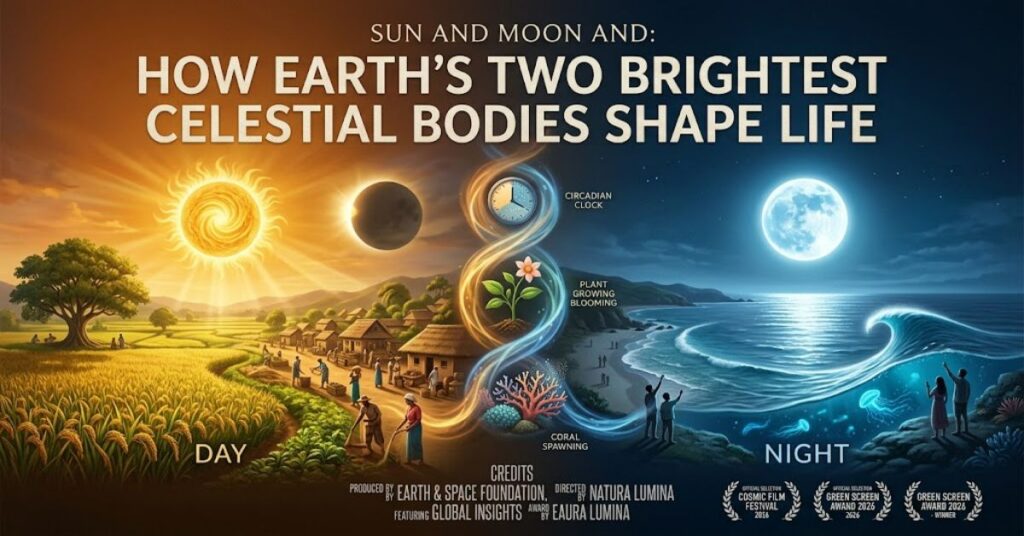
The sun and moon and their relationship with Earth are central to the way our planet looks, moves and supports life. They are the two most prominent celestial bodies visible from Earth, yet they are fundamentally different. The Sun is a massive star that produces its own light and energy. The Moon is a rocky natural satellite that orbits Earth and appears bright because its surface reflects sunlight.
Their importance extends far beyond what we see in the sky. Earth’s rotation creates the daily cycle of daylight and darkness, while its orbit around the Sun, combined with the tilt of its axis, produces the seasons. The Moon’s gravitational pull contributes to ocean tides, while the gravitational pull of the Sun also plays a significant role.
The relationship among these three bodies also produces eclipses. A solar eclipse occurs when the Moon moves between Earth and the Sun, while a lunar eclipse occurs when Earth moves between the Sun and Moon. Their apparent size in the sky creates another remarkable effect: although the Sun is vastly larger than the Moon, its much greater distance means that both can appear similar in size from Earth.
Understanding the Sun and Moon means looking at more than two objects in the sky. It means understanding a system of gravity, light, orbital motion and physical scale. Their relationship has also influenced calendars, navigation, agriculture, mythology and scientific discovery for thousands of years.
The Sun: Earth’s Main Source of Energy
The Sun is a star composed mainly of hydrogen and helium. At its core, nuclear fusion converts hydrogen into helium and releases enormous amounts of energy.
That energy travels through space as electromagnetic radiation. A small fraction reaches Earth, providing the light and heat necessary for many of the planet’s natural systems.
Solar energy powers photosynthesis, influences atmospheric circulation and drives the water cycle. Without the Sun, Earth would not maintain the conditions that support life as we know it.
The Sun is also extraordinarily large compared with Earth. Its diameter is about 1.39 million kilometres, making Earth tiny by comparison.
The Moon: Earth’s Rocky Companion
The Moon is Earth’s only natural satellite. Unlike the Sun, it does not produce visible light through nuclear fusion. Moonlight is sunlight reflected from its surface.
The Moon’s appearance changes throughout the month because, as it orbits Earth, observers see different portions of its illuminated half.
These changes are known as lunar phases. They include:
- New Moon
- Waxing Crescent
- First Quarter
- Waxing Gibbous
- Full Moon
- Waning Gibbous
- Last Quarter
- Waning Crescent
A complete cycle of phases, known as a synodic month, takes approximately 29.5 days.
Sun and Moon and Their Key Differences
| Feature | Sun | Moon |
| Classification | Star | Natural satellite |
| Produces its own light | Yes | No |
| Main composition | Hydrogen and helium | Rock and metal |
| Diameter | About 1.39 million km | About 3,475 km |
| Relationship to Earth | Earth orbits the Sun | Moon orbits Earth |
| Main visible effect | Daylight and solar energy | Reflected light and lunar phases |
The enormous difference in size is one of the most striking facts about the system. The Sun is roughly 400 times wider than the Moon, but it is also roughly 400 times farther from Earth. This relationship helps explain why the two bodies can appear similar in size during certain eclipses.
How the Sun and Moon Affect Earth
The Sun has the greatest influence on Earth’s energy system. Its radiation warms the surface and atmosphere, drives weather patterns and supports plant growth.
The Moon’s influence is most visible in ocean tides. Its gravitational attraction pulls on Earth, creating tidal bulges. As Earth rotates, coastal areas move through these regions, producing the familiar cycle of high and low tides.
The Sun also affects tides. When the Sun, Moon and Earth are aligned during a new or full Moon, their gravitational effects combine to produce particularly large tidal ranges known as spring tides.
When the Sun and Moon are positioned at roughly right angles relative to Earth, the tidal range is generally smaller. These are known as neap tides.
Structured Insight: How Their Effects Differ
| Earth System | Primary Influence | Role of the Other Body |
| Day and night | Sun provides daylight | Moon provides reflected night light |
| Seasons | Earth’s orbit and axial tilt relative to the Sun | Minimal direct role |
| Ocean tides | Moon’s gravity | Sun strengthens or weakens tidal effects |
| Eclipses | Provides light blocked during solar eclipses | Creates solar eclipses and receives Earth’s shadow |
| Biological rhythms | Light and seasonal energy | Night-time illumination and tidal cycles |
| Human calendars | Solar year | Lunar month |
Why the Moon Does Not Always Look the Same
The Moon is always partly illuminated by the Sun, except during a lunar eclipse. However, the portion visible from Earth changes as the Moon travels around our planet.
A Full Moon occurs when Earth is positioned approximately between the Sun and Moon, allowing observers to see most of the Moon’s illuminated face.
A New Moon occurs when the Moon is positioned roughly between Earth and the Sun. Its illuminated side faces away from Earth, making it difficult to see.
The changing phases were among the earliest reliable astronomical cycles observed by human societies. Long before modern clocks, lunar cycles helped people measure the passing of time.
Eclipses: When the Geometry Aligns
Eclipses occur because of the changing positions of the Sun, Earth and Moon.
A solar eclipse happens when the Moon passes between Earth and the Sun. Depending on the observer’s location and the Moon’s apparent size, the eclipse may be total, partial or annular.
A lunar eclipse occurs when Earth moves between the Sun and Moon, causing Earth’s shadow to fall across the lunar surface.
Eclipses do not occur every month because the Moon’s orbit is tilted relative to Earth’s orbital plane. The alignment has to occur at the right point in the Moon’s orbit.
This is an important insight because a Full Moon alone does not guarantee a lunar eclipse, and a New Moon alone does not guarantee a solar eclipse.
Three Important Insights About Their Relationship
The Moon’s apparent brightness can be misleading
The Moon often appears extremely bright against a dark sky, but it is not producing that light. Its visibility depends on reflected sunlight and its changing position relative to Earth.
The Sun also influences tides
The Moon is usually associated most strongly with tides, but the Sun’s gravity also affects them. The largest tidal ranges occur when the gravitational effects of both bodies reinforce each other.
Similar apparent size is a temporary astronomical coincidence
The Sun and Moon can appear similar in size from Earth, allowing total solar eclipses to occur. However, the Moon is gradually moving away from Earth over geological time. This means the geometry that makes total solar eclipses possible will not remain unchanged forever.
The Cultural Importance of the Sun and Moon
The sun and moon and their movement across the sky influenced some of humanity’s earliest attempts to understand time.
Solar calendars are based on Earth’s journey around the Sun. Lunar calendars use the phases of the Moon, while lunisolar calendars attempt to combine both cycles.
Across different cultures, the Sun and Moon have also appeared in mythology, art and religious symbolism. They have represented life and death, masculine and feminine forces, order and change, and the passage of time.
Their cultural importance comes partly from visibility. Unlike distant stars or invisible physical forces, both bodies are easy to observe without advanced equipment.
The Future of Sun and Moon and Astronomy in 2027
In 2027, the Sun and Moon will remain major subjects of scientific observation. Solar research continues to focus on solar activity, space weather and the ways solar eruptions can affect satellites, communications and electrical infrastructure.
The Moon is also becoming increasingly important for space exploration. NASA’s Artemis programme and other international lunar initiatives are focused on returning humans and robotic missions to the lunar environment and developing long-term scientific capabilities.
This creates a modern shift in the meaning of lunar exploration. The Moon is no longer viewed only as a destination for isolated missions. It is increasingly considered part of a wider infrastructure for scientific research and future deep-space exploration.
However, long-term plans still face technical, financial and operational constraints. Human missions require reliable life-support systems, transportation, communications and protection from radiation. Progress will depend on successful testing and sustained funding.
Key Takeaways
- The Sun is a star that provides the light and energy essential to Earth’s natural systems.
- The Moon is a rocky natural satellite that reflects sunlight and orbits Earth.
- The Moon has the strongest influence on Earth’s tidal cycles, while the Sun also contributes gravitational effects.
- Earth’s seasons are caused by its axial tilt and orbit around the Sun.
- Lunar phases result from changing viewing angles between the Sun, Moon and Earth.
- Solar and lunar eclipses depend on precise orbital alignment.
- Scientific interest in the Moon is likely to remain strong as lunar exploration develops through 2027.
Conclusion
The sun and moon and their connection to Earth form one of the most important natural systems visible from our planet. The Sun supplies the energy that drives climate, weather and life, while the Moon influences tides and provides a changing pattern of phases that has helped humans measure time for thousands of years.
Although they often appear together in art, stories and everyday language, they are physically very different objects. One is a massive star producing energy through nuclear fusion. The other is a rocky satellite reflecting that energy back into space.
Their changing positions create eclipses, influence tidal behaviour and provide some of the most recognisable patterns in the night and daytime sky. Modern astronomy has explained much of this relationship through physics and orbital mechanics, yet the Sun and Moon remain powerful objects of scientific and cultural interest.
As lunar exploration expands and solar research continues, these familiar celestial bodies will remain important not only for understanding Earth, but also for exploring the wider Solar System.
Frequently Asked Questions
What are the Sun and Moon?
The Sun is a star at the centre of the Solar System. The Moon is Earth’s natural satellite, a rocky body that orbits our planet and reflects sunlight.
Why does the Moon shine if it is not a star?
The Moon appears bright because its surface reflects sunlight. The amount of illuminated surface visible from Earth changes throughout the lunar cycle.
How do the Sun and Moon affect tides?
The Moon’s gravity is the main driver of tidal patterns, while the Sun also contributes. When their gravitational forces align, tidal ranges become larger.
What causes the seasons?
Earth’s seasons are mainly caused by the tilt of its rotational axis as the planet travels around the Sun. They are not caused by Earth simply moving closer to or farther from the Sun.
Why do solar eclipses not happen every month?
The Moon’s orbit is tilted relative to Earth’s orbit around the Sun. Most New Moons pass slightly above or below the alignment needed to produce a solar eclipse.
Will humans return to the Moon?
Multiple space programmes are working towards future lunar missions. NASA’s Artemis programme is among the major efforts focused on returning astronauts to the Moon and developing long-term lunar exploration capabilities.
Methodology
This article was prepared using established astronomical knowledge about solar physics, lunar science, orbital mechanics, tides and eclipses. The analysis draws on publicly available information from major scientific institutions, including NASA and other recognised astronomy resources.
The article distinguishes between direct physical effects and cultural interpretations. Scientific claims are based on established observations and measurements, while discussion of cultural significance recognises that meanings vary between societies.
A key limitation is that future lunar exploration schedules can change because of technical challenges, budget decisions and mission readiness. Any publication should therefore have current mission dates and programme developments checked by a human editor before publication.
Editorial disclosure: This article was drafted with AI assistance and should be reviewed and verified by the Postcard.fm editorial team before publication.
References
National Aeronautics and Space Administration. (2024). Sun: Facts and science. NASA.
National Aeronautics and Space Administration. (2024). Moon: Overview and lunar science. NASA.
National Aeronautics and Space Administration. (2024). Artemis programme. NASA.
National Oceanic and Atmospheric Administration. (2024). What causes tides? NOAA.
European Space Agency. (2024). The Moon and lunar exploration. ESA.