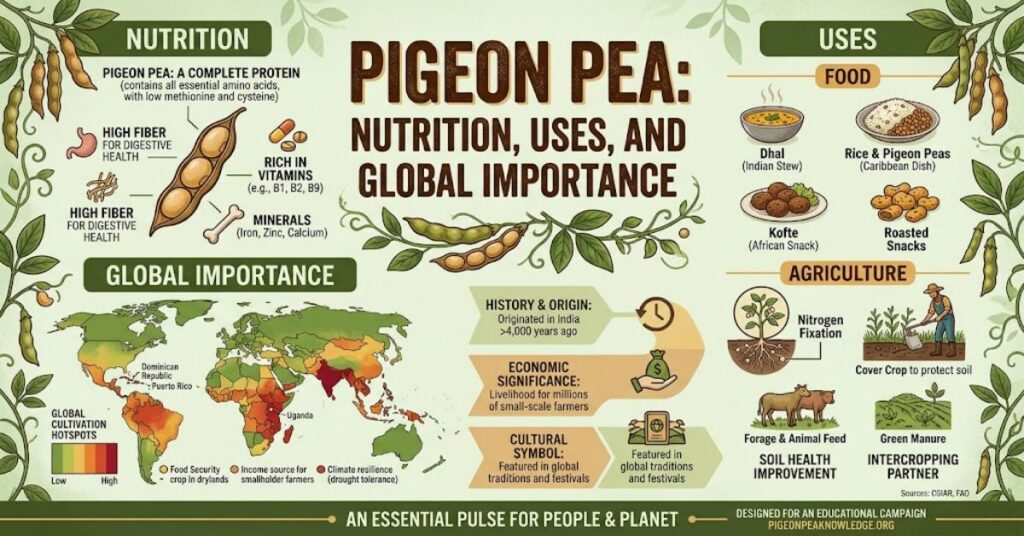
The pigeon pea is one of the world’s most widely used tropical legumes, although its name is less familiar in some Western food markets. Scientifically known as Cajanus cajan, it belongs to the Fabaceae family and is cultivated across the Indian subcontinent, Southeast Asia, Africa, Latin America and the Caribbean. Depending on the region, it may be sold fresh, dried, split or processed into flour and is known by several local names, including toor, arhar and gandules.
Its importance comes from a combination of nutrition, adaptability and culinary versatility. Like other pulses, pigeon pea provides plant protein and dietary fibre, while also supplying minerals and other nutrients. In the kitchen, its flavour works well in dals, stews, curries, rice dishes and Caribbean preparations.
The crop also matters at farm level. Pigeon pea is a long-lived legume compared with many annual pulses and can be used within mixed and diversified agricultural systems. Its root system and ability to associate with nitrogen-fixing microorganisms have made it valuable in discussions about sustainable cropping, although results depend on soil conditions, crop management and local climate.
Understanding this crop therefore means looking beyond a single recipe or nutrition label. Pigeon pea connects agriculture, regional food traditions and changing conversations about resilient food systems.
What Is a Pigeon Pea?
Pigeon pea is a grain legume belonging to the genus Cajanus. It is generally believed to have originated in the Eastern Hemisphere, with South Asia and Africa playing major roles in its long agricultural history.
The plant produces pods containing seeds that vary in colour and size according to the variety and stage of maturity. Young green seeds can be cooked as a vegetable, while mature seeds are commonly dried and stored.
In India, split pigeon peas are widely known as toor dal or arhar dal. In Puerto Rico and other parts of the Caribbean, gandules are a familiar ingredient in traditional rice dishes. East African and Southeast Asian cuisines also use the crop in regionally distinct ways.
Pigeon Pea Nutrition and Food Value
Pigeon pea is valued as a nutrient-dense pulse. Exact nutritional values vary depending on whether the seeds are fresh, dried, cooked or processed.
| Nutritional Component | Why It Matters |
| Protein | Supports the nutritional value of plant-based meals |
| Dietary fibre | Contributes to normal digestive function |
| Complex carbohydrates | Provides a sustained source of dietary energy |
| Potassium | Supports normal body functions |
| Folate | Important for several metabolic processes |
| Iron and other minerals | Contribute to the crop’s overall nutrient profile |
The nutritional advantage of pulses is strongest when they form part of a varied diet. Pigeon peas should not be viewed as a complete replacement for every other food group, but they can provide an affordable and versatile source of plant-based nutrition.
How Pigeon Peas Compare With Other Pulses
| Pulse | Typical Culinary Use | Texture | Common Regions |
| Pigeon pea | Dals, curries, rice dishes, stews | Firm to creamy when cooked | South Asia, Africa, Caribbean |
| Chickpea | Curries, salads, hummus | Dense and nutty | Mediterranean, Middle East, South Asia |
| Lentil | Soups, dals, stews | Soft and quick-cooking | Global |
| Black bean | Rice dishes, soups | Creamy and rich | Latin America and Caribbean |
| Split pea | Soups and purées | Soft and smooth | Europe and North America |
One practical difference is cooking time. Whole dried pigeon peas generally require more preparation than split forms. Soaking can reduce cooking time, while split pigeon peas such as toor dal are commonly prepared more quickly.
A Global Ingredient With Local Identities
One of the most interesting features of pigeon pea is that the same crop appears in very different food traditions.
In Indian cooking, it is strongly associated with dal preparations. In Caribbean cuisine, pigeon peas are frequently paired with rice and aromatic ingredients. In parts of Africa, the crop can be incorporated into stews and other staple dishes.
This regional diversity offers an important insight: pigeon pea is not one standardised ingredient with one correct preparation method. Its identity changes according to local agriculture, available spices, cooking techniques and food traditions.
Three useful insights often missed in basic guides
Preparation affects convenience. Whole, dried and split forms can require very different cooking times. Choosing the correct form matters when planning a meal.
Agricultural value and culinary value are linked. A crop that stores well and can be grown in challenging conditions may become especially important in regional food traditions because it fits both farm and household needs.
Regional names can create shopping confusion. A shopper looking for toor dal, arhar or gandules may encounter the same species in different forms. Checking the botanical or product description can help avoid buying the wrong pulse.
The Agricultural Role of Pigeon Pea
Pigeon pea has attracted agricultural interest because it can grow in warm climates and is used in diverse farming systems. As a legume, it forms associations with microorganisms that can fix atmospheric nitrogen, potentially contributing to soil fertility.
However, this benefit should not be overstated. Nitrogen fixation depends on factors such as soil conditions, microbial activity, crop variety and management practices. A pigeon pea crop is not an automatic substitute for a carefully planned nutrient-management programme.
Its deeper root system may also help the plant access water and nutrients from lower soil layers. This characteristic can be useful in rain-fed agriculture, particularly where water availability is variable.
The trade-off is that crop performance still depends on climate, pests, diseases and local production conditions. Resilience does not mean immunity.
How to Cook Pigeon Peas
Fresh pigeon peas can be cooked similarly to other fresh legumes. Dried peas usually require longer cooking and may benefit from soaking, depending on the recipe and product form.
A basic preparation involves:
- Rinsing the peas and removing damaged pieces.
- Soaking whole dried peas if the recipe recommends it.
- Simmering until tender.
- Adding seasoning according to the dish being prepared.
Split pigeon peas are especially popular in dals. They are typically simmered until soft and then combined with spices, aromatics and, in many recipes, a tempered mixture of ingredients cooked briefly in oil or ghee.
The key practical lesson is to check the package. Cooking times vary between whole and split peas and can also be affected by the age of dried pulses.
The Future of Pigeon Pea in 2027
By 2027, pigeon pea is likely to remain relevant to discussions around climate resilience, pulse production and plant-based diets. Interest in diversified protein sources continues to support attention towards legumes, while climate variability creates pressure to develop and maintain crops suited to challenging growing conditions.
Research institutions and agricultural organisations have also continued work on improving pulse productivity, disease resistance and adaptation. Yet there are limits to what crop genetics alone can achieve. Seed access, irrigation, storage infrastructure, farmer training and reliable markets remain important constraints.
The strongest future opportunity may be broader recognition rather than a sudden transformation of the crop. Pigeon pea already has deep roots in established food cultures. Expanding awareness in new markets could increase demand, but this must be balanced against affordability and local food access.
Key Takeaways
- Pigeon pea is a perennial grain legume from the Fabaceae family.
- It is eaten across South Asia, Africa, Southeast Asia, Latin America and the Caribbean.
- The crop can be consumed fresh, dried or split into forms used in dishes such as dal.
- It provides plant protein, fibre and a range of micronutrients.
- Its nitrogen-fixing capacity can support diversified farming systems, although outcomes depend on local conditions.
- Different regional names and product forms can make shopping and preparation confusing.
- Its future relevance is linked to resilient agriculture and growing interest in diverse plant-based foods.
Conclusion
The pigeon pea is both a traditional food and an agriculturally significant legume. Its long history across tropical and subtropical regions has produced a remarkable range of dishes, from South Asian dals to Caribbean rice preparations. That culinary diversity reflects the crop’s ability to adapt to different landscapes and food cultures.
Its wider value lies in its combination of nutrition and agricultural potential. Pigeon pea can provide plant protein and fibre while also fitting into diversified farming systems. At the same time, it is important to avoid simple claims that any single crop can solve food-security or sustainability challenges on its own. Growing conditions, infrastructure, market access and preparation all matter.
For cooks, the crop offers versatility. For farmers and researchers, it remains a useful subject in the study of resilient agricultural systems. Those two roles explain why pigeon pea continues to matter across continents and cuisines.
Frequently Asked Questions
What is a pigeon pea?
A pigeon pea is a legume scientifically known as Cajanus cajan. It is widely cultivated in tropical and subtropical regions and can be eaten fresh, dried or split.
Are pigeon peas and toor dal the same thing?
Toor dal is commonly made from split pigeon peas. The terminology can vary by region, but both refer to products derived from Cajanus cajan.
What do pigeon peas taste like?
They generally have a mild, earthy and slightly nutty flavour. Their texture becomes softer and creamier as they cook, especially when split.
Do pigeon peas need to be soaked?
Whole dried pigeon peas may benefit from soaking to reduce cooking time. Split forms often cook more quickly and may not require soaking. Package instructions and the specific recipe should guide preparation.
Are pigeon peas healthy?
Pigeon peas can contribute protein, dietary fibre and micronutrients to a balanced diet. Their nutritional value depends on portion size, preparation and the overall diet.
Where are pigeon peas commonly eaten?
They are widely eaten in South Asia, Southeast Asia, Africa, Latin America and the Caribbean. Common regional names include toor, arhar and gandules.
Methodology
This article is based on established botanical, agricultural and nutritional information about Cajanus cajan. The analysis compares the crop’s food uses with its role in tropical and subtropical farming systems and distinguishes between documented agricultural characteristics and broader claims about sustainability.
Sources for final publication should include primary agricultural research, recognised crop databases and national or international food-composition data. Nutritional values may differ according to variety, processing and cooking method, so figures should be checked against the exact form of the food being described.
The forward-looking discussion is intentionally cautious. Crop resilience does not remove the effects of drought, pests, infrastructure gaps or market volatility.
Editorial disclosure: This article was drafted with AI assistance and should be reviewed and verified by the Postcard.fm editorial team before publication.
References
Food and Agriculture Organization of the United Nations. (2023). Pulses and sustainable food systems. FAO.
International Crops Research Institute for the Semi-Arid Tropics. (2024). Pigeonpea research and development. ICRISAT.
Kew Science. (2024). Cajanus cajan (L.) Millsp. Plants of the World Online.
U.S. Department of Agriculture, Agricultural Research Service. (2024). FoodData Central. USDA.
World Agroforestry. (2023). Cajanus cajan: Agroforestry and crop information. World Agroforestry.