
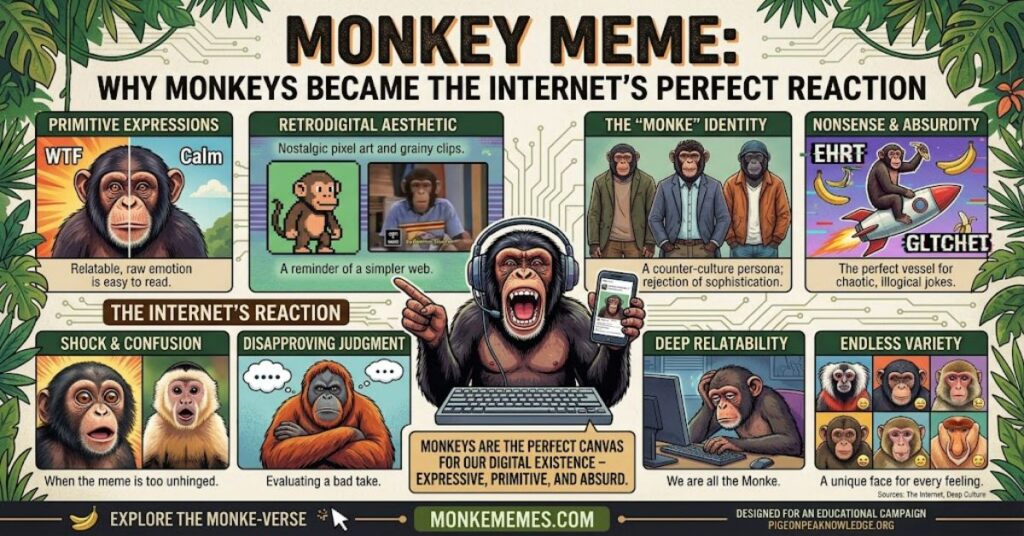
A monkey meme is more than a funny picture of an animal. It is a compact way of expressing embarrassment, confusion, suspicion, overthinking or completely chaotic behaviour. When a caption is added to the right facial expression, the image can communicate a situation that would otherwise require several sentences.
The Cambridge Dictionary defines an internet meme as an idea, joke, image or video that spreads quickly online. Monkey-based formats fit that definition particularly well because their expressions are easy to reinterpret.
Some of the most recognisable examples have very different origins. The Awkward Look Monkey Puppet came from a Japanese children’s television programme, while the Thinking Monkey photograph originated in Gibraltar. Neither image was originally created as internet humour. Their meme identities emerged later through editing, captioning and redistribution.
That history explains something important about meme culture: the internet rarely needs an image to have been created for comedy. Users can transform an ordinary photograph, television frame or video still into a shared cultural reference.
Why Monkey Memes Work So Well
The strongest formats have an obvious emotional signal. A human can look embarrassed, uncertain or suspicious, but a monkey doing the same thing adds an absurd layer to the joke.
This creates emotional distance. Instead of saying, “I made an awkward mistake,” a person can post an image of a monkey looking away. The animal becomes a substitute for the person behind the screen.
This is particularly useful on visual-first platforms. Pew Research Center noted in 2024 that Instagram had become a destination for memes and entertainment alongside personal photography.
Common Emotional Uses
| Monkey expression | Typical meme meaning | Why it works |
| Looking away | Awkwardness or embarrassment | Avoids direct confrontation |
| Thinking pose | Overthinking or strange ideas | Mimics human contemplation |
| Closed eyes | Acceptance or resignation | Creates an emotional punchline |
| Sad expression | Disappointment | Makes ordinary problems exaggerated |
| Staring expression | Confusion or disbelief | Works with short captions |
The visual format also reduces the need for context. A familiar image can carry meaning even before the viewer reads the caption.
Famous Monkey Meme Formats
Awkward Look Monkey Puppet
One of the best-known examples is the Awkward Look Monkey Puppet. The character, Kento, came from the Japanese children’s series Ōkiku Naru Ko. The meme creator Dani Flores explained in a 2021 Know Your Meme interview that he altered the puppet’s eyes in Photoshop to create the secret sideways glance that made the format recognisable.
The first version was published on 5 May 2016. Its humour came from a deeply familiar human behaviour: pretending not to look while obviously looking.
That is a useful lesson in meme construction. The joke does not depend only on the monkey. It depends on a recognisable social situation.
Thinking Monkey
The Thinking Monkey has a different emotional role. The photograph shows a Barbary macaque appearing to contemplate something while touching its mouth.
The earliest known online posting dates to 25 December 2011, when a photograph titled “gibraltar monkeys” appeared on DeviantArt. The format gained renewed attention years later, particularly around 2024.
Its strength is flexibility. The same image can represent serious thinking, an inappropriate idea, unnecessary overanalysis or a ridiculous internal debate.
Monkey Accepting Its Fate
Another example demonstrates how video can become a reaction format. A scene from National Geographic’s Eye of the Leopard, released in 2006, was later repurposed into meme content. In February 2024, a shortened clip showing the monkey closing its eyes became widely shared on X.
The original context was dramatic wildlife footage. The meme context became everyday resignation. That contrast is central to internet humour.
Monkey Meme Formats Compared
| Format | Main emotion | Typical use | Origin |
| Awkward Look Monkey Puppet | Embarrassment | Social awkwardness | Japanese television character |
| Thinking Monkey | Overthinking | Internal thoughts | Gibraltar photograph |
| Monkey Accepting Its Fate | Resignation | Giving up or accepting reality | Wildlife documentary |
| Leaning Monkey | Sadness | Disappointment or loneliness | Unknown original image |
The comparison shows that “monkey meme” is not one fixed format. It is an umbrella term covering several visual templates with different emotional functions.
The Cultural Impact of Monkey Memes
Monkey memes succeed because they turn private feelings into shared jokes. A person who feels uncomfortable after sending a message can communicate that feeling through an awkward monkey. Someone questioning a poor decision can use a thinking monkey.
This makes memes a form of informal digital communication.
The most interesting feature is their adaptability. Users continually change captions while preserving the underlying expression. Meaning therefore comes from both the image and the community’s accumulated understanding of it.
Three broader insights follow.
First, familiarity matters more than originality. A recognisable reaction image can outperform a technically better but unfamiliar image because viewers understand its emotional grammar immediately.
Second, contrast creates stronger humour. Serious wildlife footage becomes funny when placed against an ordinary human problem. The distance between original context and caption creates the joke.
Third, old material can become new culture. The Thinking Monkey photograph existed online for more than a decade before becoming a significant meme format.
Risks and Trade-Offs
Meme culture is fast, but that speed has drawbacks. Images can be detached from their original context, creators may receive little recognition, and captions can change an image’s meaning completely.
There is also a cultural risk in assuming every viral image is anonymous. The history of Awkward Look Monkey Puppet shows that identifiable creators can sit behind formats that later appear to belong to the internet as a whole.
For publishers and brands, using popular meme imagery also requires care around copyright, licensing and platform rules.
The Future of Monkey Memes in 2027
Monkey-based humour is likely to remain relevant because its underlying mechanism is simple: recognisable expression plus relatable situation.
The format may increasingly move from static images towards short videos, animated edits and AI-assisted remixes. That does not mean older formats will disappear. Meme culture frequently revives old images when a new caption or social event makes them relevant again.
The Thinking Monkey’s long delay between its original 2011 posting and later meme popularity is evidence that meme relevance does not always follow a predictable schedule.
By 2027, the strongest formats will probably continue to be those that communicate emotion instantly while remaining easy to remix.
Key Takeaways
- Monkey memes translate complicated human emotions into simple visual jokes.
- Different monkey templates have different emotional meanings.
- The Awkward Look Monkey Puppet demonstrates how editing can transform an existing character into a new cultural format.
- The Thinking Monkey shows that meme popularity can emerge years after an image first appears online.
- Context reversal is one of the strongest mechanisms behind reaction-image humour.
- Meme creators and publishers should consider attribution, copyright and original context.
- The format’s future will depend more on adaptability than on any single viral image.
Conclusion
Monkey memes have become successful because they make human behaviour look instantly recognisable and slightly ridiculous. Their expressions provide a flexible vocabulary for embarrassment, overthinking, confusion and resignation.
Their history is equally revealing. Some originated in television, some in photography and others in documentary footage. The internet then supplied the captions, edits and cultural context that turned those materials into reusable templates.
The Awkward Look Monkey Puppet illustrates how a small creative edit can transform an existing character, while the Thinking Monkey demonstrates how an overlooked photograph can gain new relevance many years later.
Ultimately, the enduring appeal of this format is not simply that monkeys are funny. It is that people recognise themselves in the expressions. The monkey becomes a harmless stand-in for the awkward, confused or chaotic parts of everyday life.
Frequently Asked Questions
What is a monkey meme?
A monkey meme is an internet image, GIF or video featuring a monkey that is paired with captions or used as a reaction to communicate humour, emotion or a relatable situation.
Why are monkey memes so popular?
Their popularity comes from expressive visuals, recognisable emotions and easy remixing. A single image can be adapted to many different situations without requiring lengthy explanation.
What is the Awkward Look Monkey Puppet meme?
It is a reaction format featuring Kento, a puppet character from the Japanese children’s programme Ōkiku Naru Ko. Its famous sideways glance was created through image editing in 2016.
What does the Thinking Monkey meme mean?
The Thinking Monkey usually represents overthinking, contemplation or an unusual thought. Its modern meme use developed from a photograph of a Barbary macaque in Gibraltar.
When did monkey memes become popular?
There is no single starting date. Different formats appeared at different times. For example, the Awkward Look Monkey Puppet emerged in 2016, while the Thinking Monkey gained wider meme attention around 2024.
Can old monkey images become viral again?
Yes. Meme culture frequently reuses older photographs and videos when users discover a caption or situation that fits a contemporary conversation.
Methodology
This article was prepared using publicly available reference material from Cambridge Dictionary, Know Your Meme and Pew Research Center. Historical details about individual meme formats were cross-checked against documented origin and interview material where available. The analysis distinguishes between verified origins and broader interpretation of meme behaviour.
A limitation is that internet meme circulation is difficult to measure comprehensively because posts can be deleted, reposted or moved between platforms. Viral metrics also change over time. The article therefore focuses on documented examples rather than claiming that any single format represents all monkey-based internet humour.
No firsthand testing or personal field reporting was conducted for this article; firsthand claims have not been presented as personal experience.
Editorial disclosure: This article was drafted with AI assistance and requires human editorial review before publication. All statistics, dates, citations and named claims should be independently checked against the original sources.
References
Cambridge Dictionary. (2026). Meme. Cambridge University Press.
McClain, C., Anderson, M., & Gelles-Watnick, R. (2024). How Instagram users view, experience the platform. Pew Research Center.
Know Your Meme. (2021). The creator of the “Awkward Look Monkey Puppet” meme reveals the true origins of his creation.
Know Your Meme. (2024). Awkward Look Monkey Puppet.
Know Your Meme. (2025). Thinking Monkey.
Know Your Meme. (2024). Monkey Accepting Its Fate.