
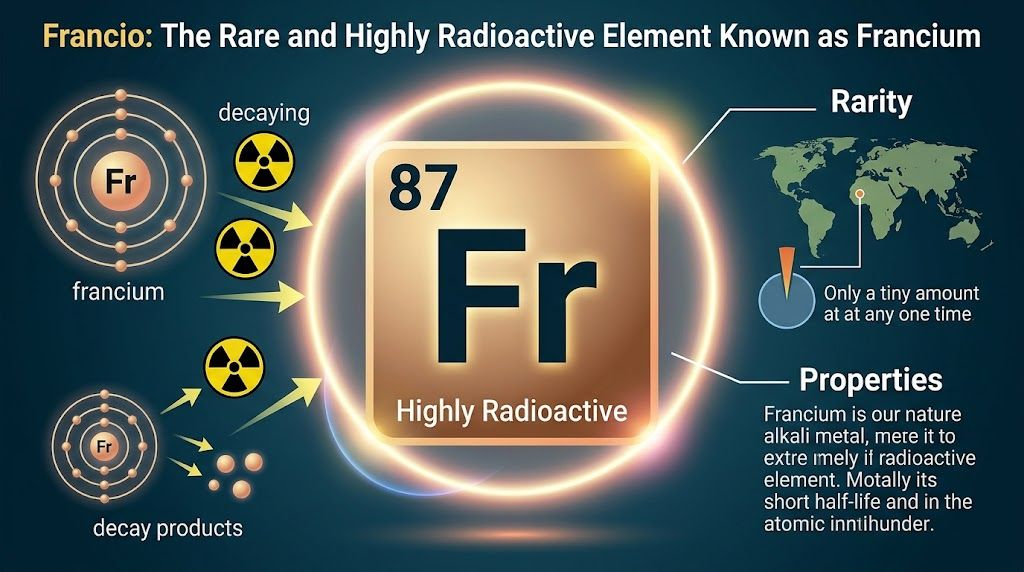
Francio, commonly known in English as francium, is a chemical element with the symbol Fr and atomic number 87. It belongs to the alkali metal group, which also includes lithium, sodium, potassium, rubidium and caesium. However, francium is unlike its better-known chemical relatives because it is exceptionally rare and highly radioactive.
Scientists know that francium exists naturally only in extremely small quantities. Its radioactive isotopes decay quickly, meaning that significant amounts cannot accumulate in the Earth’s crust. This makes the element difficult to study and explains why most people encounter it only in chemistry textbooks or discussions about the periodic table.
Despite its rarity, francium remains scientifically important. It occupies a unique position in the periodic table and helps researchers understand the behaviour of heavy atoms. Because it is positioned at the bottom of Group 1, scientists expect it to share certain characteristics with other alkali metals while also showing effects linked to its large atomic size and radioactive nature.
The study of francium also demonstrates an important principle in chemistry: not every element is useful because it can be manufactured in large quantities. Some elements are valuable because studying them expands scientific understanding. Francium is one of these cases. Its scarcity may limit practical applications, but its unusual physical and atomic properties continue to make it an important subject in nuclear and atomic research.
What Is Francio?
Francio is the name used here for francium, a highly radioactive metallic element. It has 87 protons in its nucleus, giving it atomic number 87.
Francium belongs to the alkali metals. Elements in this group generally have one electron in their outermost shell, making them chemically reactive. As scientists move down Group 1, the atoms become larger, and their behaviour changes.
Francium sits at the bottom of this group.
Because of its position, it is expected to be one of the most reactive metals. However, its short-lived radioactive nature makes direct experimentation extremely difficult. Scientists cannot simply collect a large piece of francium and study it in the same way they might examine sodium or potassium.
The core description of francium as a rare, highly radioactive alkali metal with atomic number 87 is central to the supplied article brief.
Why Is Francium So Rare?
Francium is rare because its isotopes are unstable and decay rapidly. Radioactive decay transforms unstable atomic nuclei into other elements or isotopes.
This means that even when francium is produced naturally, it does not remain present for long periods.
Scientists believe that only very small quantities of naturally occurring francium exist at any given time. Unlike stable elements such as iron or oxygen, francium cannot build up into large natural deposits.
Its rarity is therefore connected directly to its nuclear instability.
| Property | Francium |
| Chemical symbol | Fr |
| Atomic number | 87 |
| Element group | Alkali metals |
| General state | Expected to be a metal |
| Natural abundance | Extremely low |
| Radioactivity | Very high |
| Stability | Highly unstable |
Francio and the Alkali Metals
The alkali metals form one of the best-known groups in the periodic table. Their members include lithium, sodium, potassium, rubidium, caesium and francium.
These elements share an important structural feature: each has one electron in its outer shell. This makes them likely to lose that electron during chemical reactions.
| Element | Symbol | Atomic Number | Relative Stability |
| Lithium | Li | 3 | Stable |
| Sodium | Na | 11 | Stable |
| Potassium | K | 19 | Stable |
| Rubidium | Rb | 37 | Stable |
| Caesium | Cs | 55 | Stable |
| Francium | Fr | 87 | Highly radioactive |
Francium is the heaviest naturally occurring member of the group. Its position gives scientists an opportunity to investigate how atomic behaviour changes at the extreme end of the periodic table.
The Discovery of Francium
Francium was discovered in 1939 by Marguerite Perey, a French physicist working at the Curie Institute in Paris.
Her discovery followed research involving radioactive decay. Perey identified evidence of a previously unknown element produced during the decay of actinium.
The element was eventually named francium in recognition of France.
This discovery was historically significant because francium became one of the last naturally occurring elements to be identified. Its discovery also demonstrated how advances in nuclear science were changing the methods used to identify new elements.
Earlier chemical discoveries often involved isolating visible materials or analysing minerals. By contrast, radioactive elements sometimes had to be identified through the products and patterns of nuclear decay.
Why Is Francium Difficult to Study?
The greatest challenge in studying francium is that it disappears quickly.
A useful scientific experiment normally requires enough material to observe, measure and repeat results. Francium makes all of these steps difficult because of its scarcity and radioactivity.
Scientists studying the element must often work with extremely small quantities. In some cases, francium atoms are produced under controlled laboratory conditions and examined using advanced techniques.
The practical difficulty is not simply producing francium. Researchers must also detect and analyse it before radioactive decay changes the material.
This creates a major difference between francium and common elements. A laboratory can store samples of copper or sodium for long periods. Francium cannot be handled in the same ordinary way.
The Physical Properties of Francium
Many physical properties of francium are based partly on scientific predictions because obtaining enough material for direct observation is difficult.
Based on its position in the periodic table, francium is expected to behave like an alkali metal. It would likely be soft and highly reactive.
However, francium is also an extremely heavy element. This means its electrons experience conditions that differ from those found in lighter atoms.
Scientists studying heavy elements must consider relativistic effects. At very high atomic numbers, electrons can move at speeds where the effects described by Einstein’s theory of relativity become important in calculations of atomic behaviour.
This makes francium more than simply “another alkali metal.” It provides an opportunity to study the relationship between atomic structure, nuclear instability and the behaviour of extremely heavy atoms.
Does Francium Have Any Practical Uses?
Francium has very limited commercial or everyday applications.
The element is too rare, unstable and radioactive to be mined or used in ordinary industrial products. There is no practical francium jewellery, construction material or consumer technology.
Its main value lies in scientific research.
Researchers can use francium to investigate atomic structure and fundamental physical processes. Studies involving rare atoms may contribute to broader knowledge in atomic physics and nuclear science.
This is an important distinction: an element does not need a large commercial market to have scientific value.
Risks and Challenges of Studying Francium
Radioactivity is the most obvious challenge associated with francium. Unstable nuclei release energy through radioactive decay, requiring careful scientific procedures.
Another challenge is availability. The extremely small quantities involved limit the range of experiments that can be performed.
There is also a practical trade-off between scientific interest and research cost. Producing and detecting rare radioactive atoms can require specialised laboratories and equipment.
These limitations mean that francium research remains highly specialised.
The Scientific Importance of Francio
Francium may be rare, but its scientific value is connected to its position at the boundary of what researchers can easily observe.
The element provides information about heavy atoms, radioactive decay and the periodic table. It also reminds scientists that chemical classification is based on patterns rather than guarantees that every element can be observed under ordinary conditions.
One useful insight is that francium demonstrates the limits of textbook chemistry. Periodic trends can predict how an element may behave, but direct experimental evidence becomes harder to obtain when the material exists only briefly and in microscopic quantities.
A second insight is that rarity itself can become a research advantage. Because francium has unusual atomic properties, even experiments involving small numbers of atoms can provide useful information.
A third insight is that francium represents the connection between chemistry and physics. Understanding it requires knowledge of electron behaviour, nuclear instability and radioactive decay rather than chemistry alone.
The Future of Francio in 2027
By 2027, francium is unlikely to become a commercially important material. Its fundamental limitations are rooted in its radioactivity and extremely short-lived nature.
However, scientific interest in rare and exotic atoms is likely to continue. Improvements in laser spectroscopy, particle detection and atomic trapping techniques may allow researchers to make increasingly precise measurements.
The future of francium research will therefore depend more on advances in experimental physics than on industrial demand.
Researchers may continue using the element to test theoretical predictions about heavy atoms and fundamental interactions. Because francium sits at an extreme position in the periodic table, even small improvements in measurement techniques could produce valuable scientific results.
There should be no expectation that francium will suddenly become a common material. Its importance is more likely to remain scientific than commercial.
Key Takeaways
- Francio refers to francium, the element with the symbol Fr and atomic number 87.
- It is an exceptionally rare and highly radioactive member of the alkali metal group.
- Its isotopes decay rapidly, preventing large quantities from accumulating naturally.
- Francium was discovered in 1939 by French physicist Marguerite Perey.
- Its position in Group 1 makes it important for studying periodic trends.
- Research is difficult because only tiny quantities can be produced and observed.
- Its greatest value lies in atomic and nuclear science rather than commercial applications.
Conclusion
Francium is one of the most unusual elements in the periodic table. Known here through the keyword francio, it is scientifically recognised as francium, a rare and highly radioactive alkali metal with atomic number 87. Its extreme instability means that it exists only in very small quantities and cannot be collected or used like ordinary metals.
Yet its rarity does not reduce its scientific importance. Francium provides researchers with an opportunity to study the behaviour of heavy atoms, radioactive decay and the limits of periodic trends. Its discovery also marked an important moment in twentieth-century nuclear science.
The element has few practical applications because its radioactive nature makes large-scale use unrealistic. Its real value lies in research. As experimental methods become more precise, francium may continue to help scientists test theories about atomic structure and fundamental physical behaviour.
For this reason, francium remains a fascinating example of how an element can be almost impossible to find and still hold an important place in science.
FAQ
What is francio?
Francio generally refers to francium, a chemical element with the symbol Fr and atomic number 87. It is a rare, highly radioactive member of the alkali metal group.
Is francio the same as francium?
Yes. In the context of this article, francio refers to francium, the internationally recognised chemical element with atomic number 87.
Why is francium so rare?
Francium is rare because its isotopes are radioactive and decay rapidly. As a result, large quantities cannot naturally accumulate in the Earth’s crust.
Who discovered francium?
Francium was discovered in 1939 by French physicist Marguerite Perey while researching the radioactive decay of actinium.
Is francium dangerous?
Francium is highly radioactive. Its radioactivity and instability mean it must be studied only under specialised scientific conditions.
What is francium used for?
Francium has no major commercial use. Its primary importance is in scientific research involving atomic physics, nuclear physics and the behaviour of heavy elements.
Methodology
This article was developed from the supplied brief, which defines francio as francium: a highly radioactive and rare chemical element with the symbol Fr and atomic number 87, noted for its physical instability and position among the alkali metals.
The article uses that source framing to explain francium’s properties, rarity, scientific significance and likely future research relevance. The analysis is intended as an educational overview. Any specialised scientific measurements or current research findings should be independently verified against authoritative chemistry and physics sources before publication.