
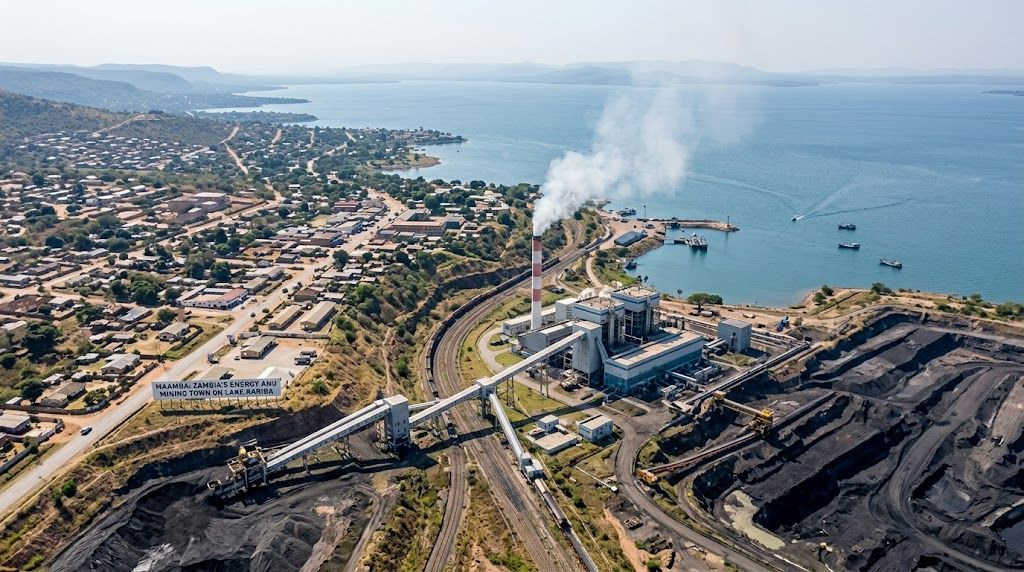
Maamba is a town in Zambia’s Southern Province, located in the Sinazongwe District along the northern side of Lake Kariba. Although it is smaller and less internationally recognised than Lusaka, Livingstone or the Copperbelt mining centres, Maamba has national importance because of its role in Zambia’s energy and mining sectors.
The town is best known for its coal deposits and for Maamba Collieries Limited, a major energy and mining operation associated with Zambia’s largest coal mine and a significant coal-fired thermal power plant. For a country whose electricity system has historically depended heavily on hydropower, Maamba represents an alternative source of generation.
That role has become particularly important during periods of drought and reduced water levels. When hydropower output is affected by changing rainfall patterns and pressure on water resources, thermal generation can provide additional electricity to support the national grid.
However, the story of Maamba is not simply about producing power. It also raises larger questions about employment, industrial development, environmental responsibility and Zambia’s future energy strategy. Coal can offer a locally available energy resource, but it also creates carbon emissions and long-term environmental concerns.
Understanding Maamba therefore means looking beyond the town itself. Its development reflects the challenge facing many resource-rich regions: how to use local natural resources to create jobs and economic value while preparing for a global energy system that is increasingly focused on lower-carbon sources.
Where Is Maamba Located?
Maamba is situated in southern Zambia in Sinazongwe District. Its location near Lake Kariba places it within a region that is important to Zambia’s energy infrastructure.
Lake Kariba is particularly significant because it supports major hydropower generation facilities shared between Zambia and Zimbabwe. This creates an interesting contrast for Maamba. While the wider region is associated with one of Africa’s most important hydroelectric systems, Maamba is primarily associated with coal mining and thermal power.
The town’s location also affects its economic development. Mining and energy infrastructure can create employment and demand for roads, services, accommodation and local businesses. At the same time, communities in resource-based areas can become heavily dependent on a limited number of major employers.
The Importance of Coal Mining in Maamba
Coal is at the centre of Maamba’s modern economic identity. The Maamba coalfield has provided an important domestic source of coal for industrial and energy purposes.
Before large-scale thermal generation became a major part of the area’s profile, coal was already used by industries that required a reliable source of fuel. Mining the resource locally also offered Zambia an opportunity to reduce dependence on imported coal.
The development of coal resources created employment opportunities directly through mining and indirectly through transport, maintenance, construction and support services.
Yet mining also comes with operational challenges. Coal extraction requires substantial infrastructure, capital investment and environmental management. Mines must address land disturbance, waste management, dust and the rehabilitation of affected areas.
| Area | Potential Benefit | Main Challenge |
| Coal mining | Employment and domestic resource supply | Environmental impact |
| Power generation | Additional electricity for the grid | Carbon emissions |
| Local economy | Demand for services and infrastructure | Dependence on one major industry |
| Energy security | Diversification beyond hydropower | Long-term transition away from fossil fuels |
Maamba Collieries and Electricity Generation
The most significant industrial development associated with Maamba is its coal mining and thermal power generation operation.
A coal-fired power plant works by using heat generated from coal combustion to produce steam. The steam drives turbines, which generate electricity. This electricity can then be supplied to the national grid.
For Zambia, the importance of this system lies in energy diversification. Hydropower has traditionally provided a large share of the country’s electricity. However, hydropower generation depends on water availability.
During drought conditions, lower water levels can place pressure on electricity production. Thermal generation cannot eliminate every energy challenge, but it can provide an additional generation source that is not directly dependent on rainfall.
This makes Maamba strategically important. Its role is connected not only to coal but also to broader concerns about electricity reliability and national energy security.
Why Energy Diversification Matters
Relying heavily on one source of electricity can create risks. Zambia’s dependence on hydropower has many advantages, including access to renewable electricity generation. However, changing weather conditions can affect water availability.
A more diversified electricity system spreads risk across different generation technologies.
| Energy Source | Key Strength | Key Limitation |
| Hydropower | Renewable and low operational emissions | Vulnerable to drought |
| Coal | Reliable fuel availability when supply is secure | High carbon emissions |
| Solar | Renewable and increasingly affordable | Variable generation |
| Thermal alternatives | Can provide dispatchable power | Fuel and infrastructure costs |
Maamba fits into this wider energy picture as a source of dispatchable thermal generation. Unlike solar power, which depends on sunlight, a conventional thermal plant can generally be operated according to electricity demand, subject to fuel and technical availability.
Economic Impact on the Local Community
Large mining and energy projects often have an impact that extends beyond the company itself. Workers need housing, food, transportation and other services. Contractors may also be required for construction, engineering and maintenance.
This can create a wider economic ecosystem around an industrial operation.
For Maamba, employment and business activity linked to mining and electricity generation can support the surrounding area. However, there is also a risk associated with dependence on one major sector.
If a local economy becomes too closely tied to a single industry, changes in commodity markets, government policy or technology can have significant consequences. Economic diversification therefore remains important.
Agriculture, fishing, tourism and small businesses could all contribute to a broader economic base in the Lake Kariba region.
Environmental Questions Around Coal Power
The benefits of coal-fired electricity must be balanced against its environmental costs.
Coal combustion produces carbon dioxide, a major greenhouse gas. It can also create other emissions that require effective pollution-control systems.
Mining itself can affect land, water and surrounding ecosystems if environmental management is inadequate.
These issues create a difficult policy question. Zambia requires reliable electricity for homes, businesses and industrial development, yet global energy systems are moving towards cleaner sources of generation.
The challenge is not necessarily solved by treating energy sources as entirely good or bad. Instead, policymakers and companies must consider reliability, affordability, environmental impact and long-term sustainability.
Maamba and Zambia’s Energy Security
Energy security is one of the strongest arguments for maintaining a diverse electricity system.
A country that relies on a single generation source can face major difficulties when that source is disrupted. Drought can affect hydropower, while fuel supply problems can affect thermal generation.
The presence of Maamba adds another layer to Zambia’s electricity infrastructure. Its value is particularly visible when hydropower production faces pressure.
However, diversification should not mean permanent dependence on high-emission technologies. The long-term objective may involve combining existing reliable generation with increased investment in solar, transmission infrastructure, storage and other energy technologies.
The Future of Maamba in 2027
By 2027, Maamba is likely to remain an important part of discussions about Zambia’s electricity security and energy transition.
The town’s coal resources and existing energy infrastructure provide immediate economic value. At the same time, international pressure to reduce carbon emissions will continue to influence investment decisions.
One possible future is that Maamba remains part of Zambia’s diversified energy system while renewable generation expands elsewhere in the country. Another possibility is greater investment in cleaner technologies that reduce the long-term role of coal.
Infrastructure will be a critical factor. Zambia’s energy future will depend not only on how much electricity it can generate but also on the strength of its transmission networks and its ability to manage changing demand.
The most realistic path is likely to involve a gradual transition rather than an overnight replacement of existing systems.
Key Takeaways
- Maamba is a strategically important town in Zambia’s Southern Province.
- Coal mining has shaped the area’s modern economy.
- Thermal generation provides diversification in a system traditionally dominated by hydropower.
- The town can benefit from employment and infrastructure development linked to energy projects.
- Coal dependence also creates environmental and climate-related concerns.
- Zambia’s long-term energy strategy will require a balance between reliability and cleaner generation.
- Maamba remains an important example of the trade-offs involved in energy security and economic development.
Conclusion
Maamba occupies a distinctive position in Zambia’s economic and energy landscape. Located near Lake Kariba in Sinazongwe District, the town is strongly associated with coal mining and thermal electricity generation. Its industrial infrastructure provides Zambia with an alternative source of power during periods when hydropower generation faces pressure.
At the same time, Maamba represents a broader challenge facing many developing economies. Natural resources can create jobs, improve energy security and support industrial growth, but they can also create environmental risks and long-term dependence on carbon-intensive industries.
The future of Maamba will depend on how effectively Zambia balances these competing priorities. Coal-based generation may continue to provide practical value in the near term, while renewable energy and modern infrastructure expand. The town’s importance lies not only in what it produces today, but also in how its experience may shape Zambia’s approach to a more diversified and sustainable energy future.
FAQ
What is Maamba known for?
Maamba is best known for its coal resources, mining operations and coal-fired thermal power generation. It plays an important role in Zambia’s efforts to diversify electricity production.
Where is Maamba located?
Maamba is located in Sinazongwe District in Zambia’s Southern Province, near Lake Kariba.
Why is Maamba important to Zambia?
The town is important because of its contribution to domestic coal production and electricity generation, particularly as Zambia seeks to reduce the risks associated with depending heavily on hydropower.
Does Maamba have a coal mine?
Yes. Maamba is associated with Zambia’s largest coal mining operations and has long been an important centre for domestic coal production.
How does Maamba support energy security?
Thermal power generation provides an additional electricity source that is not directly dependent on rainfall or water levels, helping diversify Zambia’s energy supply.
What are the environmental concerns?
Coal mining and coal-fired electricity generation can contribute to greenhouse gas emissions, land disturbance and other environmental pressures if not carefully managed.
Methodology
This article is based on the supplied topic brief, which identifies Maamba as a town in Zambia’s Southern Province, located in Sinazongwe District near Lake Kariba and primarily associated with coal mining and thermal power generation.
The analysis focuses on the relationship between local resource development, electricity diversification, economic activity and environmental trade-offs. It is intended as an accessible overview rather than a technical engineering or environmental assessment. Specific statistics, operational figures and future developments should be independently verified against current primary sources before publication.