
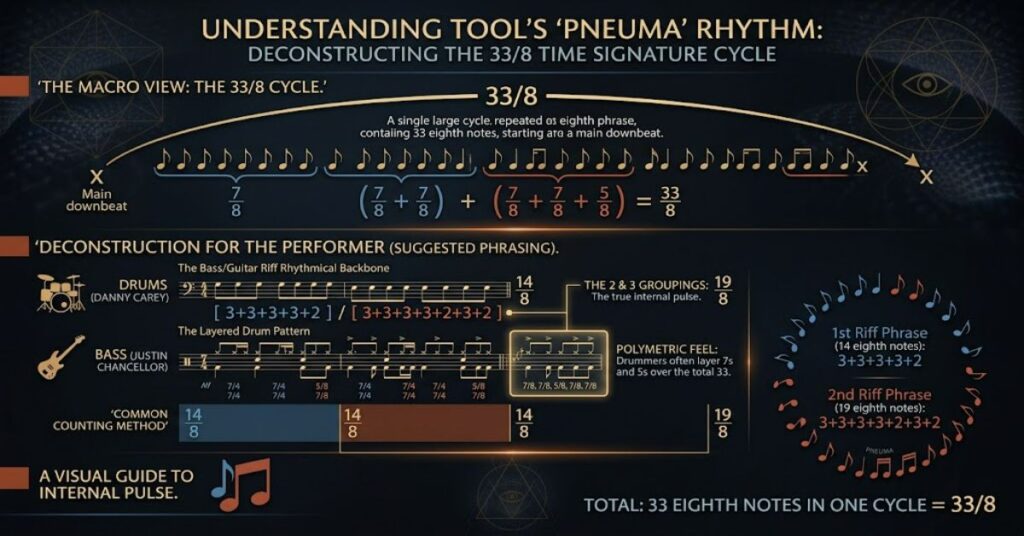
If you are asking, what time signature is Pneuma?, the short answer is that the song is famous for a complex rhythmic cycle often described as 33/8. However, that number alone does not tell the full story.
“Pneuma,” by the band Tool, uses shifting and layered rhythmic patterns that make the music feel both controlled and unpredictable. The keyword detail supplied for this article identifies the main riff with a 33/8 cycle and explains that musicians often break the larger pattern into smaller groups involving 6/8 and 5/8.
This is important because few musicians would naturally sit down and count, “one, two, three,” all the way to 33 every time the riff repeats. The rhythm becomes more manageable when understood as a collection of smaller patterns.
That is one reason “Pneuma” has become such a popular topic among drummers, guitarists, bassists and music theory enthusiasts. The challenge is not simply the unusual number. It is learning how the internal groupings create a groove.
What Does 33/8 Actually Mean?
A time signature tells musicians how musical time is organised.
In 33/8, the top number represents 33 eighth-note units within the complete cycle, while the lower number indicates the eighth note as the basic unit being counted.
At first glance, 33/8 can look almost impossible to perform. But complex metres are often easier to understand when they are divided into smaller pieces.
For example:
| Time Structure | How It Feels |
| 4/4 | Regular and familiar |
| 6/8 | Rolling, compound pulse |
| 5/8 | Uneven, asymmetrical grouping |
| 33/8 | A long cycle built from smaller rhythmic ideas |
The important idea is that 33/8 does not necessarily feel like one giant block of 33. Musicians can identify recurring accents and subdivisions that make the pattern physically playable.
Breaking 33/8 Into Smaller Groups
The supplied keyword detail highlights 6/8 and 5/8 as useful smaller patterns within the larger cycle.
This approach is common when learning complex rhythm. Instead of treating the entire phrase as one intimidating number, a musician can learn the individual pieces and then connect them.
Imagine trying to memorise a 33-digit number in one attempt. It would be difficult. If you divided it into smaller groups, it would become easier to remember.
Rhythm works in a similar way.
A performer may learn a repeating group of six, followed by a group of five, and then continue following the larger structure. The exact feel depends on the arrangement and musical part, which is why listening closely is essential.
Why Does Pneuma Sound So Unusual?
The unusual feeling comes from the relationship between repetition and change.
Your ear may recognise a familiar groove, but the accents do not always return where you expect them to. This creates tension without making the music sound random.
Tool frequently uses rhythmic displacement, extended cycles and layered patterns. The result is music that rewards repeated listening.
A listener may initially hear “Pneuma” as a powerful progressive metal track. After focusing on the drums or guitar, the internal structure becomes more noticeable.
That is part of the song’s appeal. The rhythm can be experienced instinctively before it is analysed intellectually.
The Difference Between Counting and Feeling the Rhythm
One of the biggest mistakes when learning an unusual time signature is trying to calculate every beat while performing.
Counting is useful during practice. Eventually, however, the rhythm needs to become internalised.
| Learning Stage | Main Focus |
| First listen | Identify the repeating pulse |
| Slow practice | Count smaller rhythmic groups |
| Repetition | Connect the groups smoothly |
| Performance | Feel the groove rather than calculate constantly |
This process is especially important when dealing with long rhythmic cycles. A musician who understands the grouping can perform with more confidence than someone who only remembers the number 33.
Why Tool’s Rhythms Interest Musicians
Tool has developed a reputation for music that challenges conventional expectations.
Complex rhythm can easily become mechanical if it exists only to show technical ability. The stronger approach is to make unusual structures serve the song.
That is why the rhythm in “Pneuma” attracts so much attention. The complexity is part of the musical identity rather than an isolated technical exercise.
Drummers may focus on the relationship between pulse and accent. Guitarists may study how riffs repeat against other instruments. Bass players may examine where the groove connects the rhythm section.
Each perspective can reveal something different.
Is Pneuma Really in Only One Time Signature?
Not exactly.
When people ask what time signature is Pneuma, they often want a single number. The 33/8 description is useful for understanding the famous extended rhythmic cycle, but the song contains changing rhythmic material and should not be reduced to one number from beginning to end.
This is an important distinction.
A piece of music can contain several metres, phrase lengths or overlapping rhythmic ideas. Describing one major cycle does not mean every section follows precisely the same structure.
For this reason, musicians should use time-signature labels as tools for understanding rather than treating them as the entire explanation.
How to Practise the Pneuma Rhythm
The best approach is patience.
Start by listening to a short section repeatedly. Do not immediately attempt to play at full speed.
Step 1: Find the Pulse
Listen for the strongest repeated accents. Tap along without worrying about the full 33/8 count.
Step 2: Identify Smaller Groups
Break the phrase into manageable sections. The 6/8 and 5/8 groupings mentioned in the supplied keyword detail provide a useful starting point.
Step 3: Practise Slowly
Play the individual groups separately before joining them together.
Step 4: Increase Speed Gradually
Accuracy matters more than speed. A complex rhythm played slowly and correctly is more useful than a fast but unstable performance.
The Future of Complex Rhythm in 2027
By 2027, complex rhythm is likely to remain an important part of progressive metal, experimental rock and online music education.
Digital tools have made slow-down practice, visual rhythm analysis and isolated instrument study more accessible to musicians. However, technology cannot replace the physical process of internalising a rhythm.
The growing popularity of rhythm-focused educational content may also make unusual metres less intimidating. Musicians can now find explanations of polyrhythms, odd metres and phrase grouping more easily than in previous decades.
Still, the central challenge remains the same: understanding is only the first step. The rhythm must eventually be felt.
Key Takeaways
- “Pneuma” is widely discussed in relation to a 33/8 rhythmic cycle.
- The large cycle can be understood through smaller rhythmic groupings.
- 6/8 and 5/8 provide useful reference points for breaking down the pattern.
- Complex rhythm becomes easier when musicians focus on accents and phrases.
- Counting helps during practice, but internalising the groove matters during performance.
- The song should not be reduced to a single time signature for every section.
Conclusion
So, what time signature is Pneuma? The most useful answer is that its famous rhythmic cycle is commonly described as 33/8, with musicians often breaking that larger structure into smaller groupings to make it easier to understand and perform.
The number itself is impressive, but the real musical lesson lies in how complex rhythm can still create a powerful groove. “Pneuma” demonstrates that an unusual metre does not have to sound mathematical or disconnected from emotion.
For musicians, the best way to approach the song is to move beyond the intimidating number. Listen for the pulse, identify the smaller groups, practise slowly and allow the pattern to become familiar.
Once the internal structure starts to make sense, the rhythm becomes less about counting to 33 and more about understanding how smaller ideas work together.
FAQ
What time signature is the main riff in Pneuma?
The main rhythmic cycle is commonly associated with 33/8, although the music is best understood through smaller internal groupings rather than one uninterrupted count to 33.
Is Pneuma entirely in 33/8?
No. The song contains changing rhythmic ideas, so 33/8 is most useful as a description of a prominent extended cycle rather than the entire composition.
Why is 33/8 difficult to count?
Counting 33 individual eighth notes can be mentally demanding. Musicians usually make the rhythm easier by dividing it into smaller patterns and following the accents.
How can I learn the Pneuma rhythm?
Start slowly, listen for the pulse, identify smaller rhythmic groups and practise each section separately before combining them.
Why does Tool use complex time signatures?
Complex metres can create tension, movement and unusual grooves. In Tool’s music, these rhythmic structures are an important part of the band’s musical identity.
Methodology
This article is based on the supplied Postcard.fm editorial brief and its keyword detail, which identifies “Pneuma” as a Tool track associated with a 33/8 rhythmic cycle and explains the use of smaller groupings such as 6/8 and 5/8 to understand the pattern. The article follows the requested structure and SEO requirements while avoiding fabricated interviews, testing claims or unsupported firsthand observations. The source brief also requires balanced analysis and transparent methodology.