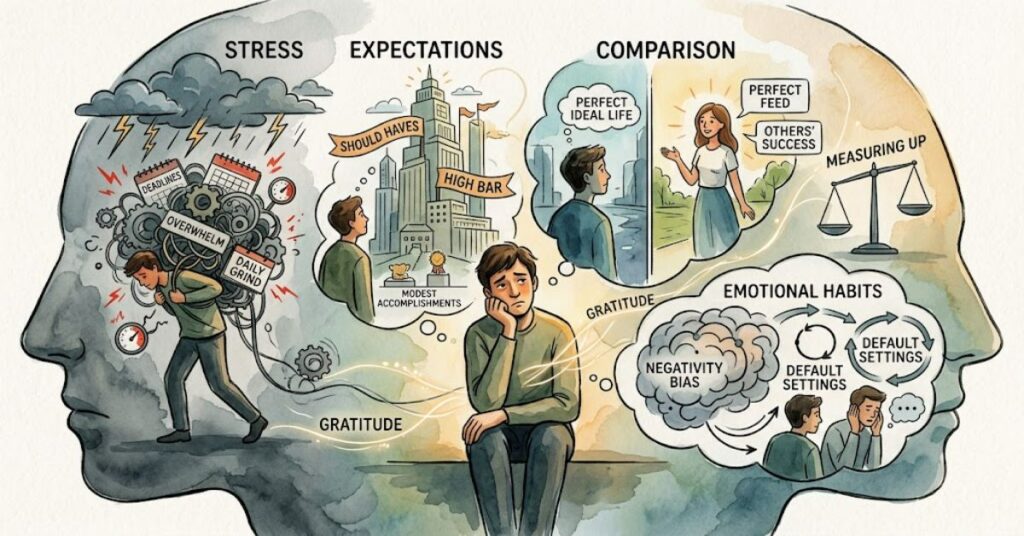
If you regularly ask yourself, “Why am I so ungrateful?”, start with this: feeling dissatisfied does not automatically mean you are selfish, spoiled or a bad person. The feeling may be a sign that your expectations are out of sync with reality, that you are emotionally tired, or that stress has narrowed your attention towards what is missing.
The keyword detail for this article frames ungratefulness as a possible mental habit, defence mechanism or response to feeling tired, stressed or disconnected from yourself.
Many people assume gratitude should appear naturally when life is going reasonably well. In practice, the human mind does not always work that way. You can have supportive people, opportunities and basic security while still feeling frustrated or empty. You may focus intensely on the one thing you do not have while barely noticing ten things that are working.
That does not mean your struggles are imaginary. It means dissatisfaction and gratitude can exist at the same time.
Understanding the cause of the feeling is usually more useful than blaming yourself for it.
Your Expectations May Be Out of Sync With Reality
One of the most common reasons people feel constantly dissatisfied is the gap between expectation and reality.
You may have imagined that reaching a certain age would bring financial security, confidence, a successful career or a stable relationship. When life does not match that picture, disappointment can take over.
| Expectation | Reality | Possible Emotional Response |
| “I should be further ahead” | Progress has been slower | Frustration |
| “I should feel happier” | Stress continues | Guilt or disappointment |
| “Others have better lives” | You see only part of their lives | Envy |
| “Success will solve everything” | New problems appear | Dissatisfaction |
The problem is not always ambition. Expectations become harmful when they turn every ordinary difficulty into evidence that life is failing.
A more balanced question is: What did I expect, and where did that expectation come from?
Sometimes the answer comes from family pressure. Sometimes it comes from social media, cultural ideas about success or comparing yourself with people whose circumstances are completely different.
Stress Can Make Gratitude Harder
When you are stressed, your mind often focuses on problems that need attention. This can be useful in a genuine emergency, but constant stress can create a habit of scanning for what is wrong.
You may become impatient with people you care about. Small inconveniences may feel overwhelming. Things that once made you happy may barely register.
This is one reason the question “Why am I so ungrateful?” should not always be answered with self-criticism. Sometimes you are not failing at gratitude. You may simply be exhausted.
| Emotional State | How It Can Affect Perspective |
| Chronic stress | Attention stays focused on problems |
| Exhaustion | Positive experiences feel less noticeable |
| Frustration | Small disappointments feel larger |
| Comparison | Other people’s lives appear better |
| Disconnection | Life can feel empty or automatic |
Before forcing yourself to “be more grateful”, it can help to ask whether you are getting enough rest, emotional space and time away from constant pressure.
Comparison Can Create a False Sense of Lack
Modern comparison is relentless.
In the past, people mainly compared themselves with family members, neighbours or colleagues. Today, you can compare your appearance, income, home, relationships and lifestyle with thousands of carefully selected images every day.
The problem is that you are usually comparing your complete reality with someone else’s highlight reel.
That comparison can make a perfectly ordinary life feel inadequate. You may stop appreciating what you have because your attention is constantly pulled towards what someone else appears to have.
Reducing comparison does not mean pretending ambition is bad. It means recognising that someone else’s success does not automatically prove that your life is unsuccessful.
Ungratefulness Can Become a Mental Habit
Repeated thoughts can become familiar patterns.
If you regularly think, “This is not enough,” your brain may begin to apply that judgement to almost everything. A new job is not good enough. A relationship is not good enough. A holiday is not exciting enough.
The issue may not be the individual situations. The issue may be the filter through which you view them.
This does not mean you should accept poor treatment or stop wanting improvement. Healthy dissatisfaction can motivate change. The difference lies in whether dissatisfaction helps you act or simply keeps you permanently unhappy.
The Difference Between Gratitude and Pretending
Gratitude is often misunderstood as forced positivity.
Real gratitude does not require statements such as, “Everything happens for a reason,” or, “Other people have it worse, so I should not complain.”
Those ideas can actually create more guilt.
A person can be grateful for supportive friends while struggling with work. Someone can appreciate their home while worrying about money. You can recognise something positive without denying something painful.
This balanced approach is more sustainable because it does not demand emotional dishonesty.
Practical Ways to Feel More Grounded
If you want to change the pattern, start small.
Notice What Is Already Working
At the end of the day, identify one or two things that went reasonably well. They do not need to be extraordinary.
A productive conversation, a good meal or a moment of peace can be enough.
Challenge Automatic Comparisons
When you notice envy, ask what information you are missing. You rarely see another person’s full financial situation, private struggles or daily frustrations.
Separate Wants From Needs
Wanting more money, success or recognition is not automatically wrong. But treating every unmet desire as a personal failure can create permanent dissatisfaction.
Give Yourself Time to Recover
Exhaustion can distort perspective. Rest will not solve every problem, but it can make problems easier to evaluate.
When the Feeling Points to Something Deeper
Sometimes persistent emptiness, guilt or inability to enjoy positive experiences may suggest that something deeper needs attention.
If your dissatisfaction is affecting relationships, work or daily functioning, speaking with a qualified mental health professional may be helpful. The goal is not to receive a label for being “ungrateful”. It is to understand the emotional patterns behind the feeling.
Self-awareness is often more productive than self-punishment.
The Future of Understanding Ungratefulness in 2027
By 2027, conversations about wellbeing are likely to continue moving away from simplistic positivity towards a broader understanding of emotional health.
People are becoming more aware that burnout, comparison and constant digital stimulation can affect how they experience daily life. The useful direction is likely to be balance rather than perfection.
Gratitude practices may remain popular, but their greatest value will come when they are used alongside realistic self-reflection. Writing down positive experiences will not fix structural problems, financial stress or unhealthy relationships. However, it may help people recognise when their minds have become trained to notice only what is missing.
The future of emotional wellbeing will probably involve a more nuanced question than simply, “Am I grateful enough?” It may instead ask, “What is shaping the way I see my life?”
Key Takeaways
- Feeling ungrateful does not automatically make you a bad person.
- Unrealistic expectations can create a constant sense of disappointment.
- Stress and exhaustion can make positive experiences harder to notice.
- Social comparison often creates a distorted picture of other people’s lives.
- Gratitude and dissatisfaction can exist at the same time.
- Small changes in attention and self-reflection can help break negative mental habits.
Conclusion
If you keep wondering, “Why am I so ungrateful?”, try replacing judgement with curiosity. The feeling may be connected to stress, exhaustion, comparison, disappointment or expectations that no longer match your reality.
Gratitude is not about ignoring problems or forcing yourself to feel happy. It is about developing a more complete perspective. You can acknowledge what is painful while also recognising what is supportive, meaningful or stable in your life.
The goal is not to become endlessly satisfied. No one is. The healthier goal is to understand when dissatisfaction is helping you grow and when it has become an automatic way of viewing everything around you.
With reflection, rest and honest attention to your emotional needs, it is possible to become more appreciative without becoming passive or pretending that life has no difficulties.
FAQ
Why do I feel so ungrateful all the time?
Persistent feelings of ungratefulness may be connected to stress, unrealistic expectations, emotional exhaustion or a habit of focusing on what is missing.
Does being ungrateful mean I am a bad person?
No. Feeling dissatisfied does not define your character. The important step is understanding why the feeling keeps appearing.
Can stress make me less grateful?
Yes. When you are overwhelmed or exhausted, your attention may become focused on problems and unmet needs rather than positive experiences.
How can I stop comparing myself to others?
Reduce unnecessary comparison, question what you actually know about another person’s life and focus on goals that reflect your own values.
Is it normal to want more while still being grateful?
Yes. Gratitude does not require giving up ambition. You can appreciate your current situation while working towards meaningful change.
Methodology
This article Why am I so ungrateful was written from the supplied editorial brief, which defines the core keyword and frames the topic around expectations, stress, emotional habits and disconnection. The article follows the requested SEO and structural requirements while avoiding fabricated personal experiences, interviews or research findings. The source brief also requires a clear methodology, balanced analysis and verified sourcing before publication.