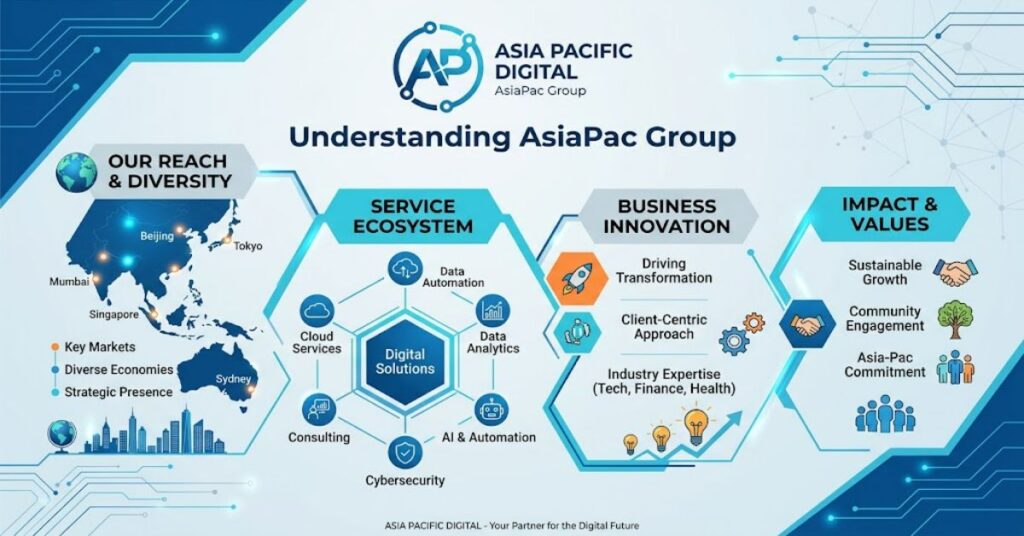
Asia Pacific Digital is a term that can describe the region’s growing digital economy, but it is also closely associated with AsiaPac Group, a Hong Kong-based digital marketing and advertising technology company. The business has developed from a traditional digital marketing operation into a broader technology-supported organisation offering services across multiple Asia-Pacific markets.
The importance of this model lies in the complexity of the region itself. Asia-Pacific is not one unified digital marketplace. Businesses operating across Hong Kong, Japan, Singapore, Indonesia, South Korea and other markets face different languages, consumer habits, platforms and regulatory environments.
This creates a challenge for international brands. A campaign cannot always be copied from one market to another without adjustment. Search behaviour may differ, preferred social platforms can change, and advertising messages that work in one country may not connect with audiences elsewhere.
AsiaPac Group’s approach combines regional marketing services with advertising technology and AI-focused software. This allows the company to support areas such as search marketing, social media, influencer campaigns, programmatic advertising and digital content.
The broader significance of Asia Pacific Digital is therefore about more than one company. It reflects a wider industry movement towards combining creative marketing with data, automation and technology. The challenge is ensuring that efficiency does not replace local understanding.
What Does AsiaPac Group Do?
AsiaPac Group operates within the digital marketing and advertising technology sector. Its services are designed to help businesses reach consumers through different online channels.
These services include search engine optimisation, search engine marketing, social media campaigns, influencer marketing, creative content and programmatic advertising. The company has also developed technology tools intended to support advertising optimisation and marketing workflows.
The company’s development demonstrates how the digital agency model has changed. In the past, agencies were often divided between creative work and media buying. Today, data platforms, automation tools and artificial intelligence are becoming increasingly connected to campaign management.
| Area | Primary Function | Business Value |
| SEO | Improving search visibility | Supports long-term organic reach |
| Paid advertising | Reaching targeted audiences | Can generate immediate traffic |
| Social media | Building audience engagement | Supports brand awareness |
| Influencer marketing | Working with online creators | Can improve local relevance |
| Programmatic advertising | Automated media buying | Supports campaign scale |
| AI tools | Assisting marketing workflows | May improve operational efficiency |
Why Asia-Pacific Requires a Different Marketing Strategy
One of the biggest mistakes in regional digital marketing is treating Asia-Pacific as a single audience.
The region includes highly developed digital economies alongside fast-growing emerging markets. Consumer expectations, internet infrastructure and platform preferences vary considerably.
This creates a practical tension between centralisation and localisation. A business may want one regional strategy to reduce costs and maintain a consistent brand identity. However, local teams may need flexibility to adapt campaigns to specific markets.
This is one of the strongest arguments for combining technology with local expertise. Centralised dashboards and shared advertising systems can improve efficiency, while local specialists can interpret cultural context and audience behaviour.
The quarter-by-quarter performance of a regional campaign may also vary significantly. A strong overall result can hide poor performance in one specific market. Businesses therefore need market-level measurement rather than relying only on regional totals.
The Role of AI in Digital Marketing
Artificial intelligence has become an increasingly important part of advertising technology. AI tools can assist with content production, campaign optimisation, audience analysis and workflow automation.
AsiaPac Group has expanded into proprietary AI-supported software as part of its technology strategy. This reflects a wider change in the industry, where agencies are becoming technology providers as well as service businesses.
However, AI has limitations.
Automation can improve speed, but it cannot automatically understand cultural nuance or business strategy. A campaign may be technically efficient while still failing to connect with its intended audience.
There are also concerns around data governance, transparency and brand safety. Businesses using automated systems need to understand how campaign decisions are made and how performance data is managed.
| Technology Benefit | Potential Risk |
| Faster campaign management | Reduced human oversight |
| Automated optimisation | Limited transparency |
| Scalable content workflows | Quality inconsistencies |
| Improved data analysis | Privacy concerns |
| Lower manual workload | Overdependence on software |
The Business Value of Regional Scale
Operating across multiple markets can provide an important advantage. Businesses expanding internationally often face the difficulty of managing separate agencies, technology providers and reporting systems.
A regional marketing partner can potentially simplify that process. Shared infrastructure may make reporting easier and help maintain consistency across campaigns.
However, scale also creates complexity. More markets mean more regulations, languages and audience segments.
The most effective strategy is usually not complete centralisation. Instead, it involves a common framework combined with local flexibility. Brand standards, measurement systems and technology can be shared, while creative messaging and media selection can be adapted to individual markets.
This balance may become even more important as digital platforms continue to change.
The Future of Asia Pacific Digital in 2027
By 2027, artificial intelligence is likely to play a larger role in marketing operations across Asia-Pacific. Content production, advertising optimisation and customer analysis are all likely to become more automated.
However, complete automation remains unlikely.
The region’s diversity will continue to create a need for local expertise. Language differences, cultural expectations and national regulations cannot always be managed through one central system.
Privacy and data regulation may also become more significant. As companies collect and analyse larger amounts of consumer information, businesses will need stronger governance and clearer accountability.
The future of Asia Pacific Digital may therefore depend on balance. Companies that combine efficient technology with experienced local teams could be better positioned than those relying entirely on either automation or traditional agency structures.
Key Takeaways
- Asia Pacific Digital is associated with the growing relationship between regional marketing, advertising technology and AI.
- AsiaPac Group represents a model that combines marketing services with technology-based tools.
- Asia-Pacific should not be treated as one uniform digital market.
- Localisation remains essential for effective cross-border campaigns.
- AI can improve marketing workflows but cannot replace strategic and cultural understanding.
- Data governance and transparent measurement will remain important challenges.
Conclusion
Asia Pacific Digital represents a broader change in the way marketing organisations operate across international markets. AsiaPac Group illustrates this development by combining traditional digital marketing services with advertising technology and AI-supported tools.
The company’s regional approach also highlights one of the most important realities of Asia-Pacific marketing: scale and localisation must work together. A business may use common technology and shared reporting systems, but successful campaigns still depend on understanding individual markets.
Artificial intelligence is likely to become more deeply integrated into marketing workflows, particularly in campaign management, content production and data analysis. Yet technology alone is not enough. Strong strategy still requires human judgement, cultural awareness and careful measurement.
As digital advertising becomes more connected across search, social media, influencer activity and automated media buying, businesses will need partners capable of managing both technology and market complexity. That combination is likely to remain central to the development of the Asia-Pacific digital sector.
FAQ
What is Asia Pacific Digital?
Asia Pacific Digital can refer broadly to digital business and marketing activity across the Asia-Pacific region. It is also associated with AsiaPac Group, a Hong Kong-based digital marketing and advertising technology company.
What does AsiaPac Group do?
AsiaPac Group provides digital marketing and advertising technology services. Its activities include search marketing, social media, influencer campaigns, creative content, programmatic advertising and AI-supported marketing tools.
Why is localisation important in Asia-Pacific marketing?
Asia-Pacific includes many different languages, cultures, consumer behaviours and digital platforms. A campaign designed for one market may need significant changes before it is suitable for another.
Does Asia Pacific Digital involve artificial intelligence?
Yes. AI is becoming increasingly important in digital marketing through automation, content support, campaign optimisation and data analysis. However, human oversight remains necessary.
What are the risks of automated digital advertising?
Potential risks include privacy concerns, limited transparency, inaccurate targeting, poor-quality automated content and excessive dependence on technology without sufficient human review.
Methodology
This article is based on publicly available information about AsiaPac Group and broader developments in digital marketing, advertising technology and AI-supported business systems. The analysis focuses on the practical relationship between regional scale, technology and localisation.
No independent testing of AsiaPac Group’s products or services was conducted for this article. Company-specific information should therefore be independently verified before publication. The analysis also recognises that digital marketing performance varies according to industry, campaign objectives, budget, local regulations and audience behaviour.
References
AsiaPac Group. (2026). Corporate information and digital marketing technology services. AsiaPac Group.
U.S. Securities and Exchange Commission. (2026). Corporate registration and company information relating to AsiaPac AdTechinno Group Limited. U.S. Securities and Exchange Commission.
International Telecommunication Union. (2024). Facts and figures: Digital connectivity and information technology trends. International Telecommunication Union.