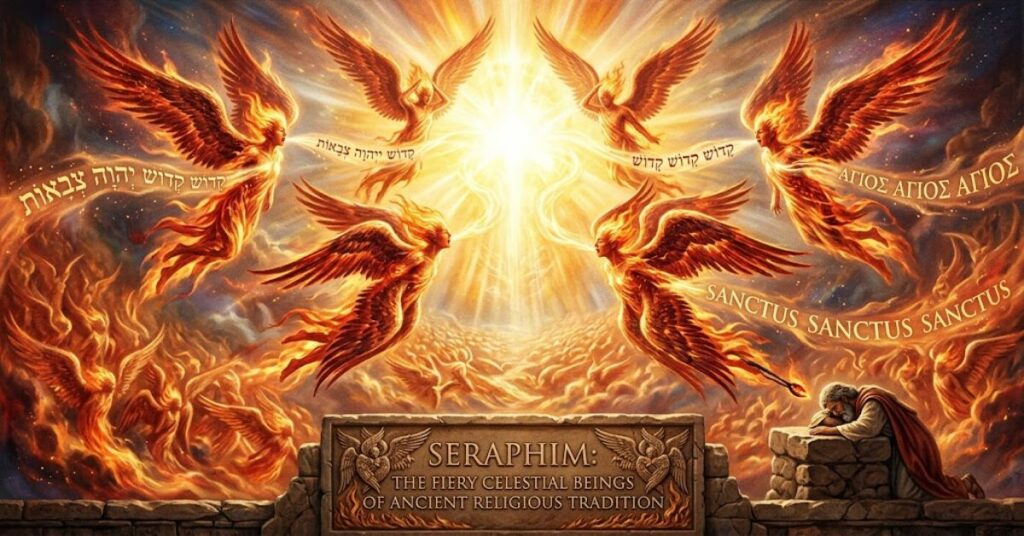
Seraphim are among the most mysterious celestial beings described in ancient religious literature. The name is generally connected with the Hebrew term seraph, associated with burning or fiery imagery. In Isaiah 6, the prophet describes a vision of God enthroned while winged beings stand above Him, proclaiming His holiness. These beings have six wings and perform a striking act of purification when one carries a burning coal from the altar to Isaiah.
The biblical account is the most important early source for understanding seraphim. It presents them not simply as decorative angels but as powerful beings connected with the divine presence, worship, and purification. Later Christian angelology placed seraphim at the highest level of a ninefold celestial hierarchy, associating them with love, light, holiness, and spiritual fire. However, that later hierarchy should not be confused with what the Hebrew Bible itself explicitly says.
Their story is therefore more complex than the familiar image of an angel with six wings. The development of the concept shows how religious communities interpreted ancient imagery and gave it new theological meaning over many centuries.
Where Do Seraphim Appear in Ancient Scripture?
The clearest description appears in Isaiah 6:1–7. Isaiah describes seeing the Lord seated on a high throne, with the seraphim above Him. Each being has six wings.
Their wings have distinct functions. One pair covers the face, another covers the feet, and the remaining pair is used for flight. They call to one another in praise of God’s holiness. The scene is accompanied by dramatic imagery: the thresholds shake and the house fills with smoke.
This description is unusual because the seraphim are not introduced through a long explanation. Isaiah simply encounters them as part of his heavenly vision. Scholars have therefore suggested that the imagery may reflect older traditions about winged divine attendants in the ancient Near East.
The passage also makes their role especially important. A seraph takes a burning coal from the altar and touches Isaiah’s lips. The action symbolises purification and prepares Isaiah for his prophetic mission.
What Does the Name Seraphim Mean?
The traditional explanation connects the word with a Hebrew root associated with burning. This is why translations and theological discussions often describe the seraphim as “burning ones” or “fiery ones.”
There is an important complication, however. The Hebrew term seraph also appears in other biblical passages referring to serpents or snake-like creatures. Encyclopaedia Judaica distinguishes these references from the winged beings in Isaiah 6.
That distinction matters because it prevents readers from assuming that every biblical use of seraph refers to an angel. The word has a broader history, while Isaiah’s vision uses it for a particular type of heavenly being.
What Do Seraphim Look Like?
The best-known physical description comes directly from Isaiah. Each seraph has six wings.
| Feature | Description | Symbolic association |
| Six wings | Three pairs of wings | Majesty and heavenly otherness |
| Covered face | One pair conceals the face | Reverence before divine holiness |
| Covered feet | One pair covers the feet | Humility and modesty |
| Flying | One pair supports flight | Service in the heavenly realm |
| Fiery coal | Used in Isaiah’s purification | Cleansing and preparation |
Modern illustrations often turn seraphim into conventional winged angels. Yet the biblical image is more unusual. The six-winged form makes them distinct from the familiar human-shaped angel of popular culture.
Their appearance also communicates a theological message. They are close to the divine throne, but even they cover themselves in the presence of God.
What Is the Role of Seraphim?
The first major role of these beings is worship. Their proclamation of divine holiness is central to the Isaiah vision. Their worship is not presented as casual praise; it accompanies the revelation of God’s overwhelming presence.
A second role is purification. The seraph who carries the burning coal performs an action that changes Isaiah’s condition before he receives his prophetic commission.
A third role is participation in the heavenly court. Isaiah’s vision places these beings around the divine throne, making them part of the celestial setting surrounding God. Jewish traditions later developed rich ideas about heavenly beings and angelic praise, with the seraphim becoming particularly important in liturgical traditions.
Seraphim and the Angelic Hierarchy
The idea that seraphim are the highest-ranking angels is mainly associated with later Christian theological development rather than the brief biblical description itself.
Traditional Christian angelology eventually organised heavenly beings into nine orders, with seraphim occupying the highest order. They became associated with divine love, spiritual fire, purity, and constant worship.
This later interpretation helped shape Western religious art. Seraphim were frequently represented with six wings, sometimes surrounding or supporting symbolic representations of the divine presence.
| Tradition or source | Main emphasis |
| Isaiah 6 | Six-winged heavenly beings and divine worship |
| Jewish interpretation | Heavenly attendants and liturgical praise |
| Early Christian interpretation | Angelic beings associated with holiness |
| Medieval Christian angelology | Highest celestial order |
| Modern popular culture | Fiery or powerful supernatural beings |
The development demonstrates how a short ancient description can acquire a much larger symbolic framework over time.
Seraphim in Jewish Religious Tradition
Jewish tradition continued to engage with the heavenly beings described by Isaiah. The seraphim became associated with angelic praise, particularly through the liturgical use of the holiness declaration known as the Kedushah.
Historical sources connect the Kedushah with the song of the seraphim in Isaiah 6. This helped preserve the imagery beyond the original prophetic vision and gave it an ongoing place in Jewish worship.
This is an important cultural development because it shows that the concept was not merely preserved as an ancient story. It became part of religious practice.
Seraphim in Christianity
Christian traditions inherited Isaiah’s imagery and expanded its theological significance. Early Christian writers interpreted the seraphim as angels, and later theological systems placed them at the summit of the celestial hierarchy.
The association with divine fire became especially influential. Fire could represent God’s presence, purification, love, illumination, and spiritual transformation.
This symbolism explains why the seraphim became popular in Christian art and theological writing. They could represent beings whose entire existence was directed towards the divine.
Seraphim and Cultural Interpretation
The continuing fascination with seraphim comes partly from their unusual combination of beauty and fear. They are not ordinary human figures with wings. Their six wings, fire imagery, heavenly position, and connection with purification create an image that feels both majestic and unsettling.
A useful way to understand their cultural impact is to separate three layers:
- Biblical layer: A specific heavenly vision in Isaiah.
- Theological layer: Later interpretations that classify them as high-ranking angels.
- Cultural layer: Artistic and popular representations that transform the imagery into familiar supernatural figures.
Confusing these layers can lead to inaccurate claims about what ancient texts actually say.
The Future of Seraphim in 2027
The cultural meaning of seraphim is likely to remain relevant in 2027 because ancient religious imagery continues to influence literature, visual art, games, film, fantasy, and digital culture.
The strongest future interpretations will probably distinguish historical sources from modern invention. Digital artists and storytellers can reinterpret six-winged celestial beings in new ways while still acknowledging the Isaiah tradition that provides their foundational imagery.
The key limitation is historical accuracy. Modern depictions may be visually impressive, but they should not automatically be presented as descriptions found in ancient scripture.
Key Takeaways
- Seraphim are most clearly described in Isaiah 6.
- They are portrayed with six wings and stand in the presence of the divine throne.
- Their name is traditionally connected with burning or fiery imagery.
- Their biblical role includes worship and the purification of Isaiah.
- Later Christianity developed the concept of seraphim as the highest angelic order.
- Jewish liturgical traditions preserved their association with heavenly praise.
- Modern depictions often combine ancient imagery with later artistic interpretation.
Conclusion
Seraphim occupy a distinctive place in the history of religious imagination. Their earliest and clearest description is not a general catalogue of angels but a dramatic vision in Isaiah 6. Six-winged beings stand near the divine throne, proclaim holiness, and participate in the purification of the prophet.
Over subsequent centuries, Jewish and Christian traditions expanded the meaning of these beings. Their association with fire developed into symbolism involving purity, divine love, illumination, and spiritual transformation. Christian angelology eventually placed them at the highest level of the celestial hierarchy.
Understanding that development helps separate the ancient source from later interpretation. The seraphim of Isaiah are mysterious heavenly attendants; the familiar image of the supreme angelic order is largely the product of later theological tradition. That distinction is what makes their history especially interesting.
Frequently Asked Questions
What are seraphim?
Seraphim are heavenly beings described in Isaiah 6. They have six wings and appear in a vision of God seated upon a throne.
What does seraphim mean?
The term is traditionally connected with a Hebrew root meaning “to burn,” which is why seraphim are often described as “burning ones” or “fiery ones.”
How many wings do seraphim have?
The seraphim described in Isaiah 6 have six wings arranged in three pairs.
Are seraphim the highest angels?
In traditional Christian angelology, seraphim are considered the highest of nine celestial orders. This classification developed later than the biblical description.
Are seraphim mentioned in Islam?
The specific Isaiah tradition of seraphim belongs to Jewish and Christian scriptural traditions. Islamic angelology has its own terminology and traditions, so the biblical seraphim should not automatically be equated with Islamic angelic beings.
What did the seraphim do to Isaiah?
One seraph took a burning coal from the altar and touched Isaiah’s lips, symbolising purification before Isaiah began his prophetic mission.
Why do seraphim have six wings?
Isaiah’s vision specifically describes six wings. The passage associates them with covering themselves and flying, while later interpretations developed additional symbolic meanings.
Methodology
This article is based on the supplied editorial brief and verified reference material concerning the biblical and historical interpretation of seraphim. The central description is grounded in Isaiah 6 and reference works discussing Hebrew terminology, Jewish interpretation, and Christian angelology. Claims about later theological development are distinguished from the biblical description rather than presented as identical traditions.
The analysis does not claim firsthand observation or original field research. Religious interpretation also varies between traditions, so broad claims about Judaism, Christianity, or Islam should be read within their specific historical contexts. A human editor should independently verify all references and quotations before publication, as required by the supplied Postcard.fm editorial guidelines.
References
Encyclopaedia Judaica. (2018). Seraph. Encyclopedia.com.
Encyclopaedia Judaica. (2018). Angels and angelology. Encyclopedia.com.
Encyclopaedia Judaica. (2018). Song, angelic. Encyclopedia.com.
Encyclopaedia Judaica. (2018). Kiddush Ha-Shem and Hillul Ha-Shem. Encyclopedia.com.