
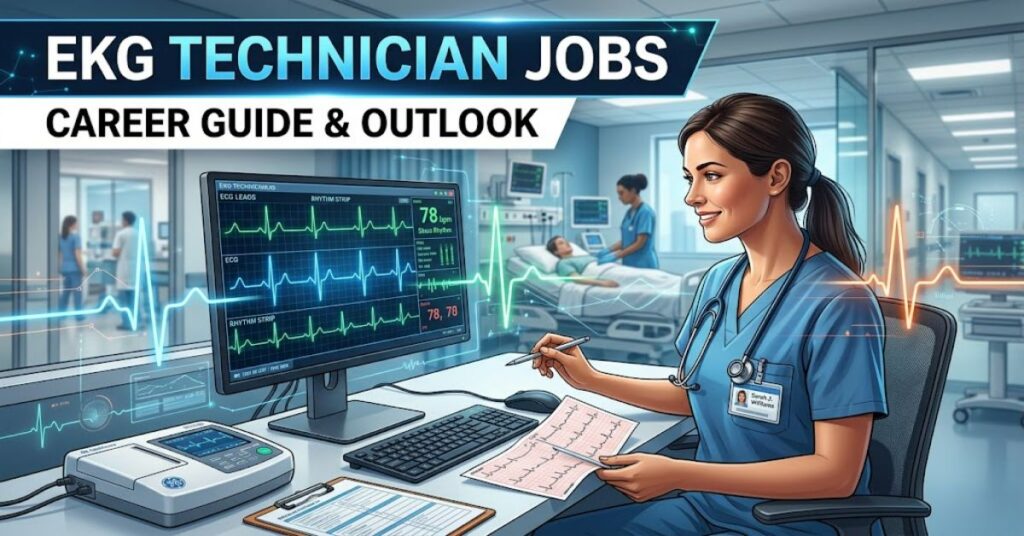
EKG technician jobs are healthcare positions focused on recording the heart’s electrical activity using electrocardiography equipment. An EKG, also called an ECG, is a non-invasive test that records electrical signals from the heart through electrodes placed on the patient’s skin. The resulting tracing can help clinicians evaluate heart rate and rhythm and identify patterns that require further medical assessment.
For people considering an allied-health career, the role can be attractive because the entry pathway may be shorter than that of many other clinical professions. The U.S. Bureau of Labor Statistics (BLS) states that EKG technicians may qualify for entry-level work with a high school diploma or equivalent, while certificate programmes can generally be completed in less than a year.
The work is more than attaching electrodes and pressing a button. Technicians must prepare patients, position electrodes correctly, operate equipment, check recordings for quality and communicate effectively with clinical staff. Errors in preparation or electrode placement can affect the quality of a tracing, making attention to detail essential.
What Does an EKG Technician Do?
An EKG technician supports physicians and other healthcare professionals by obtaining cardiovascular recordings. Typical responsibilities can include:
- Preparing patients and explaining the procedure.
- Positioning electrodes correctly.
- Operating electrocardiography equipment.
- Obtaining standard 12-lead EKG recordings.
- Checking tracings for technical quality.
- Preparing results for physician review.
- Supporting Holter or ambulatory monitoring.
- Assisting with stress testing where trained and authorised.
The National Healthcareer Association (NHA) describes EKG technician duties as including EKGs, stress tests, Holter or ambulatory monitoring and delivering test results to physicians for analysis.
Importantly, technicians generally support the diagnostic process rather than replacing the physician’s clinical diagnosis.
EKG Technician Jobs Compared With Related Roles
| Role | Main Focus | Typical Entry Path |
| EKG technician | Electrocardiograms and cardiac monitoring | Diploma/certificate and practical training |
| Cardiovascular technician | Broader cardiovascular testing | Often associate degree or specialised training |
| Medical assistant | Clinical and administrative support | Certificate or associate programme |
| Phlebotomy technician | Blood collection | Short-term training/certification |
The distinction matters when searching vacancies. Some employers advertise specifically for EKG technicians, while others place the duties within broader cardiovascular technician or patient-care positions.
Skills Employers Look For
Strong candidates combine technical accuracy with patient-facing skills. BLS identifies communication, attention to detail, interpersonal ability, physical stamina and technical competence as important qualities for cardiovascular technologists and technicians.
A useful skills profile includes:
| Skill | Why It Matters |
| Electrode placement | Helps produce technically useful recordings |
| Patient communication | Reduces anxiety and improves cooperation |
| Medical terminology | Supports communication with clinical teams |
| Equipment operation | Ensures tests are performed correctly |
| Documentation | Maintains accurate patient records |
| Infection-control awareness | Supports safe clinical practice |
One practical insight is that technical competence alone may not make a candidate competitive. Patient interaction is part of the job. A technician may work with people who are frightened, uncomfortable or experiencing symptoms, so calm communication can be as important as familiarity with the equipment.
Training and Certification
The education pathway varies by employer and jurisdiction. BLS reports that EKG technicians can enter the field with a high school diploma or equivalent, while certificate programmes may take less than a year. Broader cardiovascular technologist and technician roles commonly require more formal postsecondary education.
Certification can provide another way to demonstrate competence. The NHA offers the Certified EKG Technician (CET) credential. Its current eligibility pathway includes education or supervised experience requirements and evidence of performing EKGs on live individuals.
This creates an important job-search distinction: being eligible to take a certification examination is not necessarily the same as meeting every employer’s hiring requirements. Candidates should check individual vacancy descriptions rather than assuming that one credential guarantees employment.
Where Are EKG Technicians Employed?
Hospitals are an important employment setting, but they are not the only option. Cardiovascular technologists and technicians also work in physicians’ offices, outpatient care centres and medical or diagnostic laboratories.
BLS data show that, across the broader cardiovascular technician occupation, hospitals accounted for 77% of employment in 2025, followed by physicians’ offices at 13%.
This concentration creates another useful job-search insight: candidates should not restrict searches to the exact phrase “EKG technician”. Related titles can reveal vacancies with substantially similar duties.
Salary and Job Outlook
The latest BLS figures place median annual pay for cardiovascular technologists and technicians at $74,310 in May 2025, with projected employment growth of 4% from 2025 to 2035. The agency projects about 3,400 openings per year on average during that period.
| Indicator | Latest U.S. figure |
| Employment, 2025 | 64,500 |
| Projected employment, 2035 | 66,900 |
| Projected growth, 2025–35 | 4% |
| Median annual wage, May 2025 | $74,310 |
| Average annual openings | About 3,400 |
These figures describe the wider cardiovascular technologist and technician occupation, not EKG-only positions. That distinction is important when evaluating salary claims found on job boards.
The Future of EKG Technician Jobs in 2027
By 2027, the role is likely to remain tied to a broader cardiovascular diagnostic workforce rather than disappear because of automation. Digital equipment can simplify recording and storage, but technicians still have to prepare patients, apply electrodes and recognise when a recording may be technically inadequate.
Certification is also becoming more closely connected to employer expectations. NHA currently reports that its industry outlook data show strong employer interest in EKG certification.
The more durable career strategy is therefore to build a combination of EKG competency, patient-care skills, monitoring experience and recognised certification rather than relying on equipment operation alone.
Key Takeaways
- EKG technicians are part of the diagnostic healthcare team.
- Accurate electrode placement and quality control are central technical skills.
- Certification may improve competitiveness but does not replace employer-specific requirements.
- Hospitals represent a major source of cardiovascular technician employment.
- Searching related job titles can uncover opportunities missed by exact-keyword searches.
- Broader cardiovascular skills may provide greater career flexibility over time.
Conclusion
EKG technician jobs provide a focused entry point into allied healthcare for people interested in cardiovascular testing and direct patient interaction. The role requires technical precision, clear communication and an understanding of clinical procedures.
The U.S. employment outlook is reasonably stable, with BLS projecting 4% growth for cardiovascular technologists and technicians between 2025 and 2035. However, applicants should avoid treating that figure as a guarantee for EKG-only vacancies. Local demand, employer requirements, certification and experience can significantly affect prospects.
For someone entering the field, the strongest approach is practical: obtain appropriate training, develop hands-on competence, understand certification requirements and search across related cardiovascular job titles. That combination can make the transition from training to employment considerably clearer.
FAQ
What are EKG technician jobs?
They are healthcare positions involving the performance of electrocardiograms and, depending on the employer, related cardiovascular monitoring and testing.
What qualifications are needed for EKG technician jobs?
Requirements vary. BLS states that EKG technicians may qualify for entry-level work with a high school diploma or equivalent, while certificate training can provide additional preparation.
Is EKG technician certification required?
Not universally. Requirements vary by employer and location. Certification can nevertheless demonstrate relevant knowledge and skills.
How long does EKG technician training take?
Some certificate programmes can be completed in less than a year, according to BLS.
Where do EKG technicians work?
Common settings include hospitals, physicians’ offices and outpatient healthcare facilities. Broader cardiovascular technician employment is heavily concentrated in hospitals.
Can EKG technicians perform diagnoses?
Their primary role is to obtain and prepare cardiovascular recordings. Physicians and other qualified clinicians use those results alongside other clinical information to diagnose patients.
Methodology
This article was researched using current U.S. Bureau of Labor Statistics occupational data, National Healthcareer Association certification information and National Heart, Lung, and Blood Institute patient education material. The analysis distinguishes EKG-specific duties from the broader BLS cardiovascular technologist and technician occupation.
No firsthand testing or interviews were conducted for this article, so no personal observations or invented practitioner quotations have been presented. Salary and employment figures should be treated as U.S. occupational benchmarks rather than guarantees for individual EKG positions. Employer and state requirements should be independently checked before applying.
Editorial disclosure: This article was drafted with AI assistance and should be reviewed and verified by a qualified Postcard.fm editor before publication.
References
Bureau of Labor Statistics, U.S. Department of Labor. (2026). Cardiovascular technologists and technicians. Occupational Outlook Handbook.
National Healthcareer Association. (2026). Certified EKG Technician (CET).
National Heart, Lung, and Blood Institute. (2022). Heart tests: Electrocardiogram. National Institutes of Health.