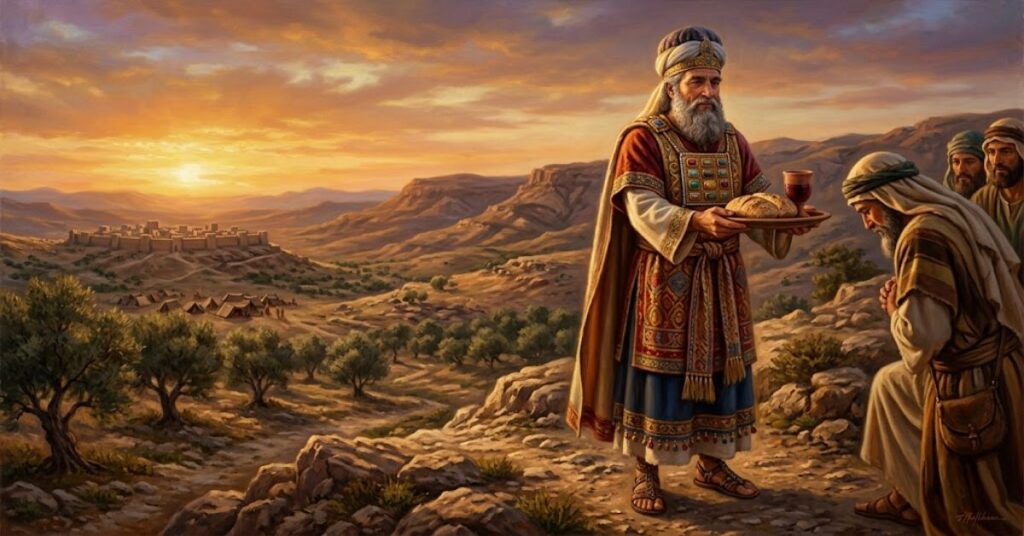
Melchizedek is a highly enigmatic figure in biblical history. He appears briefly in Genesis 14 as the king of Salem and priest of God Most High, meeting Abraham after Abraham returns from battle. Melchizedek brings bread and wine, blesses Abraham and receives a tenth of what Abraham has recovered.
What makes the passage unusual is how little information Genesis gives about him. There is no detailed genealogy, family history or account of his birth and death. Yet later biblical writing gives his short appearance much greater significance. Psalm 110 describes a ruler as being a priest forever “in the order of Melchizedek”, while Hebrews 7 uses the earlier account to explain a priesthood different from the Levitical system.
His importance therefore comes not from the number of verses devoted to him, but from the theological ideas attached to those verses. Melchizedek stands at the intersection of kingship, priesthood, blessing and sacrifice, making him one of the Bible’s most discussed mysterious figures.
Who Was Melchizedek?
Genesis identifies Melchizedek as the king of Salem and priest of God Most High. His name is traditionally understood as meaning “king of righteousness”, while Hebrews connects Salem with the idea of peace.
His dual role is particularly significant. He is not presented simply as a ruler or simply as a religious official. He combines political authority with priestly responsibility.
| Feature | Biblical description |
| Position | King of Salem |
| Religious role | Priest of God Most High |
| Encounter | Meets Abraham after battle |
| Gift | Brings bread and wine |
| Abraham’s response | Gives him a tenth |
| Later significance | Model for an enduring priesthood |
The identity of Salem has traditionally been associated with Jerusalem, although the precise historical identification has been debated. Older reference scholarship records both the Jerusalem interpretation and alternative proposals.
Melchizedek and Abraham
The meeting between Melchizedek and Abraham is recorded in Genesis 14:18–20. Abraham is returning from defeating a coalition of kings and rescuing his nephew Lot and other captives.
Melchizedek then appears with bread and wine and blesses Abraham in the name of God Most High. Abraham responds by giving him a tenth of everything.
This exchange establishes an important relationship. Melchizedek blesses Abraham, the patriarch who occupies a central place in Israel’s later story. Hebrews interprets this act as evidence of Melchizedek’s superior position in the particular argument being made: the greater blesses the lesser.
The encounter is therefore much more than a brief hospitality scene. It becomes the foundation for later discussion about priestly authority.
Why Is Melchizedek Important in Psalm 110?
Psalm 110 provides the next major reference. The psalm describes a ruler who receives a divine declaration: he is to be a priest forever in the order of Melchizedek.
This is significant because the priesthood described in Israel’s later law was associated with the tribe of Levi. Melchizedek, however, appears before the establishment of that system and belongs to a different setting.
The psalm therefore provides a framework for understanding a ruler who combines royal and priestly authority. Later Christian interpretation connected this passage directly with Jesus, particularly through the argument developed in Hebrews.
Melchizedek in Hebrews 7
Hebrews 7 gives Melchizedek his most extensive biblical treatment. The writer returns to Genesis and emphasises that Scripture provides no genealogy for him. Hebrews uses this absence as part of its theological argument, describing him as resembling the Son of God and presenting his priesthood as enduring.
The point is not necessarily that Genesis intended to provide a supernatural biography of Melchizedek. Rather, Hebrews reads the biblical presentation itself as significant. Because the Genesis account does not record his ancestry, beginning or death, the writer can use that textual silence within a larger argument about priesthood.
Hebrews then contrasts the Levitical priesthood with the priesthood associated with Melchizedek. The chapter argues that Jesus belongs to a different priestly order and that this priesthood rests not on ordinary ancestry but on an enduring divine appointment.
Later Interpretations and the Dead Sea Scrolls
Interest in Melchizedek did not stop with the biblical texts. A Dead Sea Scroll known as 11Q13, or 11Q Melchizedek, contains an interpretation of Melchizedek that reflects the theological world of the Qumran community. The official Dead Sea Scrolls archive identifies it as a Hebrew, non-biblical exegetical composition from Qumran’s Cave 11.
Modern scholarship has examined this text because it demonstrates that Melchizedek could be interpreted in different ways within ancient Jewish thought. A study published by the Hebrew University discusses Melchizedek as a model for the combination of kingship and priesthood in the Hebrew Bible, 11QMelchizedek and Hebrews.
This provides an important historical insight: Melchizedek’s significance was not created by one later tradition alone. His unusual biblical portrayal invited different communities to explore his identity and theological role.
Three Important Insights
| Insight | Why it matters |
| Kingship and priesthood overlap | Melchizedek combines two forms of authority rarely presented together |
| Textual silence becomes meaningful | Hebrews builds theological reasoning around the absence of genealogy |
| Later traditions expand his role | 11Q13 shows that ancient Jewish interpretation also developed distinctive ideas about him |
The Future of Melchizedek Studies in 2027
By 2027, interest in Melchizedek is likely to remain strong because he sits at the intersection of biblical studies, ancient Jewish interpretation and Christian theology. New discoveries would be significant, but scholars must distinguish archaeological evidence from theological interpretation.
The Dead Sea Scrolls demonstrate the value of comparing biblical passages with other ancient Jewish writings. Such comparison can reveal how figures were interpreted in different communities without assuming that every later interpretation reflects the original meaning of Genesis.
Key Takeaways
- Melchizedek was both king and priest.
- His encounter with Abraham occurs in Genesis 14.
- Abraham gives him a tenth after receiving his blessing.
- Psalm 110 associates a future ruler with his priestly order.
- Hebrews 7 develops this connection into an argument about enduring priesthood.
- The Dead Sea Scrolls show that ancient Jewish communities also interpreted Melchizedek in distinctive ways.
Conclusion
Melchizedek remains mysterious largely because the biblical text gives readers so little biographical information. Genesis introduces him suddenly as king of Salem and priest of God Most High, records his blessing of Abraham and then moves on. Yet that short encounter became enormously influential.
Psalm 110 gives his name a second life by using his priesthood as a model for an enduring royal priesthood. Hebrews 7 develops the idea further, contrasting this priestly order with the Levitical system and applying the argument to Jesus. Ancient Jewish writings such as 11Q13 add another layer, showing that Melchizedek was also interpreted within the diverse religious world surrounding the Dead Sea Scrolls.
His importance, therefore, lies less in a detailed biography and more in the unusual combination of kingship, priesthood and theological symbolism attached to his name.
Frequently Asked Questions
Who was Melchizedek?
He was the king of Salem and priest of God Most High who met Abraham after Abraham’s military victory, blessed him and received a tenth from him.
What does the name Melchizedek mean?
Hebrews interprets the name as “king of righteousness” and connects Salem with “peace”.
Where does Melchizedek appear in the Bible?
His main appearances are Genesis 14, Psalm 110 and Hebrews 7.
Was Melchizedek a priest before Levi?
Yes. In the biblical narrative, he appears before the establishment of the Levitical priesthood and belongs to a different priestly tradition.
Is Melchizedek Jesus?
Hebrews says Melchizedek resembles the Son of God and uses him as a model for Christ’s priesthood. It does not simply state that Melchizedek and Jesus are the same individual.
Methodology
This article was based on the supplied Postcard.fm editorial requirements and cross-checked against Genesis 14, Psalm 110, Hebrews 7, the official Dead Sea Scrolls archive and scholarly material concerning 11QMelchizedek.
No firsthand observation or invented expert quotation has been used. Historical claims concerning Melchizedek remain subject to interpretation, particularly regarding the identity of Salem and the meaning of later traditions.
References
Bible Gateway. (n.d.). Genesis 14, Psalm 110, Hebrews 7.
Cekiera, A. P. (2021). Interpretation of scriptural texts in 11QMelchizedek and its theological implications. Biblica et Patristica Thoruniensia.
Knohl, I. (2009). Melchizedek: A model for the union of kingship and priesthood in the Hebrew Bible, 11QMelchizedek, and the Epistle to the Hebrews. In Text, Thought, and Practice in Qumran and Early Christianity. Brill.
Israel Antiquities Authority. (n.d.). 11Q13 – 11Q Melch. Dead Sea Scrolls Digital Library.