
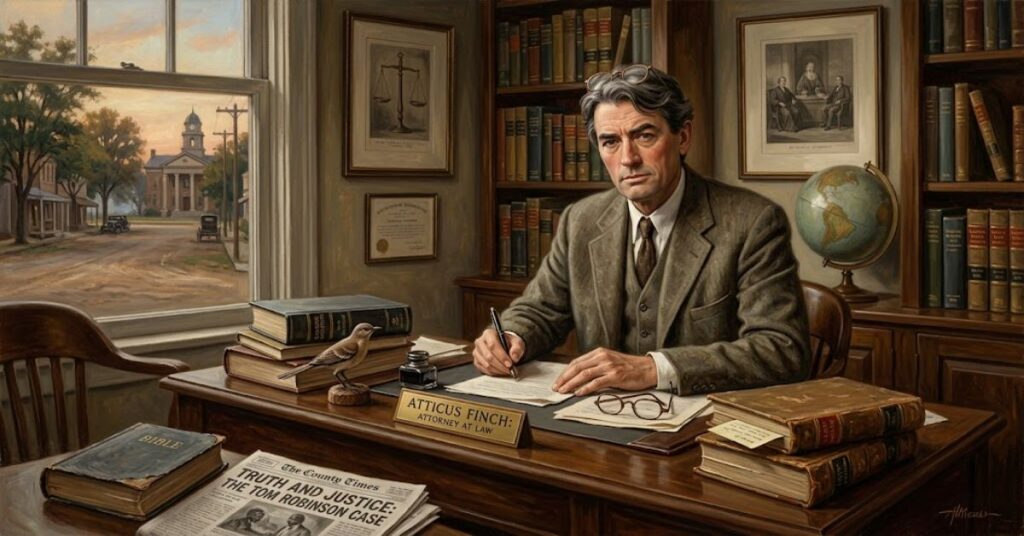
Atticus Finch is Harper Lee’s fictional lawyer and the father of Scout and Jem in To Kill a Mockingbird. Set in Depression-era Alabama, the novel follows Scout as she observes her father defend Tom Robinson, a Black man accused of raping Mayella Ewell. Atticus knows that the racial prejudice surrounding the case makes a fair outcome unlikely, yet he accepts the responsibility of representing Robinson and insists on treating the case according to evidence and law.
Harper Lee’s novel was published in 1960 and won the Pulitzer Prize for Fiction in 1961. The Pulitzer records To Kill a Mockingbird as that year’s fiction winner, establishing the book as one of the defining works of twentieth-century American literature.
Atticus is therefore more than a fictional courtroom lawyer. He functions as a moral reference point for Scout, who gradually learns that courage does not always mean winning. His story is also more complicated than the uncomplicated image of a perfect hero that became popular after the novel and its 1962 film adaptation.
Who Is Atticus Finch?
Atticus is a widowed lawyer living in the fictional Alabama town of Maycomb. He raises Jem and Scout while maintaining his legal practice and participating in the life of the local community.
One important distinction is that Scout, rather than Atticus, is the novel’s narrator. Readers experience the events through her childhood perspective and later understanding. Atticus is the central adult figure around whom much of the novel’s moral conflict develops.
This narrative choice matters. Scout initially sees her father as an ordinary parent. As the story progresses, she begins to understand why his decision to defend Robinson has made him unpopular with sections of the town.
The novel is partly a coming-of-age story because Scout learns to distinguish social reputation from moral responsibility. Atticus becomes the practical example through which that lesson is developed.
Why Does Atticus Defend Tom Robinson?
The Tom Robinson case is the central test of Atticus’s professional and personal principles.
Robinson is accused of raping Mayella Ewell, a white woman. The racial hierarchy of Maycomb means that the case exists within a deeply unequal social and legal environment. The National Endowment for the Humanities describes the novel as a story of a lawyer defending a Black man accused of rape in a 1930s Alabama setting shaped by racial tension and Jim Crow-era conditions.
Atticus does not approach the case as though social pressure has disappeared. Instead, he recognises that his responsibility as a lawyer requires him to represent his client seriously.
That distinction is central to his character.
His courage does not come from believing that the community will reward him. The opposite is true. He understands that defending Robinson will expose him and his children to criticism.
The case therefore connects three forms of responsibility:
| Dimension | Atticus’s role | Why it matters |
| Legal | Represents Tom Robinson | Professional duty requires a defence |
| Moral | Challenges prejudice | Justice cannot depend solely on public opinion |
| Parental | Guides Jem and Scout | His conduct becomes a lesson for his children |
Atticus’s importance comes from the way these responsibilities overlap. He is simultaneously a lawyer, father and citizen.
Atticus Finch and Moral Courage
The most enduring idea associated with Atticus is moral courage.
Physical courage is easy to recognise because it usually involves visible danger. Moral courage is quieter. It can involve maintaining a principle when doing so is unpopular, costly or personally uncomfortable.
That distinction helps explain why Atticus became such a memorable literary figure.
His decision to defend Robinson does not guarantee success. The courtroom cannot simply erase the prejudices surrounding the case. Atticus’s actions demonstrate that ethical conduct and successful outcomes are not always the same thing.
This is one of the strongest lessons the character offers modern readers: professional integrity is measured partly by how a person behaves when the result is uncertain.
The National Endowment for the Humanities has continued to use To Kill a Mockingbird in programmes examining law, justice and civics, demonstrating that the novel remains useful as a starting point for public discussion rather than merely a historical literary artefact.
The Lawyer and the Father
Atticus’s influence on Scout and Jem is as important as his courtroom role.
He encourages them to understand other people before judging them. His parenting is deliberately restrained. Rather than giving his children a complete moral system, he often allows events to challenge their assumptions.
This approach makes him particularly important to Scout’s development.
| Character function | Example in the story | Broader theme |
| Father | Raises Jem and Scout alone | Responsibility |
| Lawyer | Defends Robinson | Justice |
| Community member | Lives among people who oppose him | Social pressure |
| Moral teacher | Helps Scout interpret events | Empathy |
| Symbol | Becomes associated with fairness | Integrity |
The important point is that Atticus teaches primarily through behaviour. Scout can observe what happens when a respected member of the community refuses to follow the crowd.
Atticus Finch in the 1962 Film
The 1962 film adaptation significantly shaped how generations of audiences imagined Atticus.
Gregory Peck played the character, and his performance became one of the defining roles of his career. The Academy of Motion Picture Arts and Sciences records that Peck won the Academy Award for Best Actor for portraying Atticus Finch. The film received eight Oscar nominations and won three awards at the 1963 ceremony.
The film also changed the cultural reach of the character.
In the novel, readers encounter Atticus through Scout’s narration. Cinema gives audiences a physical performance: Peck’s voice, posture, expressions and courtroom presence create a visual interpretation of the character.
That distinction matters because an adaptation can influence how audiences remember the original work.
The Academy notes that the film became a defining part of Peck’s career and that the story continues to function as a teaching tool in literature, history, sociology and cinema education.
This provides one of the clearest documented examples of Atticus’s cultural afterlife: the character moved from a literary creation to an enduring screen image.
The Complicated Legacy of Atticus Finch
The reputation of Atticus changed dramatically in 2015 with the publication of Harper Lee’s Go Set a Watchman.
The book was written before To Kill a Mockingbird but published decades later. It presents an older Atticus whose views on race and desegregation are far more disturbing than the character many readers had previously admired.
Contemporary criticism highlighted the shock of encountering a prejudiced Atticus after decades of treating him as a moral hero. The Los Angeles Times reported that Watchman presented Atticus as a segregationist and described the book as an earlier draft that preceded the transformation into To Kill a Mockingbird.
This creates a useful distinction between two interpretations.
Atticus in To Kill a Mockingbird is presented through Scout’s childhood understanding and is associated with fairness, legal duty and resistance to local prejudice.
Atticus in Go Set a Watchman is an older man whose racial attitudes expose the limitations of the earlier heroic image.
The contradiction does not make the first novel meaningless. Instead, it gives readers a reason to examine the difference between individual acts of courage and a person’s complete political or social worldview.
What Atticus Finch Represents Today
Atticus remains culturally significant because the questions surrounding him have not disappeared.
Can a person act courageously in one area while holding harmful beliefs in another? Can professional integrity coexist with personal limitations? Should moral figures be judged by individual actions, broader beliefs or both?
Those questions explain why the character continues to generate debate.
The novel has also had a documented educational life. The NEH has described To Kill a Mockingbird as a text used to examine racism, the justice system and historical events such as the Scottsboro trials.
The character’s usefulness therefore extends beyond admiration. Atticus can be studied as an example of courage while also being examined critically as a representation of the racial and social assumptions of his time.
Three Evidence-Based Insights About Atticus
| Insight | Evidence | Interpretation |
| His cultural identity was shaped by adaptation | Gregory Peck won the 1963 Best Actor Oscar for the role | Many audiences encounter Atticus visually before studying the novel |
| His reputation is historically layered | Go Set a Watchman presented a substantially different Atticus | The character cannot be reduced to a simple heroic archetype |
| His story has civic relevance | NEH programmes use the work to discuss law and justice | Atticus remains useful as a framework for discussing ethical citizenship |
The first insight shows why the 1962 film matters to the character’s legacy. The second demonstrates why later publication history changed critical discussion. The third explains why Atticus continues to appear in educational and civic contexts.
The Future of Atticus Finch in 2027
By 2027, Atticus Finch is unlikely to disappear from discussions of American literature, but the way he is taught may continue to change.
The strongest educational approach is likely to move away from treating him simply as a flawless moral hero. Instead, teachers and readers can place the character alongside the historical context of Jim Crow, the civil-rights movement, legal inequality and debates about representation.
The continuing use of To Kill a Mockingbird in civics and humanities education provides evidence that the story still has institutional relevance.
At the same time, Go Set a Watchman makes a single-dimensional reading harder to sustain. Future discussion can therefore treat Atticus as a deliberately useful contradiction: a character capable of meaningful moral courage who is also limited by the social assumptions surrounding him.
That interpretation is more demanding, but it also makes the character more valuable for serious discussion.
Key Takeaways
- Legal courage: Atticus demonstrates that professional responsibility can require standing against community pressure.
- Parental influence: His conduct becomes one of the central moral lessons in Scout’s development.
- Historical context: His actions need to be understood within Depression-era Alabama and the Jim Crow system.
- Cultural transformation: Gregory Peck’s Oscar-winning performance helped establish the character’s lasting public image.
- Moral complexity: Go Set a Watchman challenged the assumption that Atticus could be understood simply as an uncomplicated hero.
- Educational relevance: The story continues to support discussion of justice, racism, law and civic responsibility.
Conclusion
Atticus Finch remains one of the most recognisable fictional lawyers because his story connects private morality with public responsibility. In To Kill a Mockingbird, his defence of Tom Robinson demonstrates the importance of professional duty when social pressure points in the opposite direction.
Yet his legacy is stronger when viewed critically rather than reverently. Gregory Peck’s 1962 performance helped turn Atticus into a cultural icon, while Go Set a Watchman later complicated the image by presenting beliefs that challenged the heroic interpretation many readers had accepted.
That tension is part of what keeps the character relevant. Atticus can represent courage without being treated as morally perfect. His story encourages readers to distinguish between individual acts of integrity and the broader beliefs held by the people who perform them.
For that reason, Atticus is still valuable not only as a literary character but also as a starting point for discussions about law, justice, prejudice, parenting and the limits of moral heroism.
FAQ
Who is Atticus Finch?
Atticus Finch is a fictional lawyer and the father of Scout and Jem in Harper Lee’s To Kill a Mockingbird. He represents Tom Robinson, a Black man accused of rape in Depression-era Alabama. Scout narrates the novel and gradually comes to understand the significance of her father’s decision to defend Robinson.
Why is Atticus Finch important?
Atticus is important because he represents professional and moral courage in the face of racial prejudice. His defence of Tom Robinson becomes one of the novel’s central examples of the conflict between justice and social pressure.
Is Atticus Finch a hero?
He can be understood as a heroic figure within To Kill a Mockingbird, particularly because of his commitment to defending Robinson. However, Go Set a Watchman complicates that interpretation by presenting an older Atticus with deeply prejudiced views.
What does Atticus Finch teach Scout?
Atticus teaches Scout lessons about empathy, fairness, responsibility and the danger of judging people without understanding their circumstances. His actions often provide stronger lessons than his words.
Who played Atticus Finch in the 1962 film?
Gregory Peck played Atticus Finch in the 1962 film adaptation. His performance won the Academy Award for Best Actor at the 1963 Oscars.
Why is Atticus Finch controversial?
The controversy largely comes from the contrast between his reputation in To Kill a Mockingbird and his portrayal in Go Set a Watchman. The later-published novel depicts an older Atticus whose views on race and desegregation are significantly more prejudiced.
Is Atticus Finch based on a real person?
Atticus is a fictional character. However, Harper Lee drew on aspects of her life and surroundings when creating the world of To Kill a Mockingbird. The novel itself is set in fictional Maycomb, Alabama.
Methodology
This article was developed from primary and institutional sources concerning Harper Lee, To Kill a Mockingbird, its cultural history and its adaptations. The Pulitzer Prizes was used to verify the novel’s 1961 Fiction award. The Academy of Motion Picture Arts and Sciences was used to verify the 1962 film’s production context and Gregory Peck’s Academy Award. National Endowment for the Humanities material was used to validate the novel’s continuing educational and civic relevance. Contemporary reporting from the Los Angeles Times was used to contextualise the publication and reception of Go Set a Watchman.
No firsthand interview, literary field study or original reader survey was conducted for this article. The experience signals therefore rely on named, documented cultural examples rather than invented personal observations. Interpretations of Atticus remain partly dependent on literary analysis, particularly where the two published versions of the character are compared.
Editorial disclosure: This article was drafted with AI assistance and should be reviewed and independently verified by the Postcard.fm editorial team before publication. All named claims, dates and citations should be checked against the original sources during editorial review.
References
Academy of Motion Picture Arts and Sciences. (2012). To Kill a Mockingbird. Oscars.org.
Academy of Motion Picture Arts and Sciences. (2013). The 35th Academy Awards. Oscars.org.
Lewis, D. (2015, July 14). What the critics are saying about Harper Lee’s “Go Set a Watchman”. Los Angeles Times.
National Endowment for the Humanities. (2019, June 12). Screenings of “To Kill a Mockingbird” intended to spark civics conversation. NEH.
National Endowment for the Humanities. (n.d.). To Kill a Mockingbird and the Scottsboro Boys Trial: Profiles in Courage. EDSITEment.
The Pulitzer Prizes. (1961). Harper Lee. Pulitzer.org.
The Pulitzer Prizes. (2020, February 27). To Kill a Mockingbird draws audience of 18,000 students at Madison Square Garden. Pulitzer.org.