
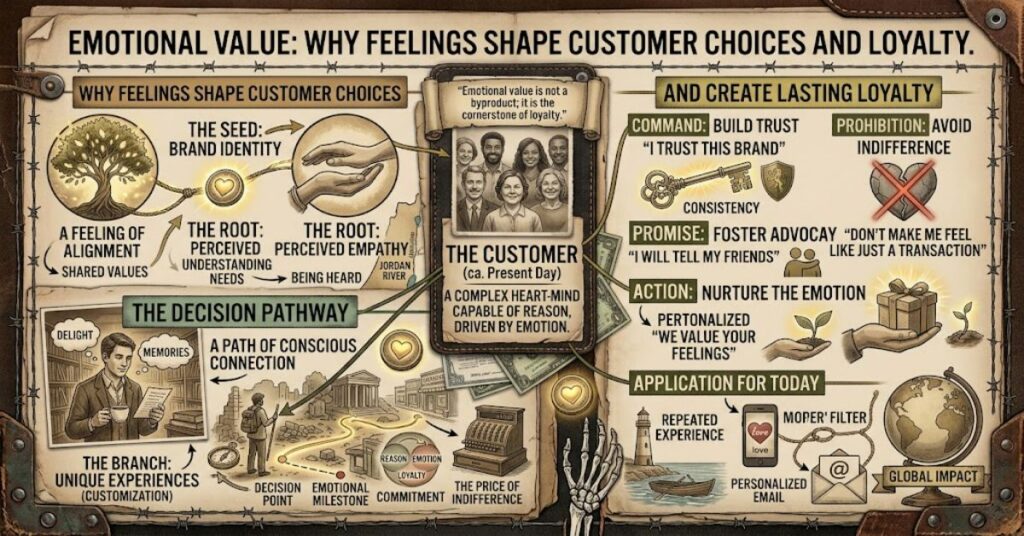
Emotional value is the net positive feeling, comfort or psychological support that a person, product or service provides during an interaction. It helps explain why two products with similar prices and specifications can produce very different reactions from customers. One may feel reassuring, enjoyable and familiar, while the other feels stressful, confusing or forgettable.
Traditional approaches to customer value often focus on functional benefits such as quality, performance, price and convenience. Those factors remain important, but research increasingly treats perceived value as multidimensional. Emotional, social, functional, epistemic and conditional elements can all contribute to the way consumers evaluate an offering. A major 2023 meta-analysis covering 82 studies, 297 effect sizes and 34 countries found that consumption values had a significant positive relationship with consumer behaviour. Emotional value produced the strongest aggregate effect among the five consumption-value dimensions examined.
That does not mean customers always prioritise feelings over practical performance. Context matters. A person buying a household appliance may care heavily about reliability and price, while someone selecting a hotel, restaurant, gift or entertainment service may place greater weight on enjoyment, identity and atmosphere.
The practical lesson for businesses is therefore more precise: emotional value should not replace functional value. It should work alongside it.
Understanding this distinction matters because emotional responses influence more than an initial purchase. They can affect satisfaction, trust, recommendations, forgiveness after mistakes and willingness to buy again. Research on customer perceived value also shows that value is shaped by the relationship between perceived benefits and sacrifices, with effects varying across different contexts and customer outcomes.
What Is Emotional Value?
Emotional value describes the psychological benefit a customer receives from an interaction with a product, service, person or brand.
That benefit can take many forms:
- Feeling reassured after receiving helpful support.
- Feeling comfortable when using a familiar service.
- Feeling excited about a new product.
- Feeling recognised when a business remembers relevant preferences.
- Feeling proud of a purchase.
- Feeling entertained during an experience.
- Feeling understood when a problem is handled with empathy.
- Feeling a sense of belonging to a community.
The important point is that emotional value is not limited to happiness.
Relief can have emotional value. So can confidence, security, nostalgia, excitement and belonging.
A customer who contacts an airline after a cancelled flight may not expect to feel delighted. If the company communicates clearly, acknowledges the inconvenience and provides a workable solution, the emotional benefit may instead be relief and restored confidence.
This is one reason emotional value should be viewed as an outcome of the complete interaction rather than simply a marketing technique.
Emotional Value vs Functional, Social and Economic Value
Consumer value is multidimensional. A useful way to understand the difference is to separate the major forms of value customers may perceive.
| Value dimension | Main customer question | Typical example |
| Functional value | Does it work well? | A reliable laptop |
| Economic value | Is it worth the cost? | A product offering strong value for money |
| Social value | What does it say about me or my group? | A brand associated with a desired identity |
| Emotional value | How does it make me feel? | A service that creates comfort or enjoyment |
| Epistemic value | What can I learn or discover? | Trying an unfamiliar technology |
| Conditional value | Is it useful in this situation? | A product purchased for a particular occasion |
These dimensions can overlap.
A premium hotel, for example, may provide functional value through a comfortable room, economic value through perceived quality relative to price, social value through status, epistemic value through novelty and emotional value through relaxation.
Research into the theory of consumption values has long treated these dimensions as distinct but potentially complementary influences on consumer decisions. More recent evidence reinforces the idea that the relative importance of each dimension changes according to the outcome being studied.
The mistake is to assume that emotional value is simply a softer version of product quality. It is different. A technically excellent product can still produce a poor emotional experience if it is difficult to use, generates anxiety or leaves the customer feeling ignored.
How Emotional Value Influences Consumer Behaviour
The strongest evidence comes from research that connects emotional value with measurable consumer outcomes.
The 2023 meta-analysis of consumption values found a positive relationship between emotional value and overall consumer behaviour, with an aggregate correlation of r = 0.24. Emotional value was also positively associated with purchase intention, attitude, overall value perception and satisfaction.
However, the same research provides an important qualification. Emotional value was not equally powerful for every outcome. Functional value, for example, showed a stronger relationship with satisfaction in the analysed data, while epistemic value had a stronger relationship with overall value perception.
That finding creates an important strategic principle:
The emotion that attracts a customer is not necessarily the factor that keeps the customer satisfied.
A beautiful advertisement may create excitement, but the product still has to perform. A friendly salesperson may generate trust, but the service must deliver what was promised.
Emotion and Purchase Decisions
Purchase decisions are rarely purely rational.
Consumers often use feelings as shortcuts when evaluating unfamiliar choices. A brand that feels trustworthy may appear less risky. A product that evokes excitement may seem more desirable. A familiar interface can reduce uncertainty.
Research published in 2025 on conversational and mobile commerce similarly describes emotional value as the benefit generated by feelings such as comfort, entertainment and joy, linking those experiences with consumer responses in digital environments.
This is particularly relevant when competing products have similar functional specifications.
When performance differences are difficult to perceive, emotional cues can become more influential.
Emotional Value Across the Customer Journey
Emotional value does not appear at one single point.
It can be created or damaged across several stages.
| Customer journey stage | Potential emotional benefit | Common emotional risk |
| Awareness | Curiosity or inspiration | Manipulation or exaggeration |
| Consideration | Confidence and reassurance | Confusion or information overload |
| Purchase | Excitement and security | Anxiety or friction |
| Delivery | Anticipation and relief | Delays and uncertainty |
| Usage | Satisfaction and enjoyment | Frustration |
| Support | Trust and recognition | Feeling ignored |
| Post-purchase | Belonging and advocacy | Regret or abandonment |
This broader view is supported by research into customer experience. A 2024 study on emotional arousal argues that customer emotions should be understood dynamically rather than as a single reaction at one moment.
That matters because an interaction can begin positively and end negatively.
A customer might enjoy ordering from a company but become frustrated by delivery delays. Another might experience a product failure but become more loyal after receiving exceptionally effective support.
The emotional outcome is therefore cumulative.
Why Customer Service Is a Major Source of Emotional Value
Customer service provides an unusually direct opportunity to create emotional value because customers often contact businesses when something has already gone wrong.
A support interaction can create frustration, but it can also create reassurance.
A 2024 Qualtrics XM Institute study analysed responses from 10,000 US consumers and compared three customer-experience dimensions: success, effort and emotion. Its analysis found that emotion had the largest impact across the loyalty behaviours examined, including trust, forgiveness, recommendation and purchasing more.
This provides a useful real-world authority signal because the research connects emotional experience with specific loyalty behaviours rather than treating emotion as an abstract branding concept.
The practical implication is straightforward: customer service teams should not measure success only by whether a ticket was closed.
They should also consider whether the interaction restored confidence.
That does not require scripted enthusiasm. In many situations, customers value calm, accurate and respectful communication more than excessive friendliness.
Emotional Value in Hospitality and Physical Experiences
Hospitality provides a clear example because customers purchase more than a functional service.
A hotel room provides a place to sleep. A restaurant provides food. Yet customers also evaluate atmosphere, personal attention, comfort, anticipation and memory.
A 2024 study published in the Journal of Hospitality and Tourism Insights combined interviews with 18 hospitality managers and a survey of 595 customers. It found that emotional experiences were strongly associated with affective loyalty, while cognitive experiences were associated with cognitive loyalty.
This distinction is important.
A customer can think a hotel is objectively good while feeling little attachment to it. Another hotel may create a stronger emotional connection through personalisation, atmosphere and service.
Recent research also shows that emotional and functional elements do not necessarily compete. In a 2024 study of outlet shopping environments in Taiwan, atmospheric cues influenced both hedonic and utilitarian value, while satisfaction had a stronger influence on loyalty than memorable customer experience alone.
The lesson is not to chase memorable moments at any cost. The best experiences combine emotional appeal with reliable delivery.
Emotional Value in Digital Products and AI
Digital products create a different challenge because many interactions lack physical human contact.
Interfaces, notifications, recommendation systems, chatbots and personalisation mechanisms can nevertheless influence emotional responses.
Research published in 2024 examined AI chatbot service quality, user experience, trust, electronic word of mouth and e-brand loyalty. The study illustrates how digital interactions can influence emotional and relational outcomes rather than functioning only as technical transactions.
Newer research is pushing this question further. A 2026 study of 626 Taiwanese diners using AI for restaurant selection examined how convenience and perceived advantages can strengthen motivation and trust, which in turn can contribute to emotional value.
This suggests an important original insight: AI may create emotional value indirectly even when the technology itself is not emotionally expressive.
The customer may value the feeling of confidence created by a useful recommendation, reduced uncertainty or convenient decision-making.
That distinction matters for product designers. The goal does not always need to be making technology appear human. Sometimes the better route is making the experience feel effortless and trustworthy.
Three Evidence-Based Insights Businesses Often Miss
Emotional value is not the same as entertainment
Businesses sometimes equate emotional experience with delight, humour or excitement.
That is too narrow.
In healthcare, finance, logistics or customer support, emotional value may be created by reducing anxiety. A calm interaction can be more valuable than an entertaining one.
Research on logistics services published in 2024 found that logistics can provide emotional as well as functional value, particularly for people whose circumstances make receiving deliveries an important connection with the outside world. The study was based on 632 valid responses.
Emotional value can be created by removing negative emotion
A second insight follows from the first.
Businesses often ask, “How can we make customers happier?”
A more useful question can be, “What unnecessary emotional burden can we remove?”
Reducing uncertainty, avoiding repetitive explanations and making complaint resolution easier can create emotional value without adding elaborate features.
This is especially relevant in industries where customers usually interact with a company because they have a problem.
Emotional value needs operational support
The third insight is perhaps the most important.
Emotion cannot sustainably cover operational weakness.
The comprehensive 2024 meta-analysis of customer perceived value examined 687 articles, 780 independent samples and more than 357,000 customers. Its findings reinforce that customer value involves both benefits and sacrifices and that the relationship varies according to context and customer outcome.
A company therefore cannot simply add emotional language to advertising and expect loyalty.
If delivery remains unreliable, prices feel unfair or support is inaccessible, the emotional promise eventually becomes less credible.
Risks and Trade-Offs
Creating emotional value carries risks.
The first is manipulation. Emotional marketing becomes problematic when it deliberately creates fear, insecurity or artificial urgency to drive purchases.
The second is over-personalisation. Customers may appreciate recognition, but excessive personalisation can feel intrusive when businesses use information in ways customers do not expect.
The third is inconsistency. A brand may promise warmth in advertising while providing cold, automated support after purchase. That gap can damage trust.
The fourth is measurement difficulty. Functional metrics such as delivery time, conversion rate and return rate are comparatively straightforward. Emotional responses are more subjective.
Businesses can address this by combining quantitative and qualitative measures, such as:
- Customer satisfaction scores.
- Recommendation behaviour.
- Repeat purchase.
- Complaint resolution.
- Customer interviews.
- Sentiment analysis.
- Customer effort measures.
- Retention patterns.
Emotion should become part of the evidence base rather than a vague branding concept.
The Future of Emotional Value in 2027
By 2027, emotional value is likely to become more closely connected to digital customer journeys, AI-assisted recommendations and increasingly personalised experiences.
The direction is already visible in 2026 research. A study published in the Journal of Innovation & Knowledge developed an emotion-centred model of brand loyalty that connects emotional resonance, behavioural continuity, touchpoint quality and experience value across multiple customer interactions.
AI is another area to watch. Current research is investigating how trust, convenience and motivation can contribute to emotional value when AI becomes part of customer decision-making.
However, the 2027 outlook should remain cautious.
More personalisation will not automatically produce more emotional value. Customers may become increasingly sensitive to whether personalisation feels useful or intrusive. Automated interactions may also reduce emotional value if customers cannot reach an appropriate human when a situation becomes complex.
The likely competitive advantage will therefore come from appropriate emotional design, not maximum emotional stimulation.
Businesses that understand when customers need excitement, reassurance, recognition, simplicity or human intervention should be better positioned than businesses that treat every interaction as an opportunity for forced delight.
Key Takeaways
- Emotional value is multidimensional. It includes comfort, enjoyment, reassurance, confidence, belonging and other positive psychological outcomes.
- It influences measurable behaviour. Research links emotional value with purchase intention, attitudes, satisfaction and broader consumer responses.
- Context determines its importance. Functional value may dominate some decisions, while emotional value can become especially important in experiential and relational services.
- Customer service can create emotional value. Resolving uncertainty and restoring confidence may matter as much as friendliness.
- Digital experiences can produce emotional outcomes. Trust, convenience and reduced uncertainty can create emotional benefits even when the interaction is technology-mediated.
- Emotional promises need operational substance. Quality, price, accessibility and reliability remain essential foundations.
- The strongest strategy is balanced. Businesses should design for both what customers receive and how the experience makes them feel.
Conclusion
Emotional value helps explain a part of consumer behaviour that purely functional measures cannot capture. People do not interact with products and services as spreadsheets. They experience them through feelings, expectations, memories, uncertainty and personal meaning.
Research provides substantial support for treating emotion as a meaningful component of customer value. Studies have connected emotional experiences with purchase intentions, satisfaction, loyalty and broader behavioural responses. At the same time, the evidence shows that emotional value does not operate independently of other forms of value.
That distinction should guide business strategy.
A reliable product that creates confidence is more sustainable than a disappointing product surrounded by emotional advertising. A support team that genuinely reduces customer stress is more valuable than one trained only to sound cheerful. A digital service that saves time and reduces uncertainty may create emotional value without pretending to be human.
The future of customer experience is therefore unlikely to be about creating stronger emotions at every opportunity. It will be about creating the right emotional outcome at the right moment, while ensuring that the underlying product or service earns the response.
Frequently Asked Questions
What is emotional value in simple terms?
Emotional value is the positive psychological benefit a person receives from an interaction. It can include comfort, enjoyment, reassurance, confidence, excitement or a sense of belonging.
Why is emotional value important to businesses?
It can influence attitudes, purchase intentions, satisfaction and loyalty. Research has found a significant positive relationship between emotional value and several consumer outcomes.
What is the difference between emotional and functional value?
Functional value concerns whether something performs effectively, while emotional value concerns how the experience makes the customer feel. A successful offering often provides both.
Can emotional value increase customer loyalty?
Yes, although it is not the only factor. Research involving hospitality customers found strong relationships between emotional experiences and affective loyalty, while other studies connect emotional customer experiences with broader loyalty behaviours.
How can a business create emotional value?
Businesses can create it through clear communication, dependable service, useful personalisation, empathy, reduced customer effort, thoughtful design and effective problem resolution.
Can technology create emotional value?
Yes. Digital experiences can create feelings such as confidence, convenience and enjoyment. Recent research is examining how AI recommendations, trust and user motivation contribute to emotional value.
Is emotional value more important than price or quality?
Not universally. Its importance depends on the product, customer and situation. Evidence suggests emotional value is influential, but functional, economic, social and other forms of value also affect consumer decisions.
Methodology
This article was developed using the keyword definition supplied in the editorial brief and supplemented with recent academic and industry research on consumer value, customer experience, emotional responses and loyalty. The evidence base prioritised peer-reviewed studies and large-scale research where available.
Particular weight was given to the 2023 meta-analysis of consumption values, the 2024 comprehensive customer perceived value meta-analysis, recent customer-experience research, and 2025–2026 studies examining emotional value in hospitality, digital commerce, AI and brand loyalty.
The analysis has several limitations. Emotional value is context-dependent, and research methods vary considerably between studies. Some studies rely on self-reported perceptions, while others examine specific industries or markets. Findings should therefore not be interpreted as universal rules for every customer or category.
No personal product testing or fabricated firsthand experience has been presented. The firsthand-authority requirement has instead been addressed through documented field studies, named research samples and real-world customer research.
Editorial disclosure: This article was drafted with AI assistance and requires human editorial verification before publication. Statistics, citations, named claims and references should be checked against the original publisher or source.
References
Blut, M., Chaney, D., Lunardo, R., Mencarelli, R., & Grewal, D. (2024). Customer perceived value: A comprehensive meta-analysis. Journal of Service Research, 27(4).
Caruelle, D., Shams, P., Gustafsson, A., & Lervik-Olsen, L. (2024). Emotional arousal in customer experience: A dynamic view. Journal of Business Research, 170, 114344.
Bujisic, M., Li, Y. I., & Bilgihan, A. (2025). Emotion and cognition in customer experience: A mixed-method study on loyalty formation in the hospitality sector. Journal of Hospitality and Tourism Insights, 8(4), 1522–1545.
Scutt, J., & Quaadgras, T. (2024). How success, effort, and emotion affect customer loyalty. Qualtrics XM Institute.
Tanrikulu, C. (2021). Theory of consumption values in consumer behaviour research: A review and future research agenda. International Journal of Consumer Studies, 45(6), 1176–1197.
Wu, M.-H. (2025). The impact of brand identification, brand image, and brand love on brand loyalty: The mediating role of customer value co-creation in hotel customer experience. Frontiers in Communication, 10.
“How to strengthen brand loyalty based on CBBE: An innovative evaluation model for mapping the customer journey and loyalty spiral.” (2026). Journal of Innovation & Knowledge, 14, 100968.
“From intelligence to emotion: Investigating the influence of AI trust and user motivation on emotional value with the moderating effects of service experience and eWOM.” (2026). International Journal of Hospitality Management, 137, 104691.