
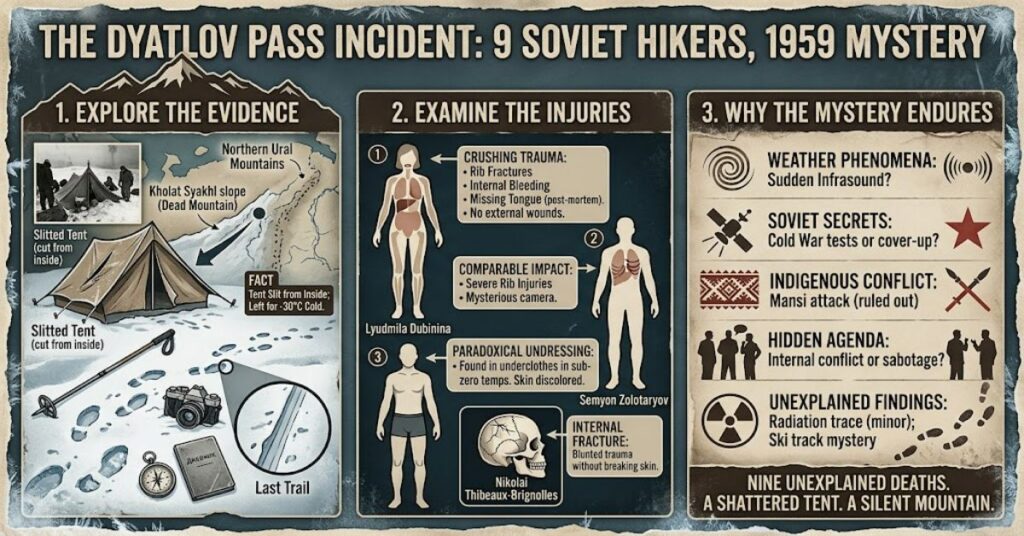
The Dyatlov Pass incident is one of the most enduring mysteries in modern mountaineering. On the night of 1–2 February 1959, nine experienced Soviet hikers died during an expedition in the northern Ural Mountains. Their tent was later discovered damaged and abandoned on the slope of Kholat Syakhl, while the hikers were found at different locations below it.
The circumstances were extraordinary. The tent appeared to have been cut from the inside, and several members of the group left without adequate clothing for severe winter conditions. Some victims suffered serious chest or skull injuries, while hypothermia was ultimately responsible for most of the deaths. The combination created an apparently contradictory scene: why would experienced hikers abandon shelter in freezing weather?
The original Soviet investigation concluded that a “compelling natural force” had caused the deaths without identifying that force. Decades of speculation produced theories ranging from avalanches and hurricane-force winds to military activity, infrasound and deliberate attacks.
Modern research has narrowed the field considerably. A 2021 scientific study demonstrated a physically plausible mechanism for a delayed slab avalanche, while follow-up expeditions in 2022 found that avalanches can occur in the area. Russia’s Prosecutor General’s Office had also concluded in 2020 that an avalanche was the most likely explanation.
That does not mean every question has been answered. The incident remains a case where the broad explanation has become more convincing while several details remain uncertain.
What Happened at Dyatlov Pass?
The expedition was led by Igor Dyatlov, a 23-year-old engineering student and experienced skier. The group consisted of eight men and two women initially, but one member, Yuri Yudin, became ill and turned back before the fatal section of the journey.
That left nine hikers.
On 1 February, the group established its final camp on the slope of Kholat Syakhl rather than continuing towards their planned destination. Their diaries and surviving expedition records show that they were experienced enough to understand winter travel and mountain conditions.
The following events have to be reconstructed from physical evidence, photographs, diaries, autopsies and search records.
Searchers located the abandoned tent on 26 February. The hikers’ bodies were found over the following weeks. Two were discovered near a cedar tree, three closer to the tent and four in a ravine.
| Evidence | What it tells investigators |
| Tent damaged from inside | Suggests an urgent departure |
| Inadequate clothing | The group left before fully preparing |
| Bodies separated across the slope | Movement continued after leaving camp |
| Severe injuries in several victims | Supports a significant physical event |
| Hypothermia | Major cause of death |
| No clear evidence of fighting | Weakens deliberate-attack theories |
The evidence therefore points towards a sudden emergency rather than a planned departure.
Why Did They Leave the Tent?
This remains the central question.
The group had clothing, equipment and shelter inside the tent. Leaving it during a severe winter night would have been dangerous even without an external threat. Their decision therefore suggests that remaining inside was perceived as more dangerous than going outside.
One leading explanation is that snow began moving above the tent or that the hikers believed a larger avalanche was imminent. They could have cut their way out rather than using the entrance if they feared the tent entrance was obstructed.
The group then appears to have moved downhill towards a forested area. That decision makes sense if the immediate objective was to escape a perceived avalanche danger.
The difficulty is that early searchers did not record obvious evidence of a large conventional avalanche at the tent site. The slope also appeared relatively shallow by conventional avalanche standards.
This is where modern research changes the discussion.
The Slab Avalanche Explanation
In 2021, researchers Johan Gaume and Alexander M. Puzrin published a peer-reviewed study proposing a delayed slab-avalanche mechanism.
Their model did not require a huge avalanche. Instead, it suggested that several factors could combine: local terrain, a weak snow layer, the cut made when the hikers positioned their tent, and snow transported by strong winds.
The researchers calculated that a slab could have released approximately 7.5 to 13.5 hours after the slope was cut. That delay is important because it addresses one of the traditional objections to the avalanche theory.
A small slab could also produce substantial force without leaving the kind of massive debris field associated with a large avalanche.
| Theory | Main strength | Main limitation |
| Slab avalanche | Explains sudden evacuation and some injuries | Does not resolve every post-evacuation detail |
| Hurricane-strength wind | Explains severe weather conditions | Less convincing as a direct cause of injuries |
| Human attack | Could explain an emergency departure | Little supporting physical evidence |
| Military explanation | Attempts to explain unusual reports | Evidence remains circumstantial |
| Infrasound | Could theoretically affect perception | No established evidence that it caused this event |
Follow-up fieldwork published in 2022 strengthened the environmental case. Researchers reported observing avalanches at Dyatlov Pass and concluded that the area is genuinely avalanche-prone.
The Injuries and the Hypothermia Puzzle
The victims’ injuries have fuelled much of the mystery.
Several hikers had serious internal injuries, including substantial damage to the chest or skull. Other unusual details, such as missing soft tissue from some bodies, have sometimes been presented as evidence of violence.
Those interpretations need caution.
Bodies exposed to snow, freezing temperatures, water and decomposition can undergo substantial post-mortem changes. Missing eyes or soft tissue do not automatically indicate deliberate mutilation.
The more important forensic question is whether the injuries could result from snow movement. The 2021 modelling study concluded that a relatively small slab could produce severe but non-fatal chest and skull injuries.
That creates a coherent sequence: an avalanche or snow slab triggers an emergency evacuation; the hikers move downhill; they struggle to relocate the tent in darkness and poor visibility; exposure and hypothermia then become fatal.
The sequence is plausible without explaining every minute of the night.
Three Insights the Evidence Adds
The tent location matters. The mystery is often framed around what happened after the hikers escaped. Yet modern modelling suggests the precise way they cut into the snow to install the tent may have contributed to instability.
A small avalanche can be more important than a spectacular avalanche. Popular descriptions often imagine a huge wall of snow. The scientific model instead depends on a relatively small slab capable of causing injury and panic without burying the entire campsite.
The strongest explanation does not require every mystery to disappear. A historical explanation can be probable without being complete. The avalanche model addresses several major observations but does not independently establish exactly how every person behaved afterward.
The Future of the Dyatlov Pass Incident in 2027
The future of Dyatlov Pass research is likely to be less about sensational theories and more about forensic reconstruction.
Digital terrain modelling, snow mechanics, historical weather reconstruction and computational simulation can test scenarios that investigators in 1959 could not quantify. Researchers can now examine slope geometry, wind transport and snowpack stability with far greater precision.
However, there is a hard limit: the original event cannot be recreated exactly. Weather measurements from the night are incomplete, snow conditions have changed and eyewitness evidence is limited.
That means the incident may never receive the kind of definitive answer associated with a modern forensic case. Instead, competing explanations will continue to be judged according to how much evidence they explain with the fewest unsupported assumptions.
Key Conclusions
- Nine hikers died during the 1959 expedition after abandoning their tent.
- The original investigation attributed the deaths to an unidentified natural force.
- The avalanche hypothesis was historically challenged by the lack of obvious avalanche evidence.
- Modern modelling provides a mechanism for a delayed snow-slab release.
- Field expeditions have demonstrated that the area is avalanche-prone.
- Hypothermia explains most deaths, while several victims suffered major traumatic injuries.
- The avalanche explanation is strong but does not resolve every disputed detail.
Frequently Asked Questions
What was the Dyatlov Pass incident?
It was the 1959 death of nine Soviet hikers in the northern Ural Mountains. Their abandoned tent and unusual circumstances created a long-running historical mystery.
When did the Dyatlov Pass incident happen?
The deaths occurred during the night of 1–2 February 1959 near Kholat Syakhl in the northern Urals.
Did an avalanche cause the Dyatlov Pass deaths?
An avalanche, particularly a delayed snow-slab release, is now the leading natural explanation. Scientific modelling has shown that such an event could occur under plausible conditions.
Why did the hikers leave their tent?
The most widely supported explanation is that they perceived an immediate danger, potentially from snow movement above the tent, and evacuated quickly.
Were the Dyatlov hikers murdered?
There is no strong physical evidence establishing murder. Later investigations focused primarily on natural explanations, including avalanches and extreme weather.
Why is the case still considered mysterious?
The evidence does not provide a complete minute-by-minute reconstruction. Questions remain about the hikers’ movements, injuries and decisions after leaving the tent.
Methodology
This article Dyatlov Pass incident was based on published scientific research, historical case materials and reporting on the Russian investigations. Particular weight was given to the 2021 Communications Earth & Environment study by Johan Gaume and Alexander M. Puzrin and their 2022 follow-up on field observations.
The analysis distinguishes established facts from proposed explanations. The exact sequence of events cannot be reconstructed with certainty because no surviving witness observed the incident itself. Claims concerning injuries, weather and the avalanche mechanism therefore require cautious interpretation.
No firsthand testing or personal field observation was conducted for this article. Historical case-file material and scientific publications were treated as the primary evidence base.
This article was drafted with AI assistance and requires human editorial verification before publication. All named claims, statistics and references should be independently checked by the editorial team at Postcard.fm.
References
Gaume, J., & Puzrin, A. M. (2021). Mechanisms of slab avalanche release and impact in the Dyatlov Pass incident in 1959. Communications Earth & Environment, 2, 10.
Puzrin, A. M., & Gaume, J. (2022). Post-publication careers: Follow-up expeditions reveal avalanches at Dyatlov Pass. Communications Earth & Environment, 3, 63.
Prosecutor General’s Office of the Russian Federation. (2020). Investigation findings concerning the deaths of the Dyatlov group.
Dyatlov Foundation. (1959–2026). Dyatlov Pass case files, investigation materials, diaries and chronology.
TASS. (2020, July 11). Prosecutors say avalanche killed Dyatlov group in Urals in 1959.