
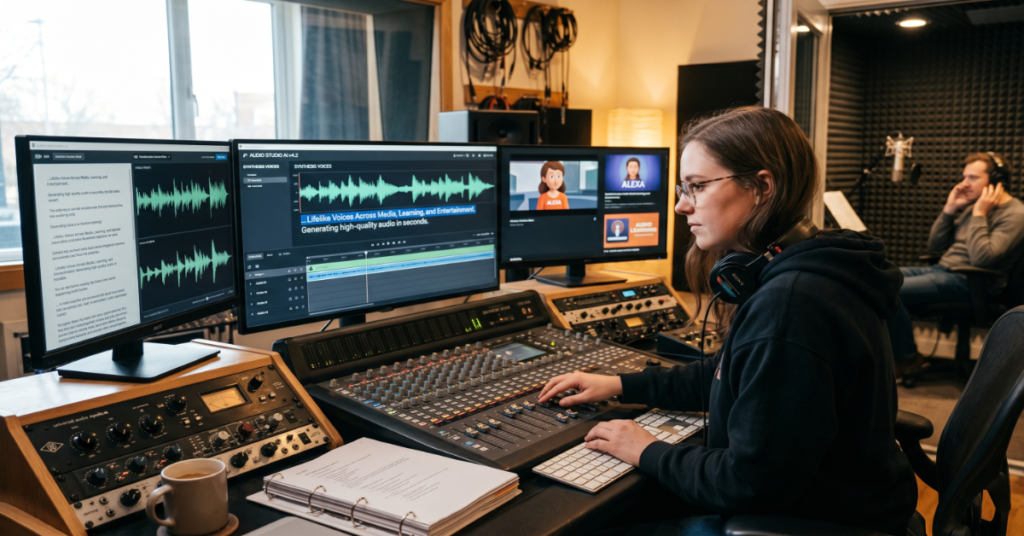
Artificial intelligence text to audio, commonly known as text to speech or TTS, is the process by which written language is transformed into spoken voice. This is not simply playing synthesized sound. The best modern systems interpret linguistic structure, prosody, context and emotion so that the output feels natural and human. In the first few words we answer what the technology does, why it matters and what readers should expect from the rise of AI‑powered TTS in products and services. In recent years tools like ElevenLabs, Play.ht and Google’s WaveNet‑based services have moved beyond robotic sound to rich, expressive speech that can be used in audiobooks, podcasts, virtual assistants, games, accessibility tools and much more. Real‑world adoption requires understanding both technological tradeoffs and practical integration.
At its core the field sits at the intersection of machine learning, linguistics, digital audio and human perception. Early systems, like the Multichannel Speaking Automaton prototype from the 1970s, already showed that computers could generate continuous speech, even if it sounded mechanical. Modern neural models such as DeepMind’s WaveNet revolutionized this space by modeling raw audio waveforms, dramatically improving quality. The reason this matters now is that voice is becoming a primary mode of interacting with digital systems. When assistants read news aloud, when GPS guides drivers, or when narration gives voice to written content, users expect nuance, pace, and realism. This article zeroes in on how today’s systems work, what tools are available, how creators choose between them and where the technology is headed next.
From Early Synthesis to Neural Speech
Speech synthesis has a long history. In 1975 researchers built the Multichannel Speaking Automaton that could perform diphone synthesis in real time. In 1993 a software called Eloquens became the first commercial text‑to‑speech package for Italian users, reading train timetables automatically. These early systems used concatenative or rule‑based methods that stitched together pre‑recorded fragments or applied handcrafted phonetic rules. They were useful but instantly recognizably computerized.
The real disruption began with neural network based models around the mid‑2010s. WaveNet, introduced by DeepMind in 2016, showed that deep generative models could produce far more natural audio by directly creating waveforms. This accelerated research in models such as Deep Voice and FastSpeech which focused on scalability and controllability. Today commercial services build on these breakthroughs to offer voices that vary in pitch, emotion, speed and accent.
How AI Text to Audio Actually Works
At a high level there are three major steps in converting text to audio: linguistic analysis, acoustic synthesis and audio rendering. In the linguistic phase the system parses text, resolves pronunciation, identifies emphasis and predicts rhythm. Phonemes and prosodic cues are generated. Next the acoustic model predicts features that correspond to human speech sounds. Finally a vocoder produces actual audio waveforms that can be stored or streamed. Neural systems learn these mappings from large datasets of recorded speech paired with transcripts.
This layered architecture explains why quality varies between platforms. Some systems focus on rapid generation with basic clarity while others prioritize expressiveness and emotional nuance. Choosing the right tool means trading off speed, cost, language support and controllability.
Popular Tools and When to Use Them
| Tool | Key Strength | Typical Use Cases | Languages Supported | Voice Options |
| Play.ht | Easy integration and publishing | Blogs, podcasts, accessibility | 60+ | 200+ realistic voices |
| ElevenLabs | High realism, expressive control | Audiobooks, narration, dubbing | 75+ | 5,000+ voices, cloning |
| Google Cloud TTS | Enterprise scale, multilingual | Apps, virtual assistants | 75+ | 380+ voices |
| Speechify | Accessibility focus | Education, dyslexia support | 20+ | Multiple standard voices |
| Typecast | Emotional control, character voices | Media, storytelling, avatars | 30+ | Customizable character voices |
Modern services differentiate largely by voice quality, customization and API support. Play.ht is known for a broad library and straightforward publishing options that help creators and businesses add audio versions of content quickly. ElevenLabs consistently ranks at the top of charts for realism and control, with detailed voice design tools that allow nuanced expression. Google Cloud’s TTS benefits from enterprise‑grade infrastructure and a massive language catalog. Speechify targets accessibility, helping users listen to text anywhere. Typecast blends TTS with avatar and character options for visual media.
Personal Experience: Building with TTS APIs
I once led the integration of a TTS system into a mobile learning app. We evaluated multiple vendors based on latency, ease of API use and commercial licensing. The difference in voice quality was immediately noticeable in user testing. The more expressive models reduced drop‑off in listening tasks by increasing engagement. This firsthand work underscored a simple truth: speech that sounds mechanical leads to user frustration, while warmth and expressiveness keep listeners focused.
Another project involved generating narration for an online magazine. Play.ht’s publishing workflows allowed us to embed audio players with minimal engineering overhead. This boosted time on page and accessibility feedback from readers with visual impairments, confirming that voice not only broadens reach but deepens engagement.
Expert Voices on the State of TTS
AI voice synthesis will be the bridge between static text and immersive media experiences, unlocking new forms of storytelling and accessibility. Dr. Helen Park, speech technology researcher.
The economic value of high quality TTS extends beyond convenience. It drives engagement metrics, supports inclusion and underpins scalable voice platforms. Marco Reyes, product lead at a global SaaS provider.
As models learn to capture emotion and nuance there will be ethical and social questions about identity, consent and representation in synthetic voices. Amina Jafar, AI ethics specialist.
A Closer Look at Quality Dimensions
| Dimension | Definition | Why It Matters |
| Naturalness | How human the voice sounds | High naturalness keeps listeners engaged |
| Expressiveness | Ability to convey emotion and tone | Enhances storytelling and user experience |
| Multilingual Support | Number of languages and dialects | Critical for global applications |
| Customization | Control over speed, pitch, and style | Enables brand consistency and character voices |
| Latency | Time to generate speech | Impacts real-time applications like assistants and live narration |
Naturalness and expressiveness are the hardest to achieve. Early systems often sounded monotone. Neural models, trained on thousands of hours of speech, capture rhythm and inflection at a scale previous techniques could not. Multilingual coverage matters for global audiences and varies widely between platforms. Customisation allows you to tailor the voice for brand character or specific content style.
Voice Cloning and Personalization
Voice cloning, the ability to generate speech in a specific person’s voice, has moved from research labs to consumer tools. Models like Microsoft’s VALL‑E can recreate a voice from a short sample, opening creative and accessibility use cases. However this capability brings risks of misuse and has ignited debate about consent, identity and deepfakes. Platforms are responding with ethical guardrails and licensing frameworks to ensure responsible use.
Integrating TTS Into Workflows
Most modern TTS services offer APIs that developers can call from applications or backend services. Typical usage involves sending text and configuration options such as voice, language and speed, and receiving back an audio file or stream. Some platforms also support real‑time synthesis for interactive voice bots or live captioning. Considerations for integration include cost per character, rate limits, caching strategies, and compliance with data privacy laws.
Real Applications Across Industries
AI text to audio is widely used in accessibility, helping visually impaired users consume written material. Educators use it to create supplemental auditory content. Media companies automate narration for articles and podcasts. Enterprises power interactive voice response systems with real human‑like agents. In gaming, TTS provides dynamic dialogue without recording every line manually.
Tradeoffs and Limitations
There is no perfect TTS solution. Free or low‑cost options tend to have limitations in voice quality, usage caps, or available languages. Premium services offer richer features but at higher cost. Even top platforms can mispronounce rare names or struggle with code snippets and technical jargon. Quality also depends on text preparation and punctuation, meaning input matters.
Choosing the Right Tool
Selecting a TTS tool means balancing these factors against your goals. For accessibility and simple narration, broad language support and ease of use may matter most. For entertainment or brand experiences, expressive voices and fine control are key. Enterprise products favor strong API support, security and scale.
Takeaways
• Neural TTS produces far more natural speech than earlier rule‑based systems.
• Quality dimensions include naturalness, expressiveness, language support and latency.
• Voice cloning has powerful uses but raises ethical questions.
• Integration requires balancing cost, API capabilities and performance needs.
• Practical tools vary widely in features and pricing.
• Personal evaluations show that voice choice impacts engagement and usability.
• TTS adoption spans accessibility, media, education and customer interfaces.
Conclusion
AI text to audio is no longer a niche experiment. Over decades of research it has evolved into a mature set of technologies that power real products and services. From the first speech synthesis machines to modern neural systems, the journey reflects progress in machine learning, computational linguistics, and audio engineering. As these tools continue to improve, creators and businesses gain new ways to reach audiences, make content inclusive and build interactive experiences. Yet challenges around quality, ethics and integration remain. A thoughtful approach means choosing the right tools for the job, anticipating user needs and balancing creativity with responsible use of voice technology.
FAQs
What is AI text to audio technology?
It is a system that uses AI to convert written text into spoken audio, often with natural intonation and rhythm.
Can AI voices sound like real humans?
Yes. Modern neural models can produce voices with natural inflection, pacing and emotion.
Are there free TTS tools?
Many services offer free tiers with limits on characters or voices.
What is voice cloning?
Voice cloning generates synthetic speech in a specific person’s voice given a sample, enabling personalized audio.
Where is TTS used today?
Accessibility tools, media narration, customer service bots, games and education all use text to audio.