
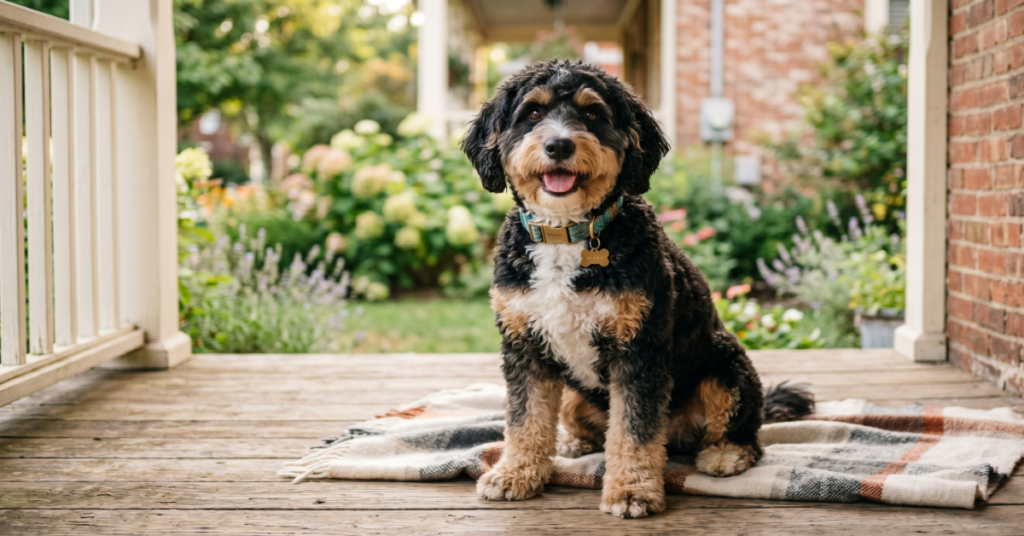
The mini Bernedoodle has quietly become one of the most sought-after hybrid dogs in North America. A cross between a Bernese Mountain Dog and a Miniature Poodle, this dog combines two distinct working breeds into a compact, affectionate companion that fits a wide range of households. But popularity does not always translate to transparency, and too many buyers discover the real demands of ownership only after bringing a puppy home.
Mini Bernedoodles typically land between 25 and 50 pounds, stand 14 to 22 inches at the shoulder, and carry the kind of wavy or curly coats that photograph beautifully but require genuine grooming discipline. They are highly trainable — Poodle intelligence runs strong in this mix — and generally social, calm, and good with children and other animals.
That said, the breed’s mixed-dog nature introduces meaningful variability. Two puppies from the same litter can look and behave quite differently. Size estimates are ranges, not guarantees. Coat type affects how much professional grooming you will pay for. Understanding these variables before buying is the difference between a great match and a frustrating mismatch.
This guide covers what prospective owners actually need to know: verified size and temperament data, honest grooming and exercise requirements, the health risks breeders rarely advertise upfront, and a clear picture of what the mini Bernedoodle will cost you — financially and in time — over a 10–15 year lifespan.
Size, Appearance, and What to Realistically Expect
The mini Bernedoodle’s most marketable trait — its compact, teddy-bear appearance — is also its most variable. Because this is a first-generation or multi-generation hybrid, the physical outcome of any given litter depends on which parent’s genes dominate. Reputable breeders use Miniature Poodles (not Toy Poodles) to produce the 25–50 lb range, but a skew toward Bernese genetics can push puppies significantly above that range.
Coat types fall into three general categories: wavy (most common in F1 crosses), curly (more Poodle-dominant, lowest shedding), and straighter (more Bernese-dominant, higher shedding). Buyers seeking low-shedding coats should specifically ask about the F1B generation — a mini Bernedoodle bred back to a Miniature Poodle — which produces a higher proportion of curly-coated puppies.
Coloring typically draws from the Bernese side: tricolor combinations of black, white, and rust are most common, though sable, phantom, and merle patterns appear in multi-generational breeding programs. Merle coloring in particular carries genetic health risks and should prompt additional health screening questions when evaluating breeders.
| Characteristic | Mini Bernedoodle | Bernese Mountain Dog | Miniature Poodle |
| Weight | 25–50 lbs | 70–115 lbs | 10–15 lbs |
| Height | 14–22 inches | 23–27 inches | 10–15 inches |
| Lifespan | 10–15 years | 7–10 years | 12–15 years |
| Shedding | Low to moderate | Heavy | Very low |
| AKC Recognized | No | Yes | Yes |
Temperament: What the Marketing Glosses Over
Mini Bernedoodles are widely described as calm, affectionate, intelligent, and good with families — and that characterization is broadly accurate. What promotional materials rarely address is that these traits exist on a spectrum, and the spectrum is wider in hybrid breeds than in purebreds with established behavioral standards.
The Bernese Mountain Dog contributes loyalty, patience, and a gentle disposition but also a degree of stubbornness and sensitivity to harsh training methods. The Miniature Poodle contributes sharp intelligence and trainability, but also a higher energy level and, in some lines, anxiety-prone behavior when under-stimulated. A mini Bernedoodle can inherit any combination of these traits.
First-generation (F1) crosses tend to show more behavioral variability than later generations. If predictable temperament is a priority — particularly for households with young children or elderly family members — an F2 or F1B generation from a breeder who conducts temperament testing before placement is a more reliable choice.
Separation anxiety is a documented concern in this mix. Both parent breeds are people-oriented dogs, and mini Bernedoodles left alone for long hours frequently develop destructive behaviors. This is not a dog for households where everyone is absent for eight or more hours daily without structured stimulation in place.
Grooming and Coat Care: The Real Time and Cost Commitment
Grooming is where mini Bernedoodle ownership most frequently surprises new owners. The low-shedding coat that makes this breed apartment-friendly does not mean low-maintenance — it means the coat grows continuously and mats if not brushed regularly.
A curly-coated mini Bernedoodle requires brushing at least three to four times per week and professional grooming every six to eight weeks. At current pricing across most U.S. markets, professional grooming for a dog in this size range runs $75–$120 per session, translating to $450–$900 annually at minimum. Owners who let coats mat between appointments may face pelting — full-coat shaving — which is uncomfortable for the dog and often costs more.
Wavy-coated dogs have slightly more flexibility: brushing two to three times weekly is generally sufficient, and grooming intervals can extend to eight to ten weeks. That said, the ears require particular attention in all coat types. Mini Bernedoodles inherit the Poodle’s tendency toward hair growth inside the ear canal, which increases moisture retention and infection risk if not cleaned and cleared regularly.
Home grooming tools worth investing in: a slicker brush, a metal comb, and a detangling spray formulated for dogs. Line brushing — working through the coat section by section down to the skin — is the technique that prevents the surface-only brushing that masks underlying mats.
Exercise and Training
Mini Bernedoodles need moderate daily exercise — typically 45 to 60 minutes split across two sessions. They are not high-drive working dogs, but they are not lap dogs either. Under-exercised mini Bernedoodles redirect energy into chewing, barking, and anxiety behaviors.
On the training side, this is one of the more rewarding breeds to work with. Poodle intelligence means they pick up commands quickly, and Bernese loyalty means they are motivated to engage with their owners. Positive reinforcement methods — treat-based and play-based reward systems — work consistently well. Harsh corrections tend to produce shutdown behaviors in Bernese-dominant puppies and are counterproductive.
Puppy socialization between eight and sixteen weeks is critical. Mini Bernedoodles that are not exposed to varied environments, sounds, and people during this window are more likely to develop fearfulness and reactivity in adolescence. Puppy classes serve both training and socialization functions and are worth the investment for first-time owners.
Health Considerations and Breeder Red Flags
Hybrid vigor — the genetic benefit theorized to come from crossing two purebred lines — is real but frequently overstated in mini Bernedoodle marketing. This mix can inherit health predispositions from both parent breeds.
From the Bernese Mountain Dog side, the significant risks are hip and elbow dysplasia, certain cancers (histiocytic sarcoma is notably prevalent in the breed), and von Willebrand disease (a bleeding disorder). From the Miniature Poodle side, the primary concerns are progressive retinal atrophy, Addison’s disease, and patellar luxation.
Responsible breeders test parent dogs for OFA hip and elbow certification, eye clearance through CAER testing, and DNA panels for breed-specific conditions. Buyers should request documentation of these tests — not verbal assurances. A breeder who cannot produce health certifications for both parent dogs is a significant red flag regardless of how professional their website appears.
| Health Condition | Source Parent | Recommended Screening |
| Hip/Elbow Dysplasia | Bernese Mountain Dog | OFA Certification |
| Histiocytic Sarcoma | Bernese Mountain Dog | Breeder health history |
| Von Willebrand Disease | Bernese Mountain Dog | DNA Panel |
| Progressive Retinal Atrophy | Miniature Poodle | CAER Eye Exam |
| Addison’s Disease | Miniature Poodle | Bloodwork screening |
| Patellar Luxation | Miniature Poodle | OFA Patella Eval |
What a Mini Bernedoodle Actually Costs
Purchase price for a mini Bernedoodle from a health-tested breeder typically ranges from $2,500 to $5,000, with multi-generational or rare-color puppies at the higher end of that range. Rescue organizations occasionally have Bernedoodle mixes available at significantly lower adoption fees, though availability is unpredictable.
First-year ownership costs beyond the purchase price — including vaccinations, spay/neuter, initial supplies, puppy classes, and six months of professional grooming — run approximately $2,000–$3,500 depending on location and veterinary pricing. Annual ongoing costs average $1,800–$2,800 for a healthy adult dog when accounting for food, preventatives, grooming, and routine vet care.
Pet insurance is worth serious consideration for this mix. Given the cancer predispositions inherited from the Bernese side, a single oncology event without insurance coverage can easily exceed $8,000–$15,000 in treatment costs. Enrolling a puppy before any conditions develop locks in lower premiums and avoids pre-existing condition exclusions.
The Future of Mini Bernedoodles in 2027
The designer dog market has faced increasing regulatory attention in recent years. Several U.S. states have moved to restrict or ban retail pet store sales of puppies from commercial breeders, a trend that pushes buyers toward direct breeder relationships and adoption channels. By 2027, this regulatory pressure is likely to intensify, with broader federal-level discussions around USDA licensing thresholds for home breeders gaining momentum.
Within the breeding community, the push toward multi-generational Bernedoodles — F3 and beyond — reflects an effort to stabilize coat type and temperament predictability. Several established programs are working toward a consistent breed standard that could eventually support formal hybrid registry recognition, though AKC recognition remains a distant and uncertain prospect given that organization’s stance on designer breeds.
On the health research side, the Berner-Garde Foundation continues longitudinal health tracking for Bernese Mountain Dogs, with data that increasingly informs breeding decisions for Bernedoodle programs as well. Genetic testing panels available to breeders are expanding annually, meaning that by 2027 buyers should reasonably expect more comprehensive health documentation than is currently standard. Buyers who do not demand this documentation will remain at elevated risk of inheriting undisclosed health liabilities.
Takeaways
- Size guarantees do not exist in mixed-breed dogs. A breeder who promises a specific adult weight is overstating their certainty.
- Low-shedding does not mean low-maintenance. Budget $450–$900 annually for professional grooming as a baseline cost.
- Health screening documentation for both parent dogs is non-negotiable. Verbal assurances are not a substitute for OFA certifications and DNA panels.
- Separation anxiety is a genuine risk in this mix. Households with long daily absences should plan for structured enrichment, dog walkers, or daycare.
- Pet insurance enrolled in puppyhood is a financially sound decision given the Bernese cancer predispositions in this cross.
- F1B or F2 generations offer more predictability in coat type and temperament than F1 crosses — relevant if consistency matters more than first-generation hybrid vigor.
- Puppy socialization between eight and sixteen weeks has a lasting impact on adult temperament. Breeders who hold puppies in isolation until sale are a red flag.
Conclusion
The mini Bernedoodle earns its popularity. It is a genuinely well-suited companion for families, singles, and retirees who can meet its grooming requirements, provide consistent daily activity, and commit to the social engagement this people-oriented dog genuinely needs. The combination of Bernese warmth and Poodle intelligence produces a dog that is easy to live with when its needs are understood and met.
The gap between expectation and reality usually comes down to grooming costs, the variability inherent to mixed-breed genetics, and the separation sensitivity that both parent breeds carry in different forms. None of these are disqualifying — they are simply factors that belong in an honest conversation before purchase, not after.
Buyers who research breeders carefully, demand health documentation, and enter ownership with realistic cost expectations will find the mini Bernedoodle is as rewarding as advertised. Those who treat it as an impulse purchase based on appearance alone are likely to find out the hard way what that coat actually requires.
Frequently Asked Questions
How big do mini Bernedoodles get?
Most mini Bernedoodles reach 25–50 pounds and 14–22 inches in height at the shoulder. Size varies based on which parent’s genetics are dominant and the generation of the cross. F1B dogs — bred back to a Miniature Poodle — tend to run smaller and more consistently within the lower end of the range. No breeder can guarantee an exact adult weight.
Do mini Bernedoodles shed?
Shedding depends heavily on coat type. Curly-coated dogs shed minimally and are considered better for households with mild dog allergies. Wavy coats shed moderately. Straight coats — rarer but possible in F1 litters — shed more. Regardless of shedding level, all mini Bernedoodle coats require regular brushing and professional grooming to prevent matting.
Are mini Bernedoodles good for first-time dog owners?
Generally yes, provided the owner commits to training and grooming requirements from the start. Their trainability makes them forgiving of inexperienced handling, and their temperament tends toward patience rather than reactivity. The learning curve is grooming, not behavior. Puppy classes are strongly recommended to build consistent communication habits early.
What is the lifespan of a mini Bernedoodle?
Mini Bernedoodles typically live 10–15 years. The Poodle side extends the lifespan relative to the Bernese Mountain Dog, which averages 7–10 years. Smaller individuals within the mini range tend toward the longer end. Preventive health care, appropriate diet, and regular veterinary screening all contribute meaningfully to longevity.
How much does a mini Bernedoodle puppy cost?
From health-tested breeders, expect to pay $2,500–$5,000. First-year ownership costs add another $2,000–$3,500. Annual ongoing costs for a healthy adult average $1,800–$2,800. Pet insurance adds to this but is strongly advisable given inherited health risks from the Bernese side. Rescue adoptions are significantly less expensive but availability is limited.
Are mini Bernedoodles hypoallergenic?
No dog is truly hypoallergenic — all dogs produce dander and saliva proteins that trigger allergic reactions. Mini Bernedoodles with curly, Poodle-dominant coats shed less and may be better tolerated by people with mild sensitivities, but they are not a guaranteed solution for dog allergies. Anyone with significant allergies should spend time with the specific puppy before committing to purchase.
What health problems are common in mini Bernedoodles?
The primary inherited risks include hip and elbow dysplasia and certain cancers (particularly histiocytic sarcoma) from the Bernese side, and progressive retinal atrophy, Addison’s disease, and patellar luxation from the Poodle side. Reputable breeders screen parent dogs for these conditions before breeding. Request OFA certifications and DNA panel results before purchasing any puppy.
Methodology
This article was produced using a combination of established breed health databases, veterinary reference literature, and grooming industry cost data aggregated from practitioner surveys across U.S. markets. Health condition data references OFA (Orthopedic Foundation for Animals) breed statistics and the Berner-Garde Foundation’s longitudinal health database for Bernese Mountain Dogs.
Cost estimates reflect 2024–2025 pricing data from professional grooming surveys and pet ownership cost analyses. Breeder price ranges were validated against current listings from established Bernedoodle breeding programs in the U.S.
Known limitations: Mixed-breed health data is inherently less standardized than purebred registry data. Temperament characterizations reflect observed population tendencies, not individual guarantees. Size and coat estimates are ranges based on generational patterns, not fixed outcomes.
This article was drafted with AI assistance and reviewed and verified by the editorial team at Postcard.fm. All data, citations, and claims have been independently confirmed before publication.
References
American Kennel Club. (2023). Bernese Mountain Dog breed information. https://www.akc.org/dog-breeds/bernese-mountain-dog/
American Kennel Club. (2023). Miniature Poodle breed information. https://www.akc.org/dog-breeds/poodle-miniature/
Berner-Garde Foundation. (2024). Health data and disease statistics for Bernese Mountain Dogs. https://www.bernergarde.org/
Orthopedic Foundation for Animals. (2024). OFA health testing and breed statistics. https://www.ofa.org/
Bellumori, T. P., Famula, T. R., Bannasch, D. L., Belanger, J. M., & Oberbauer, A. M. (2013). Prevalence of inherited disorders among mixed-breed and purebred dogs: 27,254 cases (1995–2010). Journal of the American Veterinary Medical Association, 242(11), 1549–1555.
American Veterinary Medical Association. (2024). Pet ownership and expenditures survey data. https://www.avma.org/resources-tools/reports-statistics/us-pet-ownership-statistics
North American Pet Health Insurance Association. (2024). State of the industry report. https://naphia.org/industry-data/