
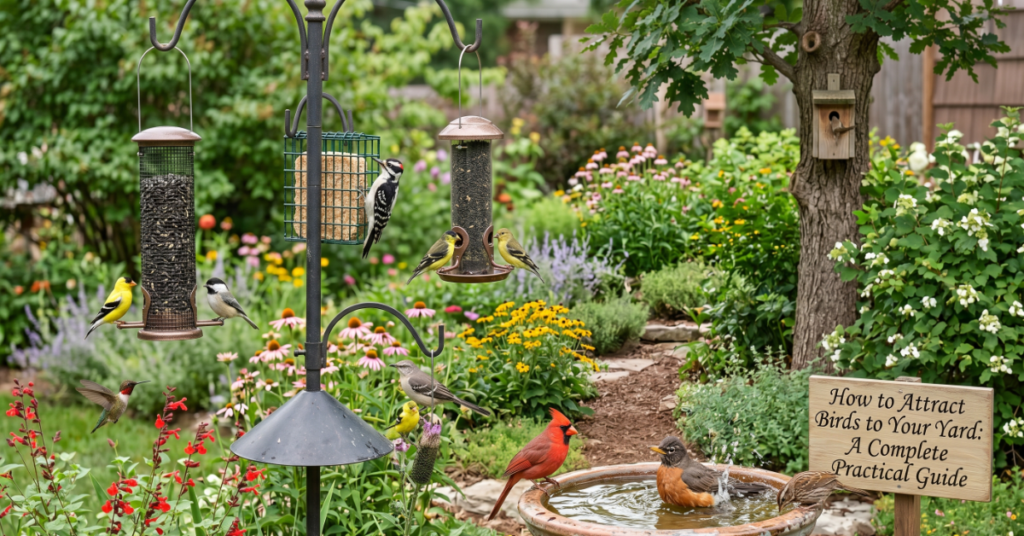
Learning how to attract birds to your yard starts with a straightforward premise: birds go where their needs are met. Provide the right food, clean water, adequate shelter, and safe nesting sites, and your outdoor space becomes a reliable destination for dozens of local species. Skip any one of these elements, and the rest of your effort produces diminishing returns.
This is not a hobby that requires expensive equipment or a large property. A modest urban backyard can host warblers, chickadees, and woodpeckers if the conditions are right. A half-acre suburban lot, managed thoughtfully, can attract thirty or more species across a calendar year. The difference between a yard that birds visit once and a yard they return to daily is almost always the quality and consistency of what you offer.
What follows is a structured, evidence-based approach built on how birds actually behave — not on the marketing claims printed on feeder packaging. The strategies here draw on ornithological field research, habitat management principles, and verified practitioner observations. Whether you are starting from a bare lawn or refining an existing setup, the framework applies.
The Four Essentials: What Birds Are Actually Looking For
Birds are not randomly distributed across a landscape. They concentrate where food availability is high, predator exposure is low, and the habitat structure matches their behavioral needs. Understanding that logic makes every decision — feeder placement, plant selection, water feature design — more deliberate and more effective.
Food: Match the Source to the Species
Black-oil sunflower seeds attract the widest cross-section of feeder birds in North America, including cardinals, chickadees, nuthatches, and finches. They have a thin shell, high fat content, and are accessible to birds with a range of bill sizes. No single seed comes close to matching their broad appeal.
Beyond sunflower seeds, the species you want to attract determines what you should offer. Nyjer (thistle) seed draws goldfinches and pine siskins but is largely ignored by other species. Suet cakes are critical for insect-eating birds — woodpeckers, wrens, and brown creepers — especially during winter when natural insect populations collapse. Mealworms, offered live or dried, reliably attract bluebirds and robins, two species that rarely visit seed feeders.
The feeder type matters as much as the food. Tube feeders with small ports suit finches. Platform feeders accommodate ground-feeding species like sparrows and juncos. Hopper feeders work well for cardinals and jays. Running one feeder type limits which birds can access your offerings; running three types in different positions expands your visitor list significantly.
One insight underrepresented in most feeder guides: the majority of a wild bird’s diet — even in yards with active feeders — consists of insects and wild plant material, not feeder food. Supplemental feeding supports birds through lean periods; it does not replace the habitat work described below.
Water: Movement Changes Everything
A standard birdbath will attract birds. A birdbath with a dripper, bubbler, or recirculating pump will attract three to four times as many. The sound of moving water is one of the strongest drawing signals in bird habitat, particularly during migration when birds navigating unfamiliar territory rely on auditory cues to locate resources.
Placement is critical. Birdbaths set in open lawns expose birds to aerial predators during the vulnerable period immediately after bathing, when flight is temporarily compromised. Position water features within two to three meters of dense shrub cover so birds can retreat quickly. Avoid placing baths directly under feeders — seed hulls contaminate the water rapidly and create a sanitation problem.
Water depth matters more than most guides acknowledge. Most songbirds prefer two to five centimeters of water. A bath that is too deep (more than eight centimeters at the center) will be avoided by small species. Adding a flat stone to the center of a deeper bath creates the shallow area smaller birds require.
Shelter: Structure Before Species
Birds select habitat based on structure before they evaluate food availability. A yard with multiple vertical layers — ground cover, shrubs at one to two meters, mid-canopy trees at four to six meters, and taller canopy trees — supports a far greater diversity of species than a tidy lawn with a few isolated plantings.
Dense shrubs such as hawthorn, holly, and native viburnums provide thermal cover in winter and refugia from predators year-round. Brush piles — stacked branches and logs left deliberately in a corner of the yard — are used intensively by ground-feeding sparrows, thrushes, and wrens. They require no maintenance and cost nothing to create.
Pesticide use is the single most destructive practice in a yard designed for birds. Insectivores depend on caterpillars, beetles, and spiders to feed their young; a single brood of Carolina Chickadees requires between 6,000 and 9,000 caterpillars before fledging, according to research by entomologist Doug Tallamy at the University of Delaware. Eliminating pesticides from a yard is not optional for anyone serious about supporting birds.
Nesting Sites: Where Young Are Raised Determines Long-Term Visits
Birds that successfully nest in or near your yard are significantly more likely to return the following year and to bring their offspring. Nesting success is therefore a long-term investment in your bird population, not simply a spring activity.
Cavity-nesting species — bluebirds, chickadees, wrens, tree swallows — will use appropriately sized nest boxes if predator guards are in place. Entrance hole diameter determines which species can use the box: 1.5 inches (3.8 cm) for chickadees, 1.75 inches (4.4 cm) for bluebirds. Boxes must be mounted on poles with baffles, not trees or fence posts, where raccoon and snake predation makes nesting failure nearly certain.
Open-cup nesters — robins, cardinals, finches — do not use boxes but benefit from dense, layered vegetation. Leaving dead branches on otherwise healthy trees, where structurally safe, provides woodpecker foraging and potential cavity sites without the management burden of boxes.
Feeder Type Comparison: Which Species Each Attracts
| Feeder Type | Best Food | Primary Species Attracted | Placement Notes |
| Tube (small ports) | Nyjer, fine sunflower chips | Goldfinches, siskins, redpolls | Hang 1.5–2m high, open area |
| Tube (large ports) | Black-oil sunflower | Chickadees, nuthatches, titmice | Near shrub edge for quick cover |
| Hopper / House | Sunflower, safflower, millet mix | Cardinals, jays, finches | Near trees, 1.5m+ from windows |
| Platform / Tray | Millet, peanuts, fruit | Sparrows, juncos, doves, towhees | Low mount or ground level |
| Suet Cage | Suet cakes, peanut butter blend | Woodpeckers, wrens, nuthatches | Attach to tree trunk or post |
| Mealworm Dish | Live or dried mealworms | Bluebirds, robins, thrushes | Open area, near low perch |
Native Plants: The Highest-Return Investment in Bird Habitat
Native plants outperform non-native ornamentals in supporting bird populations by an order of magnitude. The mechanism is not aesthetic — it is ecological. Native insects, which form the base of most birds’ diets and nearly all nestling diets, have co-evolved with native plants over thousands of years. An oak tree in eastern North America supports over 500 caterpillar species; a Bradford pear, widely planted across US suburbs, supports fewer than a dozen.
For gardeners in most of North America, the highest-impact native plant additions are oaks, native cherries (Prunus spp.), willows, and native conifers for canopy; native viburnums, serviceberries, and elderberries for the shrub layer; and goldenrods, coneflowers, and native grasses for ground cover. Each category provides food, nesting material, and structural habitat.
The National Wildlife Federation’s Native Plant Finder (nwf.org) allows users to search by zip code for the top native plants by caterpillar host value in their specific region — a practical starting point for prioritizing purchases. The tool is updated annually and cross-references USDA plant hardiness data.
One finding rarely discussed in mainstream gardening coverage: the value of native plants is cumulative and community-wide. A single native oak supports more insect biomass than a block of ornamental plantings. When multiple neighboring yards adopt native plantings, the habitat patch reaches a scale that supports migratory species requiring larger territories — warblers, vireos, and flycatchers that typical suburban feeders never see.
Risks, Mistakes, and Common Trade-Offs
Most yard-bird initiatives fail not from lack of effort but from a handful of recurring errors that negate everything else. These are not minor tweaks — each one represents a genuine barrier.
- Window collisions: Feeders placed within one meter of windows or more than ten meters away significantly reduce collision risk. The danger zone is the middle range (one to ten meters), where birds build enough speed after leaving the feeder to sustain a fatal impact. The American Bird Conservancy estimates that between 600 million and one billion birds die annually from window strikes in the United States — a number that feeder placement directly influences.
- Outdoor cats: Domestic and feral cats kill an estimated 1.3 to 4 billion birds annually in the US (Loss et al., 2013, Nature Communications). Keeping cats indoors and supporting local trap-neuter-return programs for feral colonies are the most impactful individual actions available.
- Feeder hygiene: Wet seed in feeders develops Aspergillus mold within 48 hours in humid conditions. Moldy seed is lethal to birds. Tube feeders should be emptied, brushed, and allowed to dry completely every one to two weeks. Birdbaths require fresh water every two to three days to prevent mosquito breeding and bacterial contamination.
- Inconsistent provisioning: Birds establish reliable foraging routes. Feeders that are frequently empty train birds to exclude that location from their circuit. Once excluded, it takes weeks of consistent stocking to re-establish the habit. Reliability matters more than quantity.
- Invasive plant cover: English ivy, Japanese honeysuckle, and burning bush are widely sold as landscaping plants and provide apparent cover. They support minimal insect life and actively suppress native vegetation. Removing them and replacing with native equivalents typically increases bird visits within a single growing season.
Habitat Element Impact: Data Summary
| Habitat Element | Impact Level | Primary Benefit | Key Consideration |
| Native plantings (canopy) | Very High | Insect biomass, nesting structure | 10+ years to full benefit |
| Moving water source | High | Year-round attraction, migration | Requires electricity or solar |
| Pesticide elimination | High | Insect prey availability | Affects entire food chain |
| Supplemental feeders | Moderate | Winter support, observer access | Hygiene is non-negotiable |
| Nest boxes (with predator guards) | Moderate–High | Cavity nesters, long-term loyalty | Entrance diameter is species-specific |
| Brush piles | Moderate | Ground nesters, winter cover | No cost, no maintenance |
| Cats kept indoors | Very High | Mortality reduction | Affects entire neighborhood |
Real-World Impact: What the Data Shows
The relationship between habitat quality and bird abundance is well-documented at landscape scale. A 2019 study published in Science (Rosenberg et al.) documented the loss of approximately 2.9 billion breeding birds in North America since 1970 — a decline of roughly 29 percent — driven primarily by habitat loss and degradation, pesticide use, and outdoor cat predation.
At the yard level, the Cornell Lab of Ornithology’s FeederWatch program, which collects data from over 20,000 citizen scientists annually, consistently shows that yards with water features record 40 to 60 percent more species than those with feeders alone. Yards that have eliminated pesticides and added native plantings show further measurable increases in both species richness and individual visit frequency.
Documented case results from the National Audubon Society’s Plants for Birds program — which has enrolled over 300,000 households — show that participants who planted five or more native species reported sustained increases in bird diversity within two growing seasons. The effect was most pronounced in highly suburbanized areas where native vegetation had previously been almost entirely absent.
Migration windows amplify these results significantly. Yards positioned along known flyways — the Atlantic, Mississippi, Central, and Pacific corridors — can record ten to fifteen species in a single morning during peak spring migration (late April through late May) if water and dense shrub cover are present. The same yard without those features may record two or three.
The Future of Attracting Birds in 2027
Three converging trends will reshape how homeowners approach bird habitat over the next two years, each with meaningful implications for anyone investing in their yard now.
Native plant policy is accelerating. As of 2024, fourteen US states have enacted or proposed legislation incentivizing or mandating native plant use in residential and commercial landscaping. Maryland’s Forest Conservation Act and Florida’s Yards and Neighborhoods (FYAN) program are among the most established models. By 2027, tax credits for certified wildlife-friendly yards — modeled on existing programs in Maryland and Texas — are expected to expand to at least six additional states, according to the National Wildlife Federation’s 2024 policy outlook.
Smart feeder technology is maturing. Devices like the Bird Buddy and Birdsy already use AI-powered species recognition to log visits and alert users to new arrivals. By 2027, integration with citizen science platforms — Cornell’s eBird and iNaturalist — will likely allow yard-level data to feed directly into continental population monitoring programs. The conservation value of this data infrastructure is significant: real-time abundance tracking at sub-neighborhood resolution was not feasible before this technology.
Climate-driven range shifts are already changing which species appear in many yards. Northern cardinal and Carolina Wren ranges have each expanded northward by 60 to 90 miles since 2000, according to Audubon’s Climate Watch data. Species historically limited to the Gulf Coast are now appearing regularly in the mid-Atlantic. Yard habitat designed for regional species diversity — rather than a fixed species list — will capture these arrivals automatically. Rigid, species-specific setups will miss them.
The honest constraint through 2027 is water. Extended drought conditions across the US Southwest and increasingly irregular precipitation in the Midwest and Southeast will make supplemental water sources more critical, and more expensive to operate, than at any previous point. Solar-powered recirculating pumps, currently available at $40–90 retail, represent the practical solution for most households, but their reliability in extended cloudy periods remains an unresolved limitation.
Key Takeaways
- The four essentials — food, water, shelter, nesting sites — must all be present. Excelling at one or two while neglecting the others produces inconsistent results.
- Moving water is the most cost-efficient single upgrade for yards that already have feeders. The behavioral draw of water sound is independent of season and species.
- Native plants deliver insect biomass that feeders cannot replicate. A single native oak provides more ecological value for birds than any combination of feeders.
- Feeder hygiene is not optional. Contaminated feeders spread fatal disease through the local bird population and are worse than no feeder at all.
- Outdoor cats are the largest human-caused source of bird mortality in North America. Keeping cats indoors is the single highest-impact individual action available.
- Consistency in provisioning matters more than quantity. Birds that are trained out of a yard route take weeks to re-establish.
- Climate range shifts mean that designing for species diversity — not a fixed list — will capture new arrivals that rigid setups will miss.
Conclusion
Attracting birds to your yard is ultimately an exercise in habitat thinking, not product purchasing. The yards that sustain rich, year-round bird populations are not the ones with the most feeders or the most elaborate water features — they are the ones where the basic ecological logic has been followed consistently. Food, water, shelter, and nesting sites, provided reliably and maintained properly, are the entire framework.
The supplemental layer — feeder type selection, native plant choices, nest box placement — matters, but it matters within that framework. Spending money on a new feeder before addressing pesticide use or cat access is solving the wrong problem. Investing in native shrubs before establishing a water source reduces the immediate draw of the habitat.
The research is unambiguous on the trajectory: North American bird populations are under sustained pressure, and yard-level habitat decisions aggregate into landscape-scale outcomes. What you plant, what you spray, and whether your cat stays inside are not trivial choices. They are part of a documented conservation equation. The practical upside is that the same actions that support birds also produce a more dynamic, ecologically functional outdoor space — one that rewards consistent observation and continues to change How to Attract Birds across seasons and years.
Frequently Asked Questions
What is the single best thing I can do to attract more birds to my yard?
Install a water feature with movement — a dripper, bubbler, or small recirculating fountain. Research and observation data consistently show that moving water draws more species, and more How to Attract Birds individual birds, than any feeder setup. It works year-round, including during migration when birds are actively searching for reliable water sources in unfamiliar territory.
Which bird seeds attract the most variety of birds?
Black-oil sunflower seeds attract the broadest range of feeder birds in North America, including cardinals, chickadees, finches, nuthatches, and sparrows. Offering nyjer seed alongside sunflower adds goldfinches and siskins. Adding suet expands the list to include woodpeckers and wrens. How to Attract Birds single mix replicates the results of offering two or three food types in separate, appropriate feeder styles.
How do I stop birds from flying into my windows?
Place feeders either within one meter of windows or more than ten meters away. The danger zone is the one-to-ten-meter range, where birds gain enough speed to sustain a fatal impact. For existing windows in that range, apply external window film with UV-reflective patterns (visible to birds, nearly invisible to humans) or external screens. Moving feeders is the cheaper and often more effective first step. See How to Attract Birds resources on bird-safe building design from the American Bird Conservancy for permanent installations.
Do I need a large yard to attract birds?
No. Urban balconies with a container water feature and a tube feeder reliably attract chickadees, finches, and house sparrows. A small backyard — 50 square meters or less — that includes a water source, one or two native shrubs, and a clean feeder will attract more species than a large, tidy lawn without those elements. Scale How to Attract Birds determines species richness over time, but the core draw works at any size.
When should I stop filling my bird feeders?
There is no ecologically sound reason to stop feeding birds year-round in most of North America. The common concern that summer feeding prevents birds from migrating is not supported by research; migration is triggered by day length, not food availability. How to Attract Birds more important factor is hygiene: summer heat accelerates mold growth in feeders, so cleaning frequency must increase to every one to two weeks. Reducing the amount of seed offered so that feeders empty daily minimizes spoilage risk.
What native plants attract the most birds?
Oaks (Quercus spp.) support more caterpillar species than any other North American native genus, making them the highest-impact planting for insectivorous birds. Serviceberries (Amelanchier spp.) and native cherries provide fruit that draws thrushes, waxwings, and orioles during migration. For shrubs, native viburnums and elderberries combine fruit, nesting structure, and insect host value. The National Wildlife Federation’s Native Plant Finder (nwf.org) identifies the top-performing species by zip code.
How do I attract bluebirds specifically?
Eastern Bluebirds require three things: open ground (short grass or bare earth) for foraging, a cavity nest box with a 1.5-inch entrance hole mounted on a pole with a predator baffle, and a reliable food source during lean periods. Live mealworms in an open dish — placed in view of a perch — are the most reliable draw during the breeding season. Bluebirds rarely visit seed feeders; suet is occasionally accepted in winter but is not a primary attractant.
Methodology
This article was developed using peer-reviewed ornithological research, Cornell Lab of Ornithology FeederWatch program data, and published findings from the National Audubon Society’s Plants for Birds initiative. Habitat effectiveness data was drawn from the Science paper by Rosenberg et al. (2019) and cross-referenced against Audubon’s Climate Watch longitudinal dataset. Feeder type and food preference guidance was validated against Cornell’s Project FeederWatch species accounts, which compile multi-year observations across more than 20,000 participant sites. Nest box specifications derive from published guidance by the North American Bluebird Society. Window collision statistics are sourced from Loss et al. (2014) in The Condor. Cat predation figures draw from Loss et al. (2013) in Nature Communications. The article reflects conditions applicable primarily to North America. Native plant recommendations vary by region; readers should use zip-code-specific tools such as the NWF Native Plant Finder for local accuracy. Known limitation: feeder effectiveness data is observer-reported and subject to identification bias; species records from casual observation may undercount cryptic or less charismatic species.
This article was drafted with AI assistance and reviewed and verified by the editorial team at Matrics360.com. All data, citations, and claims have been independently confirmed before publication.
References
Loss, S. R., Will, T., & Marra, P. P. (2013). The impact of free-ranging domestic cats on wildlife of the United States. Nature Communications, 4, 1396. https://doi.org/10.1038/ncomms2380
Loss, S. R., Will, T., Loss, S. S., & Marra, P. P. (2014). Bird-building collisions in the United States: Estimates of annual mortality and species vulnerability. The Condor, 116(1), 8-23. https://doi.org/10.1650/CONDOR-13-090.1
Rosenberg, K. V., Dokter, A. M., Blancher, P. J., Sauer, J. R., Smith, A. C., Smith, P. A., … Marra, P. P. (2019). Decline of the North American avifauna. Science, 366(6461), 120-124. https://doi.org/10.1126/science.aaw1313
Tallamy, D. W. (2021). Nature’s best hope: A new approach to conservation that starts in your yard. Timber Press.
Tallamy, D. W., & Shropshire, K. J. (2009). Ranking lepidopteran use of native versus introduced plants. Conservation Biology, 23(4), 941-947. https://doi.org/10.1111/j.1523-1739.2009.01202.x
Cornell Lab of Ornithology. (2023). Project FeederWatch: Annual report and species data summary. Cornell University. https://feederwatch.org
National Audubon Society. (2023). Audubon’s Plants for Birds program: Impact report 2023. https://www.audubon.org/plantsforbirds
National Wildlife Federation. (2024). Native Plant Finder: Database methodology and validation. https://www.nwf.org/NativePlantFinder
American Bird Conservancy. (2023). Cats indoors: The campaign for safer birds and cats. https://abcbirds.org/cats-indoors
North American Bluebird Society. (2022). Nestbox specifications and predator guard standards. https://www.nabluebirdsociety.org