
Healthcare organizations process millions of insurance claims, eligibility checks, and payment transactions every day. Managing these activities manually is time-consuming and increases the risk of costly errors. This is where Availity plays an essential role.
Availity is a secure healthcare information network that connects more than 95% of health insurance payers with over three million healthcare providers across the United States. Acting as a centralized clearinghouse, it enables providers and insurers to exchange administrative, financial, and clinical information electronically.
Instead of logging into multiple insurance portals or handling paper-based documentation, healthcare professionals can complete many routine tasks through one secure platform. This reduces administrative burdens while improving productivity and patient service.
How Availity Works
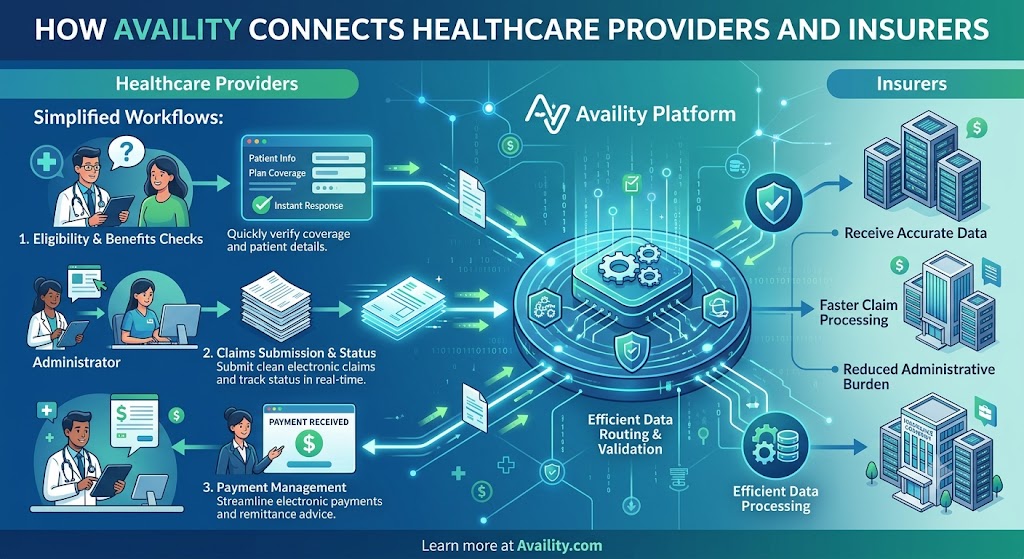
Availity functions as a bridge between healthcare providers and insurance companies. When a provider needs to verify insurance eligibility, submit a medical claim, request prior authorization, or receive payment information, the platform securely transfers data between both parties.
The process generally follows these steps:
| Step | Purpose |
| Patient Visit | Patient receives medical care. |
| Eligibility Check | Provider verifies insurance coverage through Availity. |
| Claim Submission | Medical claims are submitted electronically. |
| Claim Processing | Insurance payer reviews and processes the claim. |
| Payment Information | Provider receives electronic remittance advice and payment status. |
This streamlined workflow helps reduce delays while improving communication accuracy.
Key Features of Availity
Eligibility and Benefits Verification
Healthcare providers can instantly verify a patient’s insurance eligibility before treatment. This minimizes billing errors and allows patients to understand their coverage before receiving care.
Electronic Claims Submission
Availity supports electronic claim submission to thousands of insurance payers. Electronic filing is generally faster and more accurate than traditional paper claims.
Prior Authorization
Many medical procedures require approval before treatment. Availity simplifies prior authorization requests by allowing providers to submit documentation electronically and monitor request status in real time.
Claims Status Tracking
Providers no longer need to make repeated phone calls to insurance companies. They can easily monitor claim progress and identify issues that require attention.
Electronic Remittance Advice
Payment explanations and remittance documents are delivered electronically, helping providers reconcile payments more efficiently.
Secure Messaging
Healthcare organizations can securely exchange administrative information with participating insurance companies while maintaining patient privacy.
Benefits of Using Availity
Healthcare organizations experience numerous advantages after implementing Availity into their administrative workflow.
Improved Efficiency
Automation reduces repetitive manual tasks, allowing office staff to focus on patient care instead of paperwork.
Faster Claim Processing
Electronic claim submission often speeds up insurance processing compared to paper-based methods.
Fewer Billing Errors
Eligibility verification and automated validation reduce claim denials caused by incorrect patient or insurance information.
Cost Savings
Reducing paper forms, postage, and manual processing lowers administrative costs for healthcare organizations.
Better Patient Experience
When insurance information is verified before appointments, patients are less likely to encounter unexpected billing problems.
Common Services Available Through Availity
Availity supports numerous administrative healthcare functions.
| Service | Description |
| Eligibility Verification | Confirms patient insurance coverage. |
| Claims Submission | Sends medical claims electronically. |
| Claims Status | Tracks insurance claim progress. |
| Prior Authorization | Requests approval for specific treatments. |
| Electronic Remittance Advice | Receives payment explanations electronically. |
| Provider Directory | Accesses payer-related provider information. |
Who Uses Availity?
A wide range of healthcare organizations depend on Availity every day.
These include:
- Hospitals
- Physician practices
- Medical clinics
- Dental providers
- Behavioral health organizations
- Billing companies
- Insurance companies
- Healthcare administrators
Because the platform supports many different payer relationships, organizations can simplify workflows without managing multiple systems.
Security and Compliance
Healthcare information requires strict protection. Availity incorporates multiple security measures designed to safeguard sensitive patient and financial data.
These protections include encrypted data transmission, secure authentication methods, user access controls, and compliance with HIPAA regulations. Regular security updates help maintain a safe environment for healthcare organizations exchanging confidential information.
Challenges and Limitations
Although Availity offers many benefits, users may occasionally experience challenges.
Some healthcare organizations require employee training before fully adopting the platform. Smaller practices may also need time to integrate existing workflows with electronic processes.
Additionally, some insurance payers maintain unique requirements that providers must still follow, even when using a centralized platform.
Despite these challenges, most organizations find that the long-term benefits significantly outweigh the initial learning curve.
The Future of Availity
Healthcare continues to embrace digital transformation, and platforms like Availity are becoming increasingly important. As artificial intelligence, predictive analytics, and automation expand across healthcare administration, providers can expect even more streamlined workflows.
Future enhancements may include smarter claim validation, improved interoperability between healthcare systems, enhanced patient communication tools, and faster authorization processing. Continued investment in secure digital infrastructure will likely strengthen collaboration between providers and insurers while reducing administrative complexity.
Key Takeaways
- Availity connects millions of healthcare providers with nearly all major U.S. health insurance payers.
- The platform simplifies claims, eligibility verification, and prior authorizations.
- Electronic workflows improve efficiency and reduce administrative costs.
- Secure communication supports HIPAA-compliant information exchange.
- Faster processing benefits providers, insurers, and patients alike.
Conclusion
Availity has become one of the most important healthcare information networks in the United States. By serving as a secure connection between healthcare providers and insurance companies, it reduces administrative workloads while improving the speed and accuracy of healthcare transactions.
Its wide range of services—including eligibility verification, claims management, prior authorization, and payment processing—helps healthcare organizations operate more efficiently and provide better experiences for patients. Although implementation may require training and workflow adjustments, the long-term advantages make Availity a valuable solution for modern healthcare administration.
Frequently Asked Questions
What is Availity used for?
Availity is primarily used to exchange administrative, financial, and clinical information between healthcare providers and insurance companies.
Is Availity free for providers?
Many core services are available at no cost to eligible healthcare providers, although some advanced solutions may involve additional fees depending on the service.
Is Availity HIPAA compliant?
Yes. The platform is designed to support HIPAA-compliant communication and secure healthcare data exchange.
Can small medical practices use Availity?
Yes. Independent physicians, clinics, and large hospital systems all use the platform for administrative tasks.
Why is Availity important?
Availity improves efficiency, reduces paperwork, minimizes claim errors, and simplifies communication between providers and insurance payers.
Methodology
This article is based on the information provided in the supplied writing template and presents an explanatory overview of Availity as a healthcare information network. It should be supplemented with current official documentation and industry sources before publication.