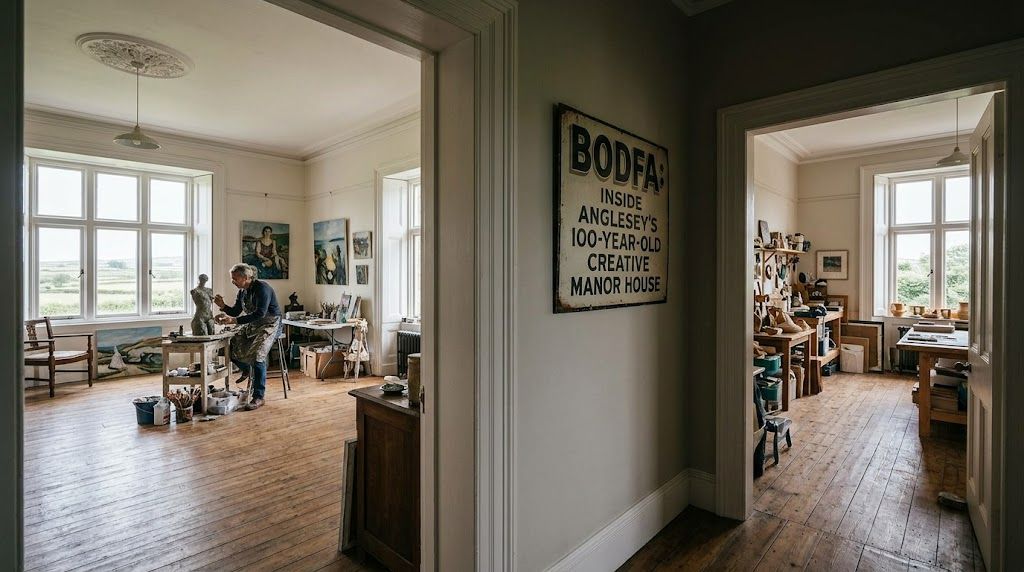
Bodfa is a 100-year-old manor house in Llangoed on the Isle of Anglesey, North Wales, but describing it simply as a historic property misses much of what makes the place unusual. Today, Bodfa combines heritage with contemporary art, community activity, environmental projects, astronomy, performance and research. The property includes gardens, a greenhouse, stables, a nature pond, an orchard, a wildflower meadow and a five-acre field.
The house was built in the 1920s as a family home, drawing on Art Deco and Arts and Crafts influences. Over time, its function changed dramatically. It became a steakhouse during the 1970s, later operated as a residential care home and eventually served as headquarters for the Elizabeth Bradley tapestry kit company. After that business moved on, the property remained empty for more than a decade.
That unusual sequence is central to understanding Bodfa today. Rather than treating heritage as something fixed behind glass, its current creative work uses the house and its surroundings as living material.
From Family Home to Creative Hub
Bodfa’s history is particularly revealing because the building has repeatedly adapted to new social and economic purposes.
| Period | Use of Bodfa |
| 1920s | Family home |
| 1970s | American-style steakhouse |
| 1979–2002 | Residential care home |
| 2002–2008 | Elizabeth Bradley headquarters |
| 2008–2018 | Empty property |
| 2019 onwards | Creative exhibitions and projects |
| 2020 onwards | Creative community and project base |
The timeline shows that Bodfa has never had only one identity. Each phase left traces in the building, creating a layered setting for later creative work. The site’s own history project describes this research as ongoing, which is important because heritage records are often incomplete and local memories can add information unavailable in formal archives.
The Creative Model Behind Bodfa
The most interesting feature of Bodfa may be its approach to participation.
Plas Bodfa Projects CIC describes its purpose as creating inclusive projects that bring together people with different ages, interests, knowledge and backgrounds. The organisation’s projects extend from Anglesey into wider Wales and international creative networks.
This makes Bodf’a different from a conventional gallery or heritage attraction. A gallery generally presents finished work. Bodf’a often provides the environment in which work is developed, tested, performed or discussed.
That distinction has practical consequences. The house becomes both venue and subject. Its architecture, previous occupants, surrounding landscape and local stories can all become starting points for creative investigation.
What Happens at Bodfa?
Bodfa’s projects cover a surprisingly wide range of disciplines.
Recent and past initiatives have included community astronomy, sculpture trails, performances, storytelling, exhibitions, environmental investigations and artist residencies. The Busby-Braden Observatory, for example, connects community participation with Welsh dark skies and astronomy.
Residencies have also brought together artists, writers and researchers for periods of thinking, making and collaboration. Listed residency activity has included poets and interdisciplinary creative practitioners between 2024 and 2026.
Bodfa’s Project Ecosystem
| Area | Example | Wider purpose |
| History | Bodfa History Project | Preserve and reinterpret local stories |
| Contemporary art | Bodfa Continuum | Connect many creative practices |
| Astronomy | Busby-Braden Observatory | Explore Welsh dark skies |
| Ecology | Aberlleiniog Sculpture Trail | Connect art with landscape |
| Performance | Piano Drowning | Combine sound, place and performance |
| Residencies | Artist residencies | Support research and collaboration |
The Evidence of Cultural Impact
One useful way to judge Bodfa’s significance is through documented participation rather than descriptions alone.
The 2019 Sui Generis exhibition brought 67 projects from 66 creatives and collaborative groups into the house. The exhibition attracted 1,393 visitors over 16 days.
Three years later, Bodf’a Continuum expanded the scale considerably. Its April 2022 exhibition involved 69 creative projects from more than 77 artists, makers and creative people, with more than 2,300 visitors.
These figures suggest an important shift: Bodfa’s cultural value is not limited to the preservation of an old building. The property can function as infrastructure for participation.
Three Insights That Make Bodfa Different
1. The building itself becomes creative material.
Its changing uses provide artists with a documented social history rather than a neutral exhibition space.
2. The landscape expands the definition of the venue.
Projects can move beyond rooms into gardens, woodlands, fields, water and nearby community spaces. This allows environmental and place-based work to sit alongside conventional artistic practices.
3. Small-scale infrastructure can support broad collaboration.
A manor house in rural Anglesey might appear geographically remote, yet Bodfa’s project model demonstrates how local spaces can connect with artists and ideas beyond the immediate community.
The Future of Bodfa in 2027
Bodfa’s direction towards 2027 appears likely to remain interdisciplinary rather than becoming a conventional cultural venue. Its existing work points towards continued collaboration involving creativity, education, science, ecology and local heritage.
The planned and recent residency model is especially significant because it identifies artists, academics, scientists, educators, musicians, writers and other researchers as potential participants.
The main constraint is equally clear: a historic rural property cannot operate like a large institutional arts centre. Access, funding, maintenance, staffing and the physical condition of an old building all shape what can realistically happen.
That limitation may actually be part of Bodfa’s identity. Its strength is its ability to support projects that respond to place rather than follow a standard cultural-venue formula.
Key Takeaways
- Bodfa’s history spans domestic, commercial, care and creative uses.
- Its 1920s architecture provides a physical foundation for contemporary cultural activity.
- The site’s gardens and surrounding landscape are as important to its identity as the manor house.
- Documented exhibitions demonstrate substantial participation and visitor interest.
- Its interdisciplinary model links heritage with art, science, ecology and community activity.
- Its future potential depends on balancing creative ambition with the practical realities of maintaining a historic rural property.
Frequently Asked Questions
What is Bodfa?
Bodfa, or Plas Bodfa, is a 100-year-old manor house in Llangoed on Anglesey, North Wales. It is now associated with creative projects, exhibitions, research, community activity and cultural events.
Where is Bodfa located?
Bodfa is located in Llangoed on Ynys Môn, the Welsh name for the Isle of Anglesey. It is in North Wales.
When was Bodfa built?
The house was built in the 1920s as a family home. Its design incorporated influences from the Art Deco and Arts and Crafts movements.
What kinds of projects take place at Bodfa?
Projects have included contemporary art exhibitions, performances, astronomy, sculpture, storytelling, environmental work, publishing and artist residencies.
Can visitors visit Bodfa?
Bodfa does not have regular visiting hours. The organisation states that guests are welcomed during scheduled events and open days.
What was Bodfa used for before becoming a creative space?
It has served as a family home, steakhouse, residential care home and business headquarters before becoming associated with contemporary creative projects.
Methodology
This article was researched using publicly available information from Plas Bodfa’s official project, history, residency and exhibition pages. Historical dates, project descriptions and visitor figures were checked against the organisation’s published records. The analysis distinguishes documented facts from interpretation and does not claim personal attendance, testing or firsthand observation.
A limitation is that Bodfa’s history project remains a work in progress, meaning some aspects of the property’s earlier history may continue to develop as additional photographs, documents and local memories are collected.
AI Editorial Disclosure: This article was drafted with AI assistance. Historical claims and project information should be independently checked by a human editor against the original sources before publication.
References
Plas Bodfa. (n.d.). Plas Bodfa history project. Plas Bodfa.
Plas Bodfa Projects CIC. (n.d.). Plas Bodfa Projects CIC. Plas Bodfa.
Plas Bodfa. (n.d.). Sui Generis – The first exhibition. Plas Bodfa.
Plas Bodfa. (n.d.). Bodfa Continuum exhibition. Plas Bodfa.
Plas Bodfa. (n.d.). Artist residencies. Plas Bodfa.