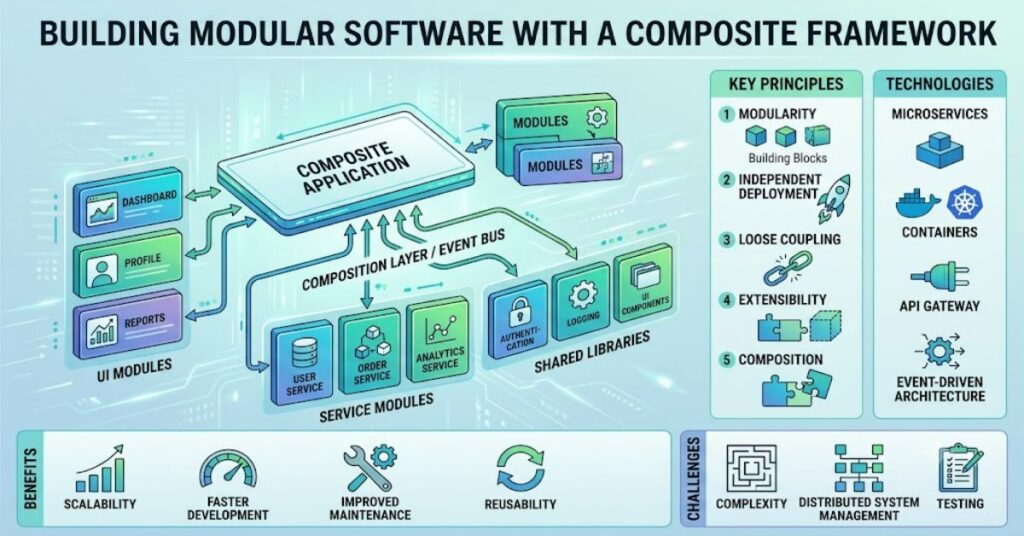
Modern software applications are becoming increasingly complex. Businesses expect applications to handle growing user demands, integrate with multiple systems, and evolve without requiring complete redesigns. This is where a composite application framework becomes valuable.
A composite application framework is a software architecture that allows developers to build large applications by combining multiple independent modules. Each module performs a specific function while working together as part of a complete application. Instead of creating one massive application with tightly connected components, developers divide functionality into smaller, manageable pieces.
This modular approach improves flexibility, simplifies maintenance, and enables development teams to work on different parts of an application simultaneously. Whether building enterprise software, healthcare systems, banking platforms, or business management tools, composite application frameworks provide an efficient way to develop reliable software.
What Is a Composite Application Framework?
A composite application framework is a development framework designed to support modular software architecture. Rather than treating an application as one large block of code, it separates features into independent components that communicate through well-defined interfaces.
Each module has a specific responsibility. Some manage user authentication, others process payments, display reports, or communicate with databases. Together, these modules create a complete application while remaining loosely connected.
This design allows developers to update, replace, or expand individual modules without affecting the entire system.
Core Components of a Composite Application Framework
Most composite application frameworks include several essential components.
| Component | Purpose |
| User Interface Module | Displays application screens and user interactions. |
| Business Logic Module | Processes application rules and workflows. |
| Data Access Layer | Connects applications with databases. |
| Communication Layer | Enables modules to exchange information. |
| Service Layer | Provides reusable business services across modules. |
Each component performs a dedicated role, making the application easier to understand and maintain.
How Composite Application Frameworks Work
The framework divides an application into multiple independent modules.
Instead of placing every feature inside one large project, developers separate functionality into reusable components. These components communicate through APIs, shared services, or messaging systems.
For example, an e-commerce platform may include separate modules for:
- User management
- Product catalog
- Shopping cart
- Inventory
- Payment processing
- Order tracking
Because each module operates independently, improvements can be made without rewriting the entire application.
Benefits of Using a Composite Application Framework
Better Scalability
As businesses grow, software requirements change. Composite frameworks allow developers to add new modules without disrupting existing functionality.
Easier Maintenance
When bugs appear, developers can isolate problems within individual modules instead of searching through an entire application.
Faster Development
Multiple teams can work on different modules simultaneously, reducing overall development time.
Improved Reusability
Modules created for one project can often be reused in another application, saving development effort.
Greater Flexibility
Organizations can replace outdated modules with newer versions while keeping the rest of the application unchanged.
Common Use Cases
Composite application frameworks are widely used across industries.
Enterprise Resource Planning (ERP)
ERP systems combine finance, inventory, sales, and human resources into one platform using modular architecture.
Healthcare Systems
Hospitals use separate modules for patient records, appointments, billing, pharmacy management, and laboratory services.
Banking Applications
Banks separate account management, transaction processing, customer services, and fraud detection into individual components.
Government Platforms
Government portals often combine taxation, licensing, identity verification, and public services within a single modular application.
Composite Framework vs Monolithic Architecture
| Composite Application Framework | Monolithic Architecture |
| Modular design | Single large application |
| Easier to maintain | Difficult to update |
| Supports independent modules | Components are tightly connected |
| Better scalability | Limited scalability |
| Faster team collaboration | Development often becomes slower |
Many organizations are moving away from monolithic applications because modular architectures provide greater long-term flexibility.
Challenges
Although composite frameworks provide many benefits, they also introduce challenges.
Communication between modules must be carefully managed to avoid performance issues. Developers must establish clear interfaces and ensure that security is maintained across all components.
Testing modular applications can also become more complex because every module must function correctly on its own while integrating seamlessly with others.
Despite these challenges, the advantages generally outweigh the drawbacks for medium and large software projects.
Best Practices
To get the most from a composite application framework, developers should follow these practices:
- Design modules with a single responsibility.
- Keep communication between modules simple.
- Create reusable services whenever possible.
- Use version control for every module.
- Write automated tests for each component.
- Document interfaces clearly.
- Monitor application performance regularly.
These practices improve reliability and reduce long-term maintenance costs.
Future of Composite Application Frameworks in 2027
Composite application frameworks are expected to become even more important as organizations adopt cloud-native technologies, microservices, and artificial intelligence. Businesses increasingly require software that can evolve quickly without major disruptions.
Future frameworks will likely provide stronger support for containerization, distributed computing, API integration, and automated deployment pipelines. Low-code and AI-assisted development tools may also simplify module creation while preserving the modular principles that composite frameworks promote.
Although development technologies continue to evolve, modular architecture will remain a key strategy for building scalable enterprise software.
Key Takeaways
- Composite application frameworks organize software into reusable modules.
- Modular architecture simplifies maintenance and updates.
- Teams can develop multiple components simultaneously.
- Enterprise software benefits greatly from modular design.
- Reusable modules reduce development costs.
- Proper communication between modules is essential.
- Composite frameworks support long-term software growth.
Conclusion
A composite application framework provides a practical solution for developing large, scalable, and maintainable software applications. By dividing functionality into independent modules, organizations can improve development efficiency, simplify maintenance, and adapt to changing business requirements more easily.
From banking systems to healthcare platforms and enterprise business software, modular frameworks have become an essential part of modern software engineering. While they require thoughtful planning and clear communication between components, the long-term advantages make them an excellent choice for organizations building applications that must grow and evolve over time.
Frequently Asked Questions
What is a composite application framework?
A composite application framework is a modular software architecture that combines independent application components into a single integrated system.
Why is modular architecture important?
It improves scalability, simplifies maintenance, and allows developers to reuse software components.
Which industries use composite application frameworks?
Banking, healthcare, government, education, retail, manufacturing, and enterprise software development commonly use them.
Is a composite framework better than a monolithic application?
For large applications, composite frameworks generally offer greater flexibility, easier maintenance, and improved scalability.
Can small projects use composite application frameworks?
Yes, although very small applications may not require the additional architectural complexity. Modular frameworks become increasingly valuable as applications grow.