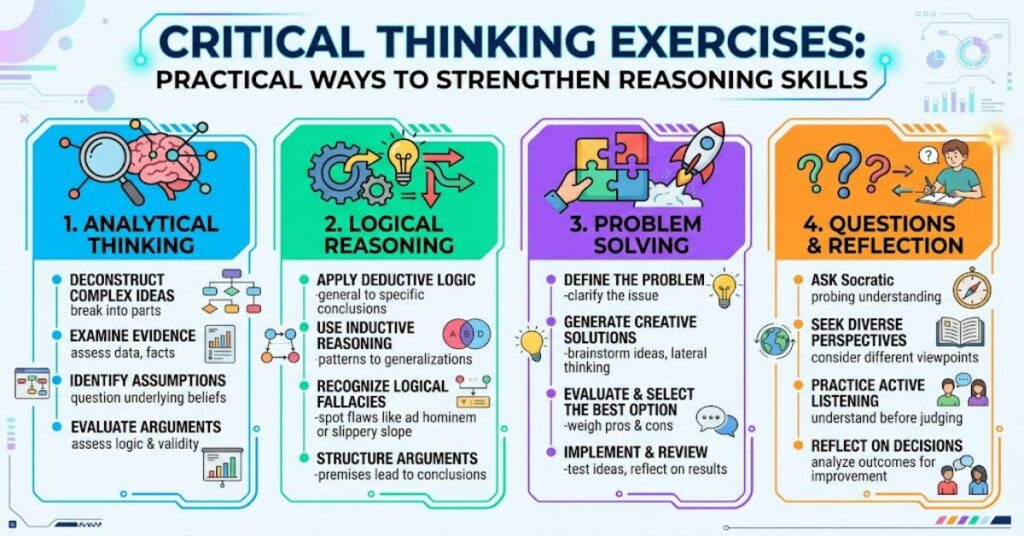
Critical thinking exercises are practical activities designed to improve how people analyse information, question assumptions and reach reasoned conclusions. They can be used in classrooms, workplaces, study sessions and everyday decision-making.
The goal is not to make someone disagree with everything. Good critical thinking means examining a claim before accepting or rejecting it. That requires attention to evidence, context, logic, uncertainty and alternative explanations.
This distinction matters because people often make decisions using incomplete information or familiar assumptions. Online content adds another challenge. The American Psychological Association has highlighted the importance of helping young people distinguish reliable information from misleading or manipulative content, including recognising the difference between evidence, opinion and unsupported claims.
The most useful activities therefore simulate real decisions. Instead of simply asking learners to define “bias” or “evidence”, an exercise can present a short claim and ask: What supports it? What is missing? Who created the information? What alternative explanation could fit the same facts?
That process turns critical thinking from an abstract concept into a repeatable habit.
What Makes an Effective Critical Thinking Exercise?
A strong activity should require more than recall. It should make the learner examine relationships between information and justify a conclusion.
| Exercise type | Main skill developed | Example task |
| Source comparison | Evidence evaluation | Compare two reports about the same event |
| Assumption check | Bias recognition | Identify what a statement takes for granted |
| Argument mapping | Logical reasoning | Separate claims, evidence and conclusions |
| Problem-solving | Decision-making | Choose between several possible solutions |
| Fact or opinion | Information literacy | Classify statements and explain why |
The OECD has emphasised that critical thinking is more useful when embedded across subjects and connected with real-world applications rather than taught only through generic interventions.
1. Challenge the Assumption
One of the simplest activities is to give learners a statement containing an unstated assumption.
For example:
“Students who use their phones during study sessions are less productive.”
Ask three questions:
- What assumption does this statement make?
- What evidence would be needed to support it?
- Could another explanation account for the same behaviour?
The exercise teaches learners to separate observation from interpretation.
This is particularly useful because assumptions often operate invisibly. A person may believe a conclusion is based on facts when part of the conclusion actually comes from an expectation or personal experience.
2. Compare Two Sources
Give learners two articles, posts or reports covering the same subject. Ask them to identify differences in language, evidence and conclusions.
They can examine:
- Who produced each source?
- What evidence is provided?
- What information is missing?
- Does the headline accurately represent the evidence?
- Are facts separated from opinions?
- Is emotionally loaded language being used?
This type of activity has practical value in digital environments. Research discussed by the APA found that lateral-reading interventions can improve students’ ability to assess the credibility of online sources.
The important lesson is that a professional-looking page is not automatically a reliable source.
3. Find the Weakest Part of an Argument
Another useful exercise is argument analysis.
Give learners a short argument and ask them to identify:
Claim → Evidence → Reasoning → Conclusion
They then decide which part is strongest and which requires more support.
For example, a person might argue that a particular product is better because “thousands of people use it”. The number of users may demonstrate popularity, but it does not necessarily prove quality.
This distinction between popularity and evidence is an important reasoning skill.
The APA’s framework for critical thinking similarly places emphasis on evaluating the quality and credibility of evidence, identifying poorly supported claims and developing conclusions through sound reasoning.
4. Solve a Problem With Multiple Solutions
Critical thinking is not only about finding flaws. It also involves choosing between possible solutions.
Present a practical problem, such as:
“A school has a limited budget and needs to improve student access to learning technology.”
Ask learners to propose three solutions. They must then evaluate each option according to cost, accessibility, likely benefits, risks and implementation difficulty.
| Decision factor | Question to ask |
| Evidence | What information supports the option? |
| Cost | Can it realistically be funded? |
| Risk | What could go wrong? |
| Impact | Who benefits most? |
| Alternatives | Is there a better solution? |
The exercise encourages balanced judgement rather than immediate preference.
5. Practise the “What Would Change My Mind?” Question
A powerful advanced activity asks learners to identify what evidence would cause them to change their conclusion.
Suppose someone believes that online learning is more effective than classroom teaching. Instead of asking whether the statement is right or wrong, ask:
“What evidence would make you reconsider your position?”
This introduces intellectual flexibility. A conclusion should not become a permanent belief simply because it was reached first.
It also helps learners recognise confirmation bias, where people tend to give greater attention to information that supports what they already believe.
Why Real-World Context Matters
Critical thinking should not remain trapped inside worksheets.
A student can practise analysing a historical source, evaluating a scientific claim, comparing product reviews or assessing a social media post. Each situation requires slightly different background knowledge.
The OECD’s work on higher education also shows an important challenge: although critical thinking is widely valued in policy and qualification frameworks, it is not always consistently reflected in assessment practices.
This suggests that teaching the skill and measuring the skill are separate problems.
Common Mistakes When Using These Activities
The first mistake is treating disagreement as critical thinking. A learner can reject every claim and still reason poorly.
The second is rewarding only the correct answer. Critical thinking should also consider how the conclusion was reached.
The third is making activities unnecessarily complicated. A short claim with three pieces of evidence can produce better discussion than a long worksheet filled with information.
Finally, exercises should not pretend that every problem has one perfect answer. Some decisions involve uncertainty and competing priorities.
The Future of Critical Thinking Exercises in 2027
By 2027, critical thinking education will face an additional challenge from generative artificial intelligence. AI tools can produce convincing explanations, summaries and arguments quickly, making source evaluation and verification even more important.
UNESCO’s International Bureau of Education has described critical thinking as a higher-order process involving analysis and evaluation and has linked the skill directly to the challenges created by generative AI.
This does not mean exercises should focus only on detecting AI-generated content. A more useful approach is to ask learners to evaluate AI-produced claims, identify unsupported statements, check sources and improve weak reasoning.
The likely constraint is implementation. Evidence-based teaching strategies do not automatically produce results simply because they sound effective. The Education Endowment Foundation has stressed that implementation conditions can influence whether promising educational approaches succeed in everyday settings.
Key Insights
- Reasoning matters more than disagreement: Critical thinking is about evaluating claims, not automatically challenging them.
- Evidence needs context: A statistic can be accurate while still being misleading if its source or context is ignored.
- Questions expose assumptions: Asking what a statement presumes can reveal weaknesses that are not obvious initially.
- Transfer is essential: Learners need opportunities to use reasoning skills in different subjects and real-world situations.
- AI increases the need for verification: Generated information still requires source checking and independent judgement.
Conclusion
Critical thinking exercises are most effective when they turn reasoning into an active process. Comparing sources, challenging assumptions, mapping arguments and evaluating competing solutions give learners opportunities to practise skills that are difficult to develop through memorisation alone.
The strongest activities also recognise that critical thinking is not simply about finding mistakes. It involves weighing evidence, considering alternative explanations, recognising uncertainty and remaining willing to revise a conclusion.
As digital information becomes easier to produce and distribute, these habits have practical importance beyond education. Students, professionals and everyday readers increasingly need to decide which claims deserve confidence and which require further investigation.
The central principle is straightforward: slow down the judgement, examine the evidence and ask what might have been missed.
FAQ
What are critical thinking exercises?
They are activities that require learners to analyse information, evaluate evidence, identify assumptions, compare alternatives and justify conclusions rather than simply recall facts.
Which activities improve critical thinking?
Source comparison, argument mapping, assumption checks, evidence evaluation, problem-solving scenarios and fact-versus-opinion activities are useful starting points.
Can critical thinking be taught?
Yes. It can be practised through structured tasks that require analysis, evaluation and reasoning. The OECD recommends connecting these skills with subject-specific and real-world contexts.
Why are critical thinking exercises important for students?
They help students assess information more carefully, recognise weak arguments and make decisions based on evidence rather than immediate reactions.
How can students practise critical thinking at home?
Students can compare news sources, question claims made online, analyse advertisements, investigate competing explanations and write down the evidence supporting a conclusion.
Do puzzles improve critical thinking?
Some puzzles can practise reasoning, but a puzzle alone does not guarantee broad critical-thinking ability. Stronger activities connect reasoning with evidence, explanation and real-world decision-making.
Methodology
This article was developed from the keyword and editorial requirements supplied in the Postcard.fm production brief, supplemented with current material from the American Psychological Association, OECD, UNESCO and the Education Endowment Foundation.
The analysis focuses on practical reasoning activities rather than claiming that every exercise produces the same measurable learning outcome. Research evidence varies by age group, subject, teaching method and implementation conditions. No firsthand classroom testing was conducted for this article, so no fabricated testing or personal observations are presented.
References
American Psychological Association. (2024, September 1). How to teach students critical thinking skills to combat misinformation online. Monitor on Psychology.
Bouckaert, M. (2023). The assessment of students’ creative and critical thinking skills in higher education across OECD countries: A review of policies and related practices. OECD Education Working Papers, No. 293. OECD Publishing.
Education Endowment Foundation. (2024). Review of evidence on implementation in education. Education Endowment Foundation.
OECD. (2023). OECD Skills Outlook 2023: Skills for a resilient green and digital transition. OECD Publishing.
UNESCO International Bureau of Education. (2024). Critical thinking and generative artificial intelligence. UNESCO.