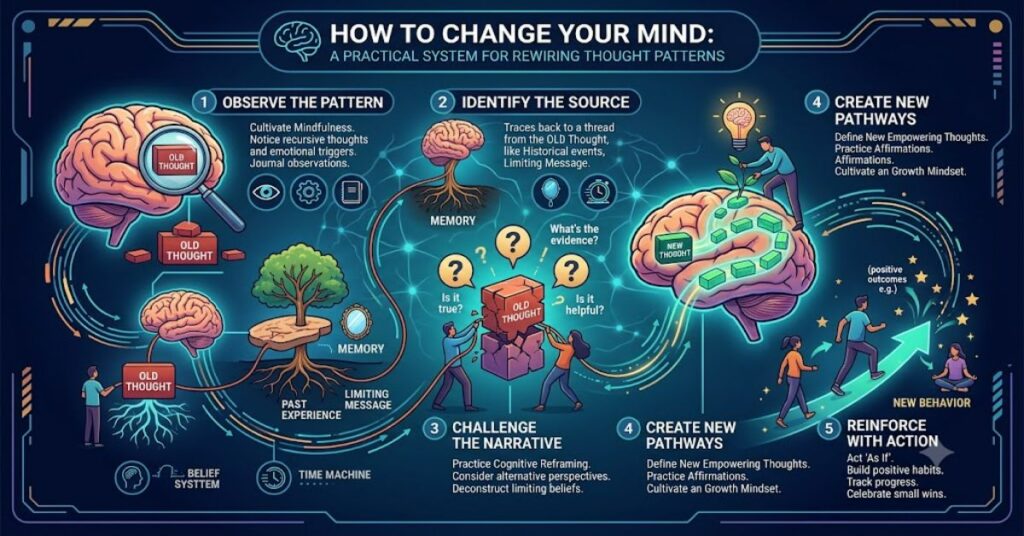
Understanding how to change your mind begins with recognizing a simple but uncomfortable fact: most beliefs are not actively chosen in real time. They are built through repetition, environment, and emotional reinforcement over long periods.
When people attempt to change their thinking, they often rely on logic alone. However, research in cognitive psychology shows that beliefs are reinforced by neural efficiency, meaning the brain prefers familiar pathways even when they are inaccurate. This is why changing an opinion can feel like resisting part of your identity.
To truly understand how to change your mind, you must look at three systems working together: cognition, behavior, and environment. Cognition defines what you think. Behavior reinforces what you repeatedly do. Environment determines what inputs are available in the first place.
This framework explains why sudden shifts in worldview are rare. Even when new information is accepted intellectually, emotional and behavioral systems often lag behind. Real change happens when all three systems are disrupted and rebuilt through structured exposure and repetition.
1. The Cognitive Architecture of Belief
Beliefs form through pattern recognition. The brain compresses repeated experiences into simplified mental models to reduce cognitive load.
Comparison: Rational vs Automatic Thinking
| System | Function | Speed | Flexibility |
| Reflective thinking | Analytical reasoning | Slow | High |
| Automatic thinking | Habitual response | Fast | Low |
Most decisions are driven by automatic thinking. This is why how to change your mind cannot rely solely on reasoning—it must also target automatic responses.
2. Behavioral Repetition and Neural Reinforcement
Neuroscience suggests that repeated thoughts strengthen neural pathways. This is often summarized as “neurons that fire together wire together.”
Data Insight Table: Habit Formation Dynamics
| Stage | Cognitive State | Change Difficulty |
| Exposure | Awareness of new idea | Low resistance |
| Repetition | Repeated consideration | Moderate resistance |
| Automation | Default response shift | High resistance |
The key insight is that mind change is not informational—it is repetitional.
3. Environmental Design and Thought Constraints
Your environment determines the boundaries of your thinking more than your intentions do.
Social groups, media consumption, and physical surroundings act as filters for belief formation.
Environmental Influence Factors
- Information exposure frequency
- Social reinforcement loops
- Emotional safety within groups
- Algorithmic content shaping
If the environment remains unchanged, cognitive change tends to revert.
4. Strategic Implications of Changing Beliefs
Understanding how to change your mind has real-world implications in decision-making, leadership, and personal development.
Organizations often fail to change strategy not because of lack of data, but because internal belief systems resist disruption.
Similarly, individuals may reject new information when it threatens identity coherence.
The strategic takeaway is simple: information alone does not produce transformation—structure does.
5. Risks and Trade-offs in Cognitive Change
Attempting to change beliefs too quickly can lead to cognitive overload or rejection of new ideas entirely.
Key risks include:
- Identity fragmentation when beliefs shift too rapidly
- Confirmation bias rebound effects
- Emotional resistance to contradiction
- Social isolation during belief transition
This explains why gradual exposure is more effective than forced persuasion.
6. Real-World Applications
Understanding how to change your mind applies across multiple domains:
- Education: improving learning retention
- Health: adopting long-term behavioral change
- Leadership: shifting organizational culture
- Personal development: overcoming limiting beliefs
The same mechanism applies: repetition in a structured environment over time.
7. Original Insights Not Commonly Highlighted
Insight 1: Cognitive inertia is energy-efficient
The brain resists change because stability consumes fewer resources than re-evaluation.
Insight 2: Environment overrides motivation
High motivation cannot sustain belief change if environmental cues remain unchanged.
Insight 3: Emotional latency slows belief change
Even after intellectual acceptance, emotional alignment may take significantly longer to adjust.
8. The Future of Cognitive Change in 2027
By 2027, cognitive change processes will increasingly be influenced by:
- AI-driven personalized learning systems
- Behavioral tracking through wearable technology
- Algorithmic content shaping belief exposure
However, regulatory concerns around psychological profiling and data ethics are likely to emerge, particularly in digital education and social platforms.
The core constraint remains unchanged: human cognition adapts slowly compared to information speed.
Key Takeaways
- Changing your mind requires cognitive, behavioral, and environmental alignment
- Repetition is more powerful than information alone
- Environment often determines belief stability
- Emotional systems lag behind intellectual acceptance
- Rapid belief shifts carry psychological risks
Conclusion
Learning how to change your mind is not a motivational exercise—it is a structural process rooted in how cognition operates under efficiency constraints. Most beliefs persist not because they are correct, but because they are reinforced through repetition and environmental consistency.
Real transformation happens when exposure, behavior, and context shift together. Without this alignment, new ideas remain temporary insights rather than stable beliefs.
This explains why meaningful change often feels slow. The brain is not resisting truth—it is optimizing for stability. Understanding this mechanism allows for more intentional and sustainable cognitive change over time.
FAQ
What does it mean to change your mind?
It means updating a belief system based on new information, repeated exposure, and contextual reinforcement.
Why is it hard to change opinions?
Because the brain favors familiar patterns and energy efficiency over cognitive restructuring.
How long does it take to change a mindset?
It varies, but sustained behavioral reinforcement is typically required over weeks or months.
Can environment affect beliefs?
Yes, environment is one of the strongest influences on thought formation and reinforcement.
Is logic enough to change your mind?
No, emotional and behavioral systems must also adapt.
What is the biggest barrier to mindset change?
Cognitive inertia and identity protection mechanisms.
References
- Kahneman, D. (2011). Thinking, Fast and Slow. Farrar, Straus and Giroux.
- Dweck, C. (2006). Mindset: The New Psychology of Success. Random House.
- Hebb, D. O. (1949). The Organization of Behavior. Wiley.
- Festinger, L. (1957). A Theory of Cognitive Dissonance. Stanford University Press.
Methodology
This article is based on established principles in cognitive psychology, behavioral science, and neuroscience literature. It synthesizes widely accepted theories on habit formation, cognitive dissonance, and neuroplasticity. No experimental data was collected directly; interpretations are derived from secondary academic sources.