Learning how to read music may seem intimidating at first, but it becomes much easier when you understand the basic symbols and patterns. Every piece of written music is built using a system of lines, spaces, notes, and rhythmic values that communicate exactly what a musician should play or sing.
To read music, you need to learn the staff, clefs, and note rhythms. These three elements form the foundation of music notation. Once you understand them, you’ll be able to recognize pitches, follow rhythms, and interpret musical expressions with confidence.
Whether you’re learning the piano, guitar, violin, flute, or simply improving your singing, reading music is a valuable skill that strengthens your understanding of music and makes learning new pieces much easier.
Understanding the Musical Staff
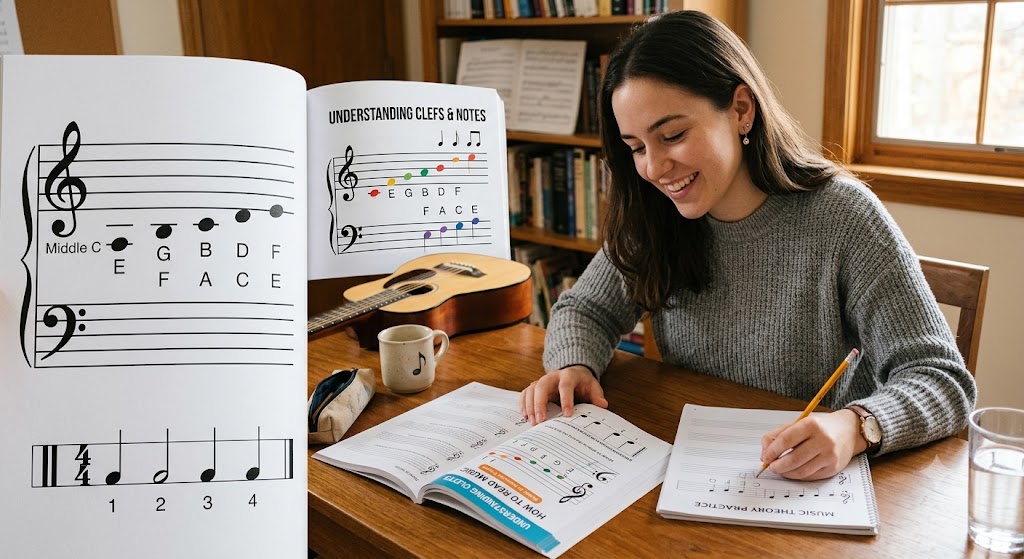
The musical staff consists of five horizontal lines and four spaces. Notes are placed on these lines and spaces to show their pitch.
Each line and space represents a different musical note depending on the clef being used.
Without the staff, musicians would have no consistent way of recording or sharing music.
Learning the Clefs
A clef tells you which notes belong to each line and space on the staff.
Treble Clef
The treble clef is used for higher-pitched instruments and voices such as:
- Piano right hand
- Violin
- Flute
- Trumpet
- Female vocals
The lines spell:
E – G – B – D – F
A common memory aid is:
“Every Good Boy Deserves Fruit.”
The spaces spell:
F – A – C – E
Together they spell the word FACE, making them easy to remember.
Bass Clef
The bass clef is used for lower-pitched instruments such as:
- Piano left hand
- Bass guitar
- Cello
- Trombone
- Tuba
The lines are:
G – B – D – F – A
The spaces are:
A – C – E – G
Learning both clefs is essential if you plan to play keyboard instruments or study music in greater depth.
Understanding Note Values
Music is not only about which notes to play but also how long to play them.
| Note | Beats (4/4 Time) |
| Whole Note | 4 beats |
| Half Note | 2 beats |
| Quarter Note | 1 beat |
| Eighth Note | 1/2 beat |
| Sixteenth Note | 1/4 beat |
As note values become shorter, the rhythm becomes faster and more detailed.
Practicing these durations with a metronome helps improve timing and consistency.
What Is Rhythm?
Rhythm is the pattern of long and short sounds in music.
Even if you know every note, playing incorrect rhythms will make the music sound wrong.
Beginners should learn to:
- Count beats aloud
- Clap rhythms
- Tap with a metronome
- Practice slowly before increasing speed
Developing rhythmic accuracy is just as important as learning note names.
Time Signatures
The time signature appears at the beginning of a piece after the clef.
For example:
4/4
The top number tells you there are four beats in each measure.
The bottom number tells you the quarter note receives one beat.
Other common time signatures include:
- 3/4 (waltz rhythm)
- 2/4 (march)
- 6/8 (compound rhythm)
Understanding time signatures helps you count music correctly.
Key Signatures
A key signature appears immediately after the clef.
It tells you which notes are consistently sharp or flat throughout the piece.
Common examples include:
- C Major (no sharps or flats)
- G Major (1 sharp)
- F Major (1 flat)
Recognizing key signatures allows musicians to identify the scale and tonal center quickly.
Dynamics and Musical Expression
Music is more than playing the correct notes.
Dynamic markings tell musicians how loudly or softly to perform.
Common symbols include:
| Symbol | Meaning |
| p | Soft |
| mp | Moderately soft |
| mf | Moderately loud |
| f | Loud |
| ff | Very loud |
Other markings indicate:
- Crescendo (gradually louder)
- Decrescendo (gradually softer)
- Accent marks
- Slurs
- Staccato
These symbols bring emotion and character to a performance.
Practical Tips for Learning to Read Music
Learning music notation becomes easier with consistent practice.
Helpful strategies include:
- Practice reading music every day.
- Learn one concept at a time.
- Use beginner sheet music.
- Say note names aloud.
- Count rhythms while clapping.
- Use flashcards for note recognition.
- Practice with a metronome.
- Review previously learned pieces regularly.
Short daily practice sessions are usually more effective than occasional long sessions.
Common Mistakes Beginners Make
Many beginners become discouraged because they expect to read music fluently right away.
Some common mistakes include:
- Memorizing songs without reading notation.
- Ignoring rhythm practice.
- Playing too quickly.
- Forgetting to count beats.
- Skipping practice on note recognition.
Avoiding these habits will help you progress much faster.
Why Learning to Read Music Matters
Reading music offers lifelong benefits.
It allows musicians to:
- Learn new songs independently.
- Communicate with other musicians.
- Perform in bands, orchestras, and choirs.
- Understand music theory.
- Compose original music.
- Develop stronger listening skills.
Instead of relying only on memory or tutorials, musicians who read music have access to an enormous library of written compositions from every genre.
The Future of Music Education in 2027
Technology continues to transform music education. Interactive learning apps, AI-powered practice assistants, digital sheet music, and real-time feedback tools are making music reading more accessible than ever. However, traditional music notation remains the universal language used by orchestras, schools, conservatories, and professional musicians worldwide. Learning to read music will continue to be an essential skill alongside modern digital learning methods.
Key Takeaways
- The staff provides the framework for written music.
- Clefs determine the names of notes.
- Rhythm controls the timing of music.
- Time and key signatures guide performance.
- Dynamics add emotion and expression.
- Daily practice leads to steady improvement.
Conclusion
Learning how to read music is a skill that develops gradually through patience and regular practice. By understanding the staff, clefs, note values, rhythms, key signatures, and dynamic markings, beginners gain the tools needed to read and perform written music confidently. Although it may feel challenging at first, each practice session strengthens note recognition and rhythmic accuracy. Over time, reading music becomes as natural as reading words on a page. Whether your goal is to play an instrument, sing, compose, or simply appreciate music more deeply, mastering music notation will make your musical journey far more rewarding.
Frequently Asked Questions
Is reading music difficult for beginners?
No. It takes practice, but most beginners can learn the basics within a few weeks of consistent study.
Do I need to read music to play an instrument?
Not always. Some musicians play by ear, but reading music greatly expands your learning opportunities.
Which clef should I learn first?
Most beginners start with the treble clef, especially if learning piano, violin, flute, or singing.
How long does it take to read music fluently?
It varies by individual, but regular daily practice often leads to noticeable improvement within a few months.
Can adults learn to read music?
Absolutely. Adults can successfully learn music notation with patience, structured lessons, and consistent practice.
References
- ABRSM. Music Theory Resources.
- Berklee Online. Music Theory Fundamentals.
- Music Theory Academy. Music Notation and Rhythm.
- Royal Conservatory of Music. Theory Syllabus.