Jackie Robinson quotations remain powerful because the man behind them changed American history as well as professional baseball. On 15 April 1947, Robinson debuted for the Brooklyn Dodgers and became the first Black player in modern Major League Baseball. His achievement was not simply a sporting milestone. It placed him at the centre of a wider struggle over racial segregation, citizenship and equal opportunity in the United States.
Many of Robinson’s best-known statements return to the same ideas: human dignity should not depend on race, success should carry responsibility, and personal courage matters most when circumstances make silence or retreat easier. One of the quotations most closely associated with him expresses the belief that a life gains value through its effect on other people. Another insists that freedom has little meaning without equality.
These words are still shared in classrooms, museums, sports broadcasts and civil rights discussions because they offer more than inspirational language. They reflect the pressures Robinson faced after signing with the Dodgers organisation and entering a segregated professional sport under intense public scrutiny.
Yet quotations can also become detached from their original setting. A memorable sentence may circulate online in altered form, without a date, speech, interview or publication attached to it. The strongest way to understand Robinson’s words is therefore to connect them with documented history rather than treating every popular image-card quotation as automatically authentic.
Jackie Robinson and the Historical Weight Behind His Words
Robinson was born in 1919 and built an extraordinary athletic career before his Major League debut. After playing professional baseball in the Negro Leagues, he joined the Dodgers organisation under the leadership of Branch Rickey. His arrival in organised baseball became a defining event in American sporting history.
The importance of his public statements cannot be separated from this experience. Robinson faced racial hostility from spectators, opposing players and parts of the baseball establishment. His ability to continue competing under that pressure became part of his public identity.
| Historical Moment | Why It Matters to His Legacy |
| 1919 | Jackie Robinson was born in Cairo, Georgia |
| 1945 | He signed with the Brooklyn Dodgers organisation |
| 1946 | He played for the Montreal Royals |
| 15 April 1947 | He debuted for the Brooklyn Dodgers |
| 1949 | He was named National League Most Valuable Player |
| 1962 | He was inducted into the Baseball Hall of Fame |
| 1972 | Jackie Robinson died, leaving a lasting civil rights legacy |
His words therefore carry two forms of significance: the meaning of the language itself and the historical record of the person who expressed it.
Famous Jackie Robinson Quotations and Their Meaning
Several statements repeatedly associated with Robinson have endured because they express clear moral principles.
One of the best known is:
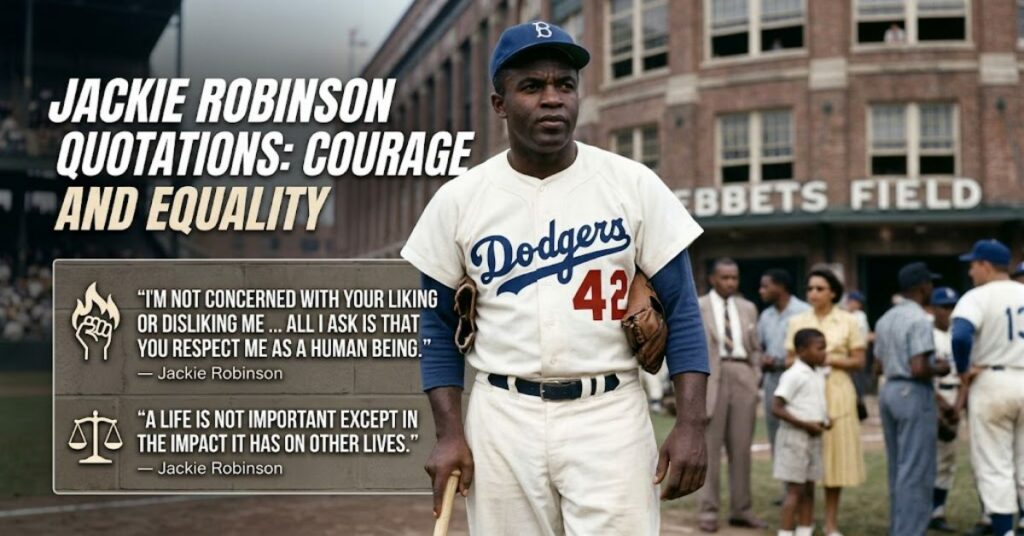
“A life is not important except in the impact it has on other lives.”
The quotation captures Robinson’s belief that achievement should not be measured only through personal success. His legacy supports that wider interpretation. Baseball made him famous, but his influence extended into civil rights advocacy, business and public life.
Another widely recognised statement is:
“There’s not an American in this country free until every one of us is free.”
Its central idea is collective freedom. Robinson argued publicly about racial discrimination and equal citizenship, making the principle especially important within the political climate of the twentieth-century United States.
A third frequently cited quotation states:
“I’m not concerned with your liking or disliking me… All I ask is that you respect me as a human being.”
The power of this statement lies in its directness. It rejects the idea that dignity depends on approval. Respect for humanity becomes the minimum standard.
A Comparison of Robinson’s Major Themes
| Theme | Core Message | Modern Relevance |
| Equality | Rights and freedom must apply to everyone | Civil rights and equal opportunity |
| Courage | Difficult action may require personal sacrifice | Leadership and social responsibility |
| Human dignity | Respect should not depend on popularity or identity | Inclusion and anti-discrimination |
| Service | Personal success matters through its effect on others | Community leadership |
| Persistence | Progress often requires endurance under pressure | Long-term social change |
These themes explain why Jackie Robinson quotations continue to travel beyond baseball. A reader does not need to understand batting averages or league history to recognise the moral argument in the words.
Why Context Is More Important Than a Perfect Sound Bite
A quotation can become more famous than its source. This creates a practical problem for readers, teachers and publishers: not every sentence attributed to a historical figure has been verified.
The safest approach is to trace a quotation to an autobiography, interview, speech, letter or reputable archival collection. Small wording differences can matter. A shortened version may preserve the general meaning while changing the original phrasing.
This is particularly relevant to Robinson because his legacy has generated decades of biographies, documentaries, commemorative projects and online quotation collections. Popularity can cause unattributed wording to spread quickly.
A useful verification framework is:
| Check | Why It Matters |
| Identify the original source | Confirms who recorded the words |
| Check the date | Places the statement in historical context |
| Compare wording | Reveals whether a quote has been shortened |
| Review surrounding text | Prevents misleading interpretation |
| Prefer archives and primary materials | Reduces reliance on copied quotation lists |
The hidden risk is that inspirational content can become less trustworthy as it becomes easier to share. Accuracy is part of preserving a historical legacy.
Three Insights That Give Robinson’s Words Greater Depth
First, Robinson’s quotations are strongest when read as part of a pattern rather than as isolated motivational slogans. His public life repeatedly connected individual achievement with wider social obligations.
Second, his legacy shows that symbolic breakthroughs do not automatically end inequality. Robinson’s debut changed Major League Baseball, but the broader struggle for civil rights continued. This distinction prevents history from being simplified into a single triumphant moment.
Third, the modern circulation of quotations creates a preservation challenge. Digital sharing has introduced Robinson’s words to new audiences, but it has also increased the importance of source verification. A powerful quotation deserves an accurate history.
The Cultural Impact of Jackie Robinson’s Legacy
Robinson’s number, 42, has become one of the most recognisable symbols in American sports. Major League Baseball retired the number across the league, and Jackie Robinson Day commemorates his historic debut.
His story has also remained present in books, museums, films and educational programmes. This continuing attention has helped move his legacy beyond the record books.
The cultural importance of his words comes partly from this visibility. When athletes speak today about discrimination, representation or social responsibility, Robinson often remains an important historical reference point.
His career demonstrates that sport can operate as a public stage where social conflicts become highly visible. The quotation and the career reinforce one another: his language expressed principles that his public life repeatedly tested.
The Future of Jackie Robinson Quotations in 2027
By 2027, Robinson’s words will likely continue reaching audiences through digital archives, educational resources, documentary storytelling and anniversary coverage. The challenge will be preserving context as quotations become increasingly fragmented across social platforms and automated content systems.
Digital access can strengthen historical education when institutions connect famous statements to primary records, photographs, interviews and contemporary reporting. It can also create confusion when unattributed versions circulate without verification.
The future value of Robinson’s legacy will therefore depend partly on editorial discipline. New technology can make his words easier to find, but trustworthy interpretation still requires reliable sourcing and historical context.
Key Takeaways
- Jackie Robinson’s words consistently connect equality with human dignity and responsibility.
- His Major League debut on 15 April 1947 gives important historical context to his public legacy.
- Famous quotations should be traced to reliable sources whenever possible.
- Robinson’s influence extended beyond baseball into civil rights and public life.
- His legacy demonstrates that symbolic breakthroughs can begin change without completing it.
- Accurate context helps preserve the meaning of historical quotations for future generations.
Conclusion
Jackie Robinson remains one of the most important figures in the history of American sport because his influence cannot be separated from the larger struggle for equality. His career changed Major League Baseball, but his public life also reflected a wider belief that success carries obligations beyond personal recognition.
The most enduring Jackie Robinson quotations continue to matter because they address questions that remain relevant: What does equality require? How should people respond to prejudice? What gives an individual life lasting value?
Their meaning becomes stronger when readers look beyond the quotation itself. Robinson’s words were shaped by a life lived under extraordinary public pressure and by a willingness to connect sporting achievement with human dignity. Preserving that context is essential. A short sentence can inspire, but history explains why it carries weight.
FAQ
What are the most famous Jackie Robinson quotations?
Among the most widely recognised are statements about the impact of one’s life on others, the relationship between freedom and equality, and the importance of being respected as a human being.
What did Jackie Robinson say about equality?
Robinson is widely associated with the principle that freedom cannot be fully enjoyed while others remain denied equal rights. His public legacy consistently connected civil rights with human dignity.
Why are Jackie Robinson quotations still popular?
They remain relevant because their themes—courage, equality, respect and responsibility—extend beyond baseball and apply to education, leadership and public life.
Did Jackie Robinson only speak about baseball?
No. Although baseball made him internationally famous, Robinson also addressed civil rights, citizenship, discrimination and the responsibilities of public figures.
How can I verify a Jackie Robinson quote?
Look for the statement in a primary source, autobiography, recorded interview, archival collection or a reputable institution dedicated to his history. Be cautious with unattributed social media graphics.
What is Jackie Robinson’s lasting legacy?
His 1947 Major League debut broke baseball’s modern colour barrier and became a major symbol of racial integration, while his later public work reinforced his role as a civil rights figure.
References
Jackie Robinson Foundation. (n.d.). Jackie Robinson: Biography and legacy. Jackie Robinson Foundation.
National Baseball Hall of Fame. (n.d.). Jackie Robinson. National Baseball Hall of Fame and Museum.
Major League Baseball. (n.d.). Jackie Robinson and Jackie Robinson Day. Major League Baseball.
Robinson, J. (1972). I never had it made: An autobiography of Jackie Robinson. G. P. Putnam’s Sons.
Methodology
This article follows the supplied Postcard.fm framework, including its requirements for keyword placement, historical context, structured sections, verification, balanced analysis and SEO metadata. The framework specifically requires real and verifiable references and warns against fabricated citations. The historical discussion should therefore be checked against primary archives and institutional records before publication.