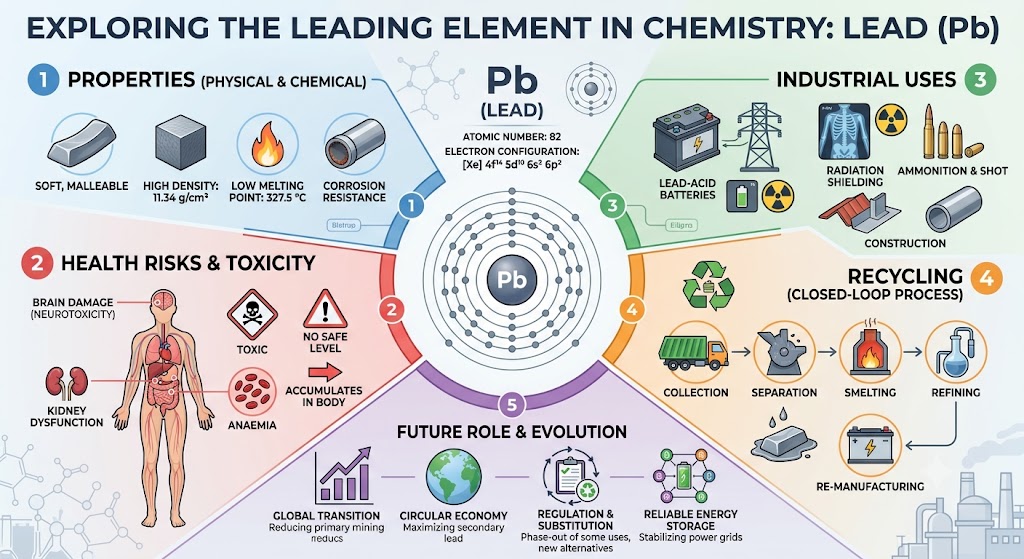
The term leading element can refer to different concepts, but in chemistry it commonly relates to lead, the chemical element with the symbol Pb and atomic number 82. Lead is a soft, heavy metal recognised for its high density, corrosion resistance, and ability to block radiation. These characteristics have made it valuable in industries ranging from energy storage to medical technology.
For centuries, lead was widely used in construction, paints, plumbing, and manufacturing. However, scientific research has revealed significant health and environmental risks linked to lead exposure, particularly affecting children and vulnerable populations. As a result, governments worldwide have introduced strict regulations limiting its use in consumer products.
Today, lead occupies a complicated position. It remains essential in certain applications, especially lead-acid batteries used in vehicles and energy systems, but industries are under pressure to improve recycling methods and reduce contamination.
Understanding the properties, applications, and challenges surrounding this metal helps explain why lead continues to influence modern technology while requiring careful management.
What Makes Lead a Unique Chemical Element?
Lead belongs to Group 14 of the periodic table and has the atomic number 82. It is classified as a post-transition metal and has several characteristics that distinguish it from lighter metals.
Key properties include:
| Property | Description |
| Chemical symbol | Pb |
| Atomic number | 82 |
| Atomic mass | 207.2 u |
| Appearance | Bluish-grey metallic solid |
| Density | Approximately 11.34 g/cm³ |
| Melting point | 327.5°C |
| Main industrial feature | High density and corrosion resistance |
Its density allows lead to absorb radiation effectively, making it useful in protective equipment. Its ability to resist corrosion also explains its historical use in pipes, although this application has declined due to safety concerns.
Major Industrial Applications of Lead
Although lead has developed a negative reputation because of toxicity concerns, it continues to serve important industrial purposes.
Lead-Acid Batteries
The largest modern use of lead is in lead-acid batteries. These batteries power automobiles, backup energy systems, and industrial equipment.
According to industry data, more than 85% of global lead consumption is connected to battery production and recycling activities. Their popularity comes from reliability, affordability, and established recycling infrastructure.
Radiation Shielding
Lead remains one of the most effective materials for protecting against X-rays and gamma radiation. Hospitals commonly use lead barriers, protective aprons, and shielding systems during medical imaging procedures.
Manufacturing and Specialised Uses
Lead is also used in:
- Ammunition production
- Certain alloys
- Cable coverings
- Scientific equipment
- Historical restoration projects
However, many traditional uses have declined because safer alternatives are available.
Lead Compared With Alternative Materials
The future of lead depends partly on how it compares with replacement materials.
| Application | Lead Advantage | Alternative Materials | Main Challenge |
| Batteries | Low cost and highly recyclable | Lithium-ion batteries | Higher initial cost for alternatives |
| Radiation protection | Excellent density | Tungsten composites | Increased material expense |
| Industrial alloys | Easy processing | Aluminium and other metals | Performance differences |
Lead remains competitive because its recycling system is highly developed. Unlike many materials, lead can be recovered repeatedly without significant loss of quality.
Environmental and Health Risks
The greatest concern surrounding lead is not its industrial usefulness but its biological impact.
Lead exposure can occur through contaminated soil, old paint, industrial pollution, and unsafe disposal practices. The metal can accumulate in the human body and affect the nervous system.
Children are particularly vulnerable because exposure can interfere with brain development. International organisations, including the World Health Organization, identify lead exposure as a significant public health concern.
A major challenge is that lead contamination can remain in environments for decades. Removing polluted soil, replacing old infrastructure, and monitoring industrial sites require significant investment.
Real-World Case Studies and Regulatory Changes
One important example is the global reduction of lead-based paint use. During the 20th century, lead compounds were commonly added to paints because they improved durability and colour. Scientific evidence later showed serious health risks, leading many countries to introduce restrictions.
Another documented example is the replacement of lead pipes in older water systems. Several cities have invested in infrastructure upgrades after studies linked ageing plumbing systems with possible lead contamination.
These cases demonstrate a wider industrial lesson: materials that provide short-term benefits may create long-term management costs.
Data Insights: Global Lead Industry Overview
| Area | Current Situation |
| Main demand source | Lead-acid batteries |
| Recycling importance | Lead is among the most recycled industrial metals |
| Main concern | Human exposure and environmental contamination |
| Future priority | Cleaner production and improved recovery systems |
An important insight is that lead’s future is unlikely to disappear completely. Instead, the industry is moving toward controlled use, responsible recycling, and reduced exposure.
The Future of Leading Element in 2027
By 2027, lead is expected to remain relevant, especially because global demand for energy storage continues to grow. Electric vehicles and renewable energy systems may increase competition between lead-acid and lithium-based battery technologies.
However, lead will likely maintain a role in applications where reliability and recycling efficiency matter. Battery manufacturers are investing in improved designs that reduce environmental impact while maintaining performance.
Regulatory agencies are also expected to continue strengthening controls around mining, waste management, and consumer exposure. The European Union, environmental agencies, and international health organisations are already pushing industries toward safer practices.
The biggest uncertainty is whether alternative technologies can replace lead in cost-sensitive markets. While alternatives are advancing, lead’s recycling network remains a major competitive advantage.
Key Takeaways
- Lead is a chemically unique heavy metal with valuable industrial properties.
- Its largest modern application is rechargeable battery production.
- Health risks have transformed how industries manage and regulate lead.
- Recycling is central to maintaining lead’s industrial importance.
- Future demand depends on responsible use and environmental protection.
Conclusion
Lead represents the complex relationship between industrial progress and environmental responsibility. Its density, durability, and chemical properties have made it valuable for batteries, radiation shielding, and specialised manufacturing. At the same time, scientific evidence has shown that uncontrolled lead exposure creates serious health and ecological risks.
Modern industries are not eliminating lead entirely but are changing how it is produced, used, and recycled. Stronger regulations, improved waste management, and technological innovation will determine its future role.
The story of lead demonstrates that useful materials require careful management throughout their entire lifecycle. Its continued importance will depend on achieving a balance between industrial needs and public safety.
Frequently Asked Questions
What is the leading element in chemistry?
In this context, the leading element refers to lead (Pb), a chemical element with atomic number 82 known for its density and industrial applications.
Why is lead still used today?
Lead remains useful because it is inexpensive, highly recyclable, corrosion-resistant, and effective for radiation protection.
Is lead dangerous to humans?
Yes. Long-term exposure to lead can damage human health, especially affecting children’s neurological development.
What is lead mainly used for?
The largest use of lead is in lead-acid batteries, followed by radiation shielding and specialised industrial applications.
Can lead be recycled?
Yes. Lead is one of the most recycled metals, and recycling reduces the need for new mining.
Methodology
This article leading element was developed using information from established scientific references, environmental agencies, and industrial research sources. Key areas reviewed include lead chemistry, industrial applications, recycling practices, and public health concerns.
The analysis considers both the benefits and risks associated with lead. Limitations include changing industrial technologies and ongoing research into alternative materials.
References
World Health Organization. (2023). Lead poisoning and health. World Health Organization.
International Lead Association. (2024). Lead applications and recycling information. International Lead Association.
United States Environmental Protection Agency. (2024). Lead: Regulatory information and health impacts. U.S. EPA.
National Institute for Occupational Safety and Health. (2023). Lead exposure and workplace safety. Centers for Disease Control and Prevention.