
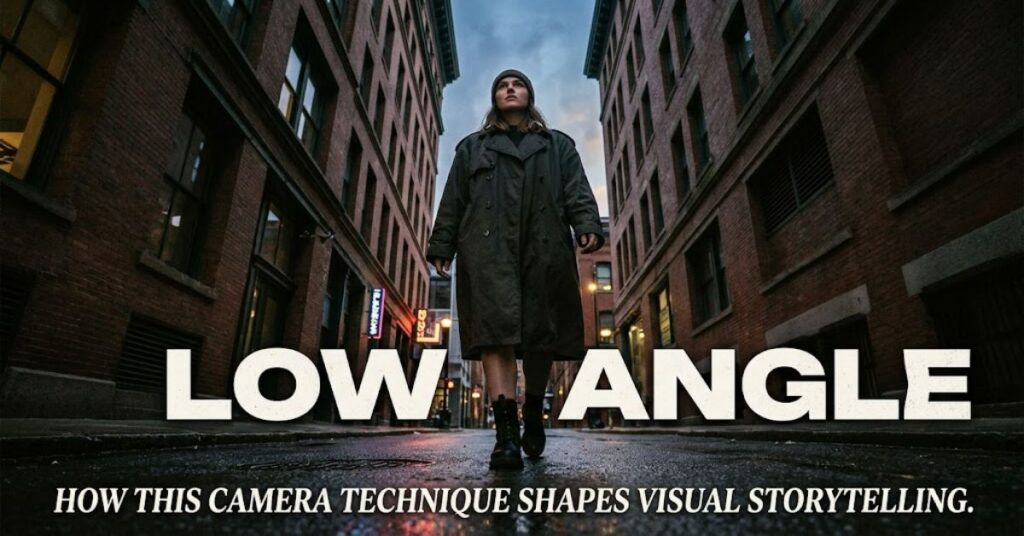
A low angle is a camera technique in which the camera is positioned below the subject’s eye level and directed upward. This changes the visual relationship between the viewer and the subject. A person may appear more powerful, a building more monumental, and an ordinary object more dramatic.
The technique is simple in principle, but its effect can be surprisingly complex. Camera height influences how an audience interprets status, vulnerability and physical scale. When viewers look upward at a subject, they are often placed in a visually subordinate position. That perspective can make a character appear confident, threatening, heroic or authoritative.
However, a low camera position does not automatically create power. Lighting, facial expression, background, lens focal length and composition all influence the final result. A playful portrait shot from the ground may feel energetic rather than intimidating. Similarly, an upward-looking architectural photograph may communicate wonder instead of dominance.
The most effective use of this perspective begins with a clear question: what should the audience feel about the subject?
Why Camera Position Changes Perception
Visual storytelling depends partly on perspective. The position of the camera determines what information is emphasised and what information is reduced.
An eye-level shot often feels neutral because it places the viewer on similar visual ground with the subject. A high-angle shot can make a subject appear smaller or more vulnerable. Shooting from below reverses that relationship.
This perspective can influence several aspects of perception:
| Visual Effect | How a Low Position Can Contribute |
| Power | Makes the subject appear dominant or authoritative |
| Scale | Emphasises height and physical size |
| Drama | Creates stronger perspective lines |
| Tension | Can make characters feel threatening or unpredictable |
| Heroism | Places the viewer in an upward-looking position |
| Monumentality | Enhances tall buildings and large structures |
The psychological effect is not fixed. Context matters. A low-angle photograph of a child may make the child appear confident and adventurous, while the same technique applied to a corporate executive may suggest authority.
Low Angle Photography and Lens Choice
Lens selection can dramatically change the result.
A wide-angle lens exaggerates the distance between foreground and background. When used close to a subject from a low position, it can make nearby features appear larger and create strong leading lines. This can be useful for action photography, architecture and energetic portraits.
A longer focal length produces less obvious perspective exaggeration. The camera can still remain below the subject, but the result may appear more controlled and natural.
| Lens Approach | Typical Visual Result | Best Use |
| Wide angle | Strong perspective and exaggerated scale | Action, architecture, creative portraits |
| Standard lens | Balanced perspective | General photography and film scenes |
| Telephoto | Compressed background and subtler angle effect | Controlled portraits and distant subjects |
One common mistake is assuming that the low position alone creates distortion. Perspective is strongly affected by the camera’s physical relationship to the subject. Moving closer can increase the visual exaggeration significantly.
Practical Uses in Photography
Portrait Photography
Photographers often use a lower camera position to make subjects appear confident or physically imposing. The technique can work particularly well when photographing athletes, performers and public figures.
Care is necessary with facial proportions. Shooting extremely close with a wide lens can distort features. A slightly lower position combined with a moderate focal length often produces a stronger image without excessive exaggeration.
Sports and Action
A low angle can bring viewers closer to movement. Photographing a runner, skateboarder or football player from near ground level can make the action feel faster and more immersive.
Foreground elements become more important in these compositions. Shoes, equipment or surfaces may create lines that guide the viewer’s attention towards the athlete.
Architecture
Tall buildings naturally benefit from upward-looking perspectives. The camera position can highlight vertical lines and create a sense of scale.
However, strong upward angles may cause vertical convergence, where the sides of a building appear to lean inward. Photographers may treat this as a creative choice or correct it through lens movements and perspective tools.
The Risks and Trade-Offs
The low angle is powerful precisely because it changes perception. That also creates risks.
A subject can appear overly aggressive when the intended mood is friendly. A wide lens may introduce distracting distortion. Background elements that are invisible at eye level may become prominent when the camera is placed near the ground.
There are also practical limitations. Low positions can be physically difficult in crowded locations or restricted environments. Cinematographers may need specialised rigs, monitors or stabilisation equipment to achieve smooth movement.
The technique should therefore support the story rather than become the story itself.
A Structured Approach to Choosing the Right Angle
Before setting up the shot, photographers and filmmakers can evaluate the intended effect.
| Question | Practical Decision |
| Should the subject feel powerful? | Consider positioning the camera below eye level |
| Is physical scale important? | Use the foreground and vertical lines deliberately |
| Is realism more important than drama? | Avoid extreme angles and wide lenses at close range |
| Does the background support the subject? | Check the frame from the actual shooting position |
| Is distortion desirable? | Choose focal length and camera distance accordingly |
This approach can prevent a common workflow problem: selecting a dramatic angle first and discovering later that it does not support the final message.
Low Angle in Film and Visual Culture
Cinema has used camera height as a storytelling tool for more than a century. Directors and cinematographers combine perspective with lighting, movement and production design to establish relationships between characters.
A character introduced from below may initially appear dominant. If later scenes shift to eye level or high angles, the audience can visually experience a change in status without explicit dialogue.
The technique also appears in advertising and fashion imagery. Products photographed from a low viewpoint can seem larger or more aspirational. Shoes, vehicles and technology products often benefit from compositions that emphasise shape and scale.
The wider cultural impact is important: audiences have learned to recognise visual grammar. Even without formal film education, many viewers associate upward-looking shots with power, spectacle and importance.
Three Practical Insights
First, the best low-angle images often use moderation. Lowering the camera by a small amount can change perception without creating obvious visual distortion.
Second, the background is frequently more important than photographers expect. Looking upward introduces skies, ceilings, architecture and overhead objects into the composition. These elements can either strengthen or weaken the image.
Third, subject movement becomes more dramatic from below. When an object moves towards or away from a low camera, changes in apparent size can create a stronger feeling of speed than a more neutral viewpoint.
The Future of Low Angle in 2027
By 2027, camera systems are likely to make unusual perspectives easier to capture rather than replacing traditional composition principles. Smaller stabilised cameras, computational photography and improved real-time monitoring continue to reduce the technical barriers associated with ground-level shooting.
Smartphone cameras have already made experimentation with perspective more accessible. At the same time, automated image correction can reduce some problems caused by lens distortion and perspective convergence.
The creative challenge will remain the same. Easier technology does not automatically produce stronger visual storytelling. As more creators gain access to stabilisation, ultra-wide lenses and computational editing tools, intentional composition may become an even more important differentiator.
The future of the technique is therefore less about whether cameras can shoot from below and more about whether creators understand why they are doing so.
Key Takeaways
- A low angle places the viewer below the subject and can change perceived power and scale.
- Lens choice and camera distance strongly influence the final image.
- Wide lenses can increase drama but may introduce distracting distortion.
- The technique is effective in portraits, sports, architecture, film and advertising.
- Background elements deserve special attention when shooting upward.
- A lower camera position should support the intended message rather than simply add drama.
Conclusion
A low angle is one of the most effective ways to change the emotional meaning of an image without changing the subject itself. By placing the camera below eye level and directing it upward, photographers and filmmakers can influence how viewers interpret scale, authority, movement and visual importance.
Its strength lies in its flexibility. The same approach can make an athlete appear heroic, a building monumental or an ordinary object unexpectedly dramatic. Yet the technique works best when combined with deliberate decisions about lens choice, distance, lighting and background.
The key is intention. Extreme perspective is not always more effective, and subtle adjustments can sometimes communicate more clearly than dramatic distortion. Understanding how camera height shapes perception allows creators to use perspective as a storytelling tool rather than relying on it as a visual effect.
FAQ
What is a low-angle shot?
A low-angle shot is created by positioning the camera below the subject and aiming upward. It can make subjects appear larger, stronger, taller or more visually dominant.
Why does a low angle make subjects look powerful?
The viewer is placed in a physically lower visual position than the subject. This upward perspective can create an impression of dominance, authority or importance, depending on the wider composition.
What lens is best for low-angle photography?
There is no single best lens. Wide-angle lenses create stronger perspective effects, while standard and telephoto lenses can produce a more natural appearance.
Can a low angle distort a person’s face?
Yes. Extreme close-up photography with wide lenses can exaggerate facial features. Increasing the distance from the subject or using a longer focal length can reduce this effect.
Is a low angle only used in filmmaking?
No. It is widely used in photography, advertising, sports imagery, architecture and visual content creation.
How low should the camera be?
The answer depends on the desired effect. Even moving the camera slightly below eye level can change perception. Ground-level positions create more dramatic perspective.
Methodology
This article follows the Postcard.fm editorial framework for keyword placement, structure, practical analysis, visual strategy and SEO metadata. The discussion focuses on established principles of camera perspective and composition, with attention to practical limitations and the distinction between creative effect and technical distortion. The analysis does not claim original hands-on testing or invented expert quotations. Readers should consider the article a practical overview rather than a substitute for direct camera