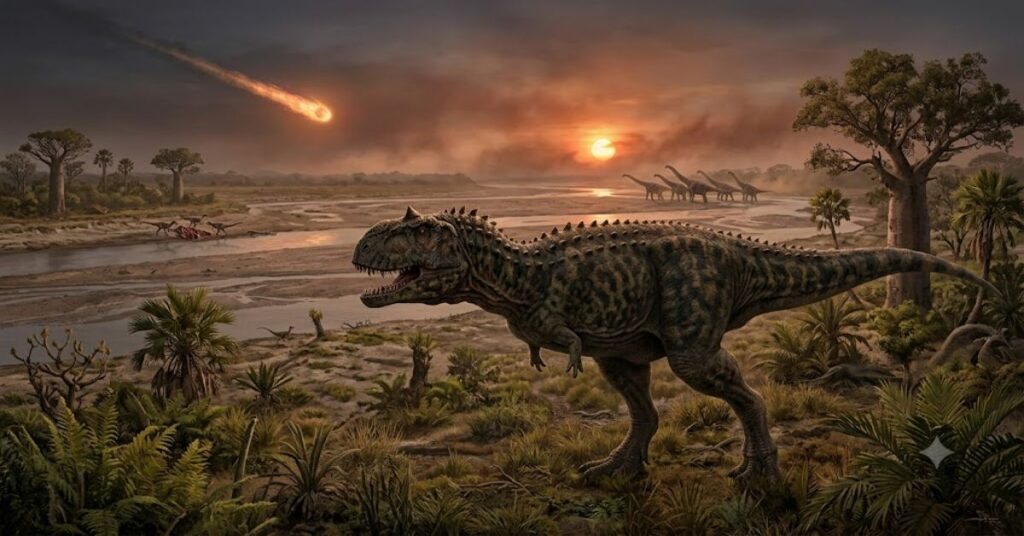
Majungasaurus is one of the best-known carnivorous dinosaurs discovered in the Southern Hemisphere. Living in Madagascar between 70 and 66 million years ago, this abelisaurid theropod was among the last non-avian dinosaurs before the catastrophic Cretaceous–Paleogene (K–Pg) extinction event ended the age of dinosaurs. Numerous fossil discoveries have allowed palaeontologists to reconstruct its appearance, behaviour, and environment with unusual confidence.
Unlike the giant predators of North America, Majungasaurus evolved in an isolated island ecosystem. That isolation shaped its anatomy and hunting strategies, making it an important species for understanding dinosaur evolution in Gondwana. Today, it remains one of Madagascar’s most scientifically significant fossil discoveries.
Overview of Majungasaurus
| Feature | Details |
| Scientific Name | Majungasaurus crenatissimus |
| Dinosaur Group | Abelisaurid theropod |
| Period | Late Cretaceous (70–66 million years ago) |
| Location | Madagascar |
| Diet | Carnivore |
| Estimated Length | 6–7 metres |
| Estimated Weight | Around 1 tonne |
Physical Characteristics
Majungasaurus had a stocky body, muscular legs, and an unusually short, deep skull. A distinctive horn-like bump on top of its head set it apart from many other carnivorous dinosaurs. Although its arms were extremely small, its jaws were exceptionally powerful, allowing it to crush bone and subdue prey.
Researchers believe its robust neck muscles helped deliver strong biting forces, compensating for the reduced forelimbs common among abelisaurids.
Habitat and Lifestyle
During the Late Cretaceous, Madagascar had a warm seasonal climate with rivers, floodplains, and forests. This environment supported a variety of dinosaurs, crocodilians, turtles, and early mammals.
As the island’s dominant terrestrial predator, Majungasaurus likely hunted medium-sized herbivorous dinosaurs while also scavenging carcasses when opportunities arose. Fossils indicate it occupied the top of the local food chain.
Comparison with Tyrannosaurus rex
| Feature | Majungasaurus | Tyrannosaurus rex |
| Length | 6–7 metres | 12–13 metres |
| Weight | About 1 tonne | 8–9 tonnes |
| Family | Abelisauridae | Tyrannosauridae |
| Location | Madagascar | North America |
| Time Period | Late Cretaceous | Late Cretaceous |
Although much smaller than Tyrannosaurus rex, Majungasaurus was perfectly adapted to Madagascar’s isolated ecosystem.
Scientific Discoveries
The first fossils were discovered in Madagascar during the late nineteenth century, but extensive excavations since the 1990s have transformed scientific understanding of the species.
One of the most remarkable discoveries was bite marks on Majungasaurus bones matching its own teeth. This evidence strongly suggests cannibalism, making it one of the few dinosaurs with convincing fossil evidence for this behaviour. Scientists believe these marks may reflect scavenging rather than active hunting of its own species.
Well-preserved skulls, vertebrae, and limb bones have also allowed researchers to study its growth patterns and biomechanics in detail.
Importance to Paleontology
Majungasaurus provides valuable evidence about dinosaur evolution on isolated landmasses. Because Madagascar separated from other continents millions of years before the dinosaur extinction, its wildlife evolved independently.
The species has helped scientists understand:
- Evolution of abelisaurid predators.
- Dinosaur adaptation on isolated islands.
- Predator-prey relationships during the Late Cretaceous.
- Behaviour inferred from fossil bite marks.
These discoveries continue to influence research into Gondwanan dinosaurs.
The Future of Majungasaurus Research in 2027
By 2027, researchers are expected to use increasingly sophisticated technologies such as high-resolution CT scanning, digital skeletal reconstruction, and biomechanical modelling to study Majungasaurus fossils.
International collaborations between Malagasy institutions and global museums continue expanding knowledge of Madagascar’s prehistoric ecosystems. While no dramatic new discoveries can be predicted with certainty, improved imaging and analytical techniques are likely to refine understanding of its growth, feeding mechanics, and evolutionary relationships.
Key Takeaways
- Majungasaurus lived during the final stage of the Cretaceous Period.
- It belonged to the Abelisauridae family of carnivorous dinosaurs.
- Madagascar’s isolation shaped its unique evolution.
- Fossils provide rare evidence of possible dinosaur cannibalism.
- It played the role of apex predator in its ecosystem.
- Ongoing fossil research continues to reveal new details about its biology.
Conclusion
Majungasaurus stands among the most significant dinosaur discoveries from the Southern Hemisphere. Although smaller than famous predators such as Tyrannosaurus rex, it was exceptionally well adapted to the environment of Late Cretaceous Madagascar. Its distinctive skull, powerful bite, and evidence of cannibalistic feeding have made it one of the most studied abelisaurid dinosaurs.
Beyond its impressive appearance, the species offers scientists an important window into dinosaur evolution shortly before the mass extinction that reshaped life on Earth 66 million years ago. Continued fossil discoveries and advances in palaeontological technology ensure that Majungasaurus will remain a key subject of prehistoric research for years to come.
FAQ
What was Majungasaurus?
Majungasaurus was a carnivorous abelisaurid dinosaur that lived in Madagascar during the Late Cretaceous, approximately 70–66 million years ago.
Was Majungasaurus larger than Tyrannosaurus rex?
No. It measured around 6–7 metres long, making it much smaller than Tyrannosaurus rex.
Did Majungasaurus eat other dinosaurs?
Yes. Fossil evidence shows it preyed on herbivorous dinosaurs and may also have scavenged carcasses.
Is there evidence of cannibalism in Majungasaurus?
Yes. Bite marks on fossil bones matching its own teeth provide strong evidence that members of the species occasionally fed on one another.
Why is Majungasaurus important?
It helps scientists understand dinosaur evolution, island ecosystems, and predator behaviour shortly before the extinction of non-avian dinosaurs.
Methodology
This article is based on peer-reviewed palaeontological research, fossil descriptions published by recognised scientific institutions, and information from museum collections. The analysis reflects current scientific consensus while acknowledging that interpretations may evolve with future discoveries.
Editorial Disclosure: This article was drafted with AI assistance and should be reviewed by a human editor before publication to verify references and factual accuracy.
References
Curry Rogers, K. A., & Wilson, J. A. (Eds.). (2014). The Sauropods: Evolution and Paleobiology. University of California Press.
Carrano, M. T., Sampson, S. D., & Forster, C. A. (2002). The osteology of Majungasaurus crenatissimus. Journal of Vertebrate Paleontology.
Natural History Museum. (2024). Majungasaurus. https://www.nhm.ac.uk
Encyclopaedia Britannica. (2024). Majungasaurus. https://www.britannica.com