
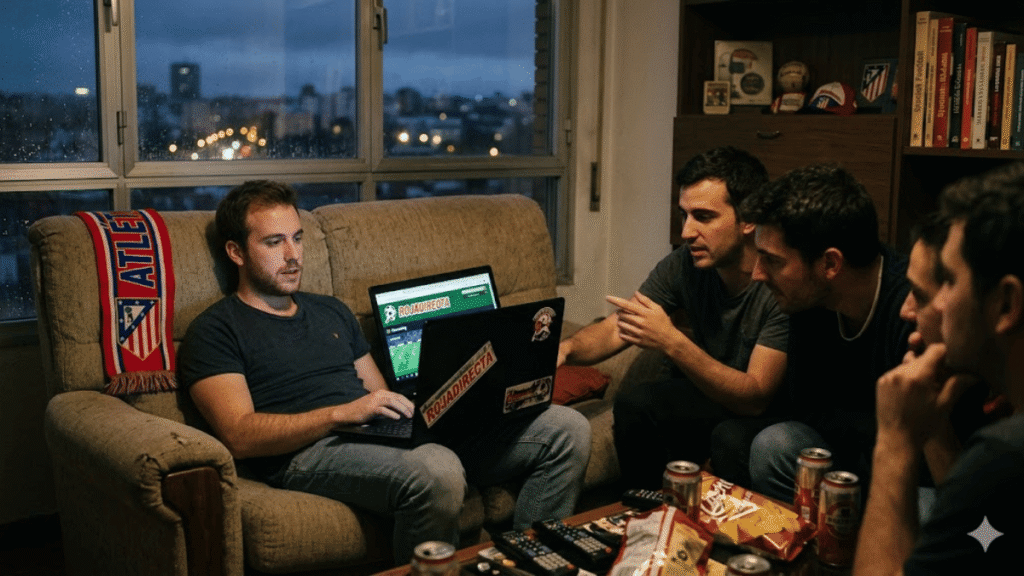
In the digital architecture of the modern sports fan, few names evoke as much partisan loyalty or corporate ire as Roja directa. Founded in 2005 by Igor Seoane in A Coruña, Spain, the site does not host video itself but acts as a sophisticated directory of links to live broadcasts of football, basketball, and tennis. For the millions of viewers who cannot afford increasingly fragmented and expensive cable subscriptions, it is a gateway to the game. For leagues like La Liga and the Premier League, it is a parasitic entity that threatens the multibillion-dollar economy of sports media rights. Despite being seized by the U.S. Department of Justice, banned in multiple countries, and facing millions in fines, the site persists through mirror domains and community-driven resilience, remaining the most resilient “red card” in the history of internet law.
At its core, Roja directa—which translates to “Direct Red Card”—is a minimalist portal that facilitates Peer-to-Peer (P2P) and direct streaming connections. The site’s longevity is largely attributed to its early adoption of a “link-only” defense, arguing that indexing content is fundamentally different from hosting it. This legal hair-splitting has been tested in high courts across Europe, most notably in Spain’s Supreme Court. While many of its contemporaries vanished in the late 2010s under the weight of “dynamic blocking” injunctions, Rojadirecta’s brand has become a genericized trademark for the underground streaming experience. It represents a broader socio-economic protest: the refusal of the global working class to be priced out of their national pastimes by exclusive broadcasting deals that often require three or four separate monthly payments just to follow a single team.
The saga of Roja directa is more than a cat-and-mouse game between pirates and police; it is a mirror reflecting the evolution of the internet itself. In the mid-2000s, the site relied on SopCast and TVAnts—finicky, software-heavy tools that required a degree of technical savvy. Today, it leverages the hyper-speed of fiber optics and HTML5, allowing users to watch a 4K stream of El Clásico with a single tap on a smartphone. This shift has forced a transformation in how sports leagues protect their product. No longer satisfied with taking down static URLs, they now employ “watermarking” technology and automated takedown bots that scan the web in real-time. Yet, as each head of the Hydra is cut, another mirror domain appears, often within minutes, signaling a fundamental flaw in the industry’s current strategy of total enforcement over competitive pricing.
The Architect of the Underground
To understand Roja directa, one must understand Igor Seoane. Unlike many digital pioneers who seek the spotlight, Seoane has spent much of the last twenty years in the shadows or the courtroom. He is an enigma whose platform was valued at millions of dollars in advertising revenue while he lived a relatively low-profile life in Galicia. In 2016, his arrest during a court hearing became a seminal moment in the Spanish tech sector, highlighting the government’s determination to treat digital copyright infringement with the same severity as physical theft. Seoane’s defense has always leaned on the precedent of search engines: if Google is not responsible for the content of the pages it indexes, why should a specialized sports index be treated differently?
The impact of his creation reaches far beyond the borders of Spain. In 2011, the U.S. government, under Operation “In Our Sites,” seized the rojadirecta.org and rojadirecta.com domains. It was an unprecedented move that sparked a diplomatic debate about extraterritorial jurisdiction. Seoane did not retreat; he sued the U.S. government to return the domains, arguing that his business was legal under Spanish law. Although he eventually withdrew the lawsuit, the move established Rojadirecta as a defiant outlier. It wasn’t just a site for free football; it was a test case for the sovereignty of the internet and the limits of the Digital Millennium Copyright Act (DMCA) when applied to foreign entities.
| Milestone | Event | Impact |
| 2005 | Launch in A Coruña, Spain | Created the first major global sports link directory. |
| 2011 | U.S. DOJ Domain Seizure | Sparked international legal battle over DMCA reach. |
| 2016 | Igor Seoane Arrested | Signaled Spain’s shift toward aggressive enforcement. |
| 2021 | 2-Year Prison Sentence | First major criminal conviction for the platform’s head. |
| 2024 | Dynamic Blocking Rulings | Leagues granted power to block IPs in real-time. |
The Economy of the “Free” Game
The primary driver of Rojadirecta’s success is the hyper-inflation of sports rights. Between 2010 and 2024, the cost for a domestic UK broadcaster to show the Premier League rose by nearly 70%, a cost passed directly to the consumer. As media analyst Dr. Julian Veronese observes, “Roja directa is a symptom of a market failure. When the price of a legitimate subscription exceeds the perceived value for the average fan, the black market becomes the only market for a significant portion of the population.” This economic disconnect has created a global audience that feels morally justified in bypassing the paywall, viewing their fandom as a birthright rather than a luxury good.
The financial infrastructure of Roja directa is equally fascinating. While the service is free to the user, it generates immense revenue through high-traffic display advertising and affiliate links with offshore betting companies. This “gray economy” allows the site to maintain a global network of servers and proxy mirrors that are designed to be discarded. When a Spanish ISP blocks one IP address, the site’s backend automatically redirects traffic to a new one, often hosted in jurisdictions like Russia or Belize, where copyright requests are frequently ignored. It is an automated war of attrition that the legacy broadcasters are losing despite their massive legal budgets.
“The struggle against Rojadirecta is no longer about technology; it’s about psychology,” says Javier Tebas, the outspoken president of La Liga. Tebas has frequently compared digital piracy to a virus that threatens the survival of smaller clubs that depend on TV revenue. “If people do not pay, the stars will leave, and the spectacle will die.” However, critics of the leagues argue that this rhetoric ignores the massive profits and executive bonuses at the top of the pyramid. They point to the “Spotify model”—where a low-cost, unified platform virtually eliminated music piracy—as the only long-term solution. Until sports media rights move away from fractured, regional exclusivity, Rojadirecta will remain an essential tool for the global fan.
The Legal Labyrinth and Global Reach
The legal battles surrounding Roja directa have redefined the concept of “communication to the public.” In the European Court of Justice, the platform has been the subject of numerous referrals that have shaped the current understanding of what constitutes an illegal act in the digital space. Initially, the “mere conduit” defense provided a shield, but recent rulings have shifted the burden of proof. Courts now increasingly rule that if a site operator has “actual knowledge” of the infringing nature of the links they provide and seeks to profit from them, they are liable. This shift led to the 2022 ruling by the Provincial Court of A Coruña, which upheld a two-year prison sentence for Seoane and significant financial penalties.
| Strategy | Legacy Approach (2010s) | Modern Approach (2020s) |
| Target | Website Domains (.com, .org) | IP Addresses and Server Hosts |
| Speed | Weeks for a court order | Real-time “Dynamic” blocking |
| Actor | Law Enforcement (Police) | ISP-Level automated filtering |
| Focus | Criminal Prosecution | Financial asset freezing |
Despite these setbacks, the platform’s traffic remains remarkably stable. In Latin America, particularly in Argentina and Mexico, Rojadirecta is often more popular than the official streaming apps of local broadcasters, which are frequently criticized for poor UI and lag. The site’s influence is so pervasive that “Rojadirecta” has entered the cultural lexicon as a verb. To “Rojadirectear” a game is to find an alternative path to the screen. This cultural embedding makes the site nearly impossible to kill; even if the original domain is permanently shuttered, dozens of clones—some legitimate heirs, some malicious impersonators—vying for its traffic would immediately take its place.
The technical resilience of the platform also stems from its community. Unlike a centralized streaming service, Rojadirecta functions more like a forum where users contribute links. This crowdsourcing of content creates a distributed network that is difficult for automated bots to map entirely. A bot might find and report ten links, but a human moderator on the site can approve twenty more in the same time frame. This human-in-the-loop system allows Roja directa to bypass the “content ID” systems that have made piracy on platforms like YouTube or Twitch much more difficult in recent years.
Future Trajectories: AI and the End of Piracy?
As we move into the second half of the 2020s, the battle is entering a new, more automated phase. Leagues are investing heavily in Artificial Intelligence to predict where piracy links will appear before they even go live. Using pattern recognition, these AI systems can identify the unique digital signature of a broadcast and trigger an ISP block within seconds of the first packet being transmitted. However, the operators of Rojadirecta are not standing still. There are reports of “obfuscated streaming” techniques that use AI to subtly alter the video feed in real-time, making it invisible to automated detection bots while remaining clear to the human eye.
The endgame for Rojadirecta likely won’t be a courtroom victory for the leagues, but a shift in the media landscape itself. We are seeing the beginning of “Direct-to-Consumer” models where leagues bypass traditional broadcasters to offer their own global subscriptions. If the NBA or the Premier League offered a single, affordable app that worked anywhere in the world without “blackouts,” the primary utility of Roja directa would vanish. Until then, the site remains a testament to the fact that in the digital age, access is a demand that cannot be suppressed—only delayed. It is the world’s most persistent red card, a reminder that the game belongs to the people, even if the rights belong to the corporations.
Key Takeaways
- Pioneer of Aggregation: Rojadirecta was one of the first platforms to successfully transition sports broadcasting from traditional TV to a global link-sharing model.
- Economic Symptom: Its popularity is directly correlated with the rising costs and fragmentation of legitimate sports streaming services.
- Legal Resilience: The site has survived domain seizures by the U.S. government and criminal trials in Spain by frequently changing its hosting and domain strategy.
- “Link-Only” Defense: For years, the platform successfully argued that indexing links was not the same as hosting content, a defense that eventually weakened under new EU laws.
- Global Brand: “Rojadirecta” has become a generic term for unauthorized streaming, particularly in Spanish-speaking countries and Latin America.
- Technological War of Attrition: The site uses automated redirection and community crowdsourcing to stay one step ahead of the “dynamic blocking” used by major leagues.
- The Igor Seoane Factor: The site’s founder remains a central figure in the debate over digital copyright, serving as both a criminal defendant and a digital folk hero.
Reflections on the Digital Turf
The story of Rojadirecta is the story of the modern internet: a space that promises total access but is increasingly carved into walled gardens. When Igor Seoane launched his site in 2005, the goal was simple—to watch a game. Two decades later, that simple act has become a geopolitical and legal battleground. The persistence of the site suggests that no amount of litigation can truly extinguish the desire for shared cultural experiences. Sports, more than any other medium, require a live audience; the tension between the exclusivity required for profit and the inclusivity required for fandom is a gap that Rojadirecta continues to fill.
Ultimately, Rojadirecta is a mirror reflecting the excesses of the sports industry. It exposes the fragility of a business model that relies on selling the same “live” moment over and over again to different regional buyers. As technology continues to flatten the world, the idea of a “broadcast right” that stops at a national border seems increasingly archaic. Whether Rojadirecta eventually falls to an AI-powered block or is rendered obsolete by a more sensible pricing model, its legacy is secure. It forced the world to acknowledge that the fans are the true owners of the game, and they will find a way to watch, no matter how many red cards are handed out.
FAQs
Is it illegal to watch games on Rojadirecta?
The legal consequences for viewers are generally non-existent in most jurisdictions, as laws typically target the distributors rather than the consumers. However, using the site can expose users to cybersecurity risks, such as malware or phishing attempts from malicious advertisements. In some countries, ISPs are required to block the site, necessitating the use of a VPN for access.
Why does the Rojadirecta domain keep changing?
Rojadirecta changes its domains to evade “site-blocking” orders issued by courts and ISPs. When a specific domain like rojadirecta.me is blocked in a country like Spain or Italy, the administrators quickly launch a mirror site on a different top-level domain (e.g., .tv, .site, or .es) to maintain service availability for their users.
Who owns Rojadirecta?
The site was founded and is largely associated with Igor Seoane and his company, Puerto 80 Projects. Despite numerous legal challenges and a prison sentence, Seoane has remained the face of the platform throughout its twenty-year history, though the current day-to-day operations are obscured behind layers of offshore hosting and proxy services.
Are there safe alternatives to Rojadirecta?
The “safest” alternatives are official broadcasting partners like DAZN, ESPN+, or Sky Sports. These provide high-quality, secure streams. For those seeking free alternatives, many leagues now broadcast smaller matches on YouTube or Twitch. However, for major events, Rojadirecta remains the primary “gray market” destination because of its comprehensive index that official services cannot match.
How does Rojadirecta make money if it’s free?
The platform generates significant revenue through advertising. Because of the high volume of traffic, particularly during major events like the World Cup or Champions League finals, the ad space is highly valuable. Additionally, the site often features affiliate links for online gambling and betting sites, which pay the platform for every new user referred.