
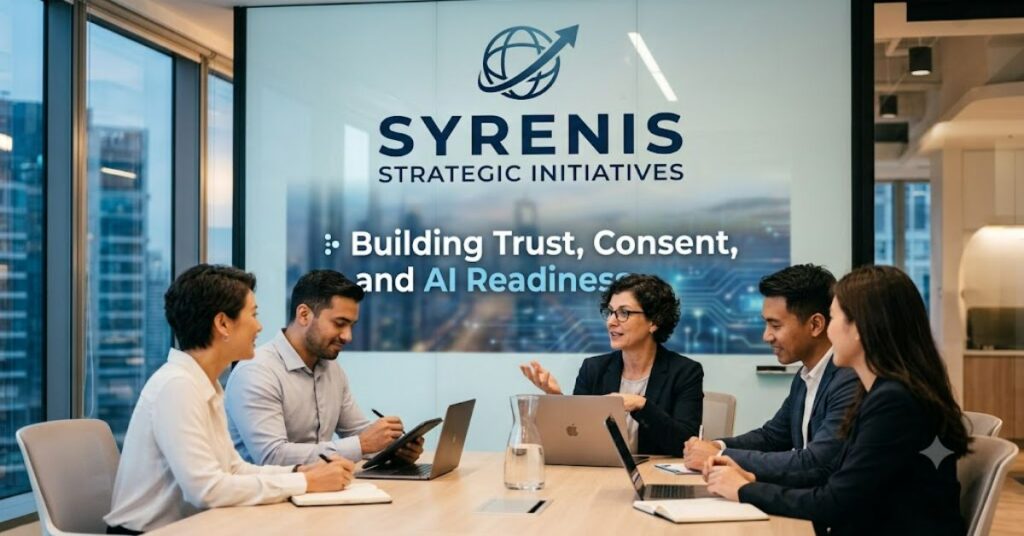
Businesses today collect enormous amounts of customer information. However, collecting data is no longer enough. Companies must also manage customer permissions accurately while maintaining trust and complying with privacy regulations. This is where syrenis strategic initiatives have become increasingly important.
Rather than viewing consent management simply as a legal obligation, Syrenis positions it as a valuable business asset. The company’s strategy focuses on helping organizations build trusted relationships with customers through transparent permission management. This approach also prepares businesses for the growing use of artificial intelligence, where accurate and trusted data is becoming essential.
By shifting the conversation from compliance to customer trust, Syrenis enables organizations to make better use of their data while respecting individual privacy preferences.
Understanding Syrenis
Syrenis is recognized for providing enterprise consent and preference management solutions. Its technology helps organizations manage how customer data is collected, stored, updated, and used across multiple systems.
Instead of relying on disconnected databases or manual processes, businesses can centralize customer permissions using a unified platform. This ensures that marketing teams, customer service representatives, and digital applications all work from the same trusted source of consent information.
The platform supports organizations operating in highly regulated industries where data privacy is critical.
From Compliance to Business Growth
Historically, many organizations invested in consent management only because regulations required it.
Syrenis promotes a different perspective.
Rather than treating privacy as a cost, businesses can view customer trust as a competitive advantage. When customers understand how their information is used and have control over their preferences, they are often more willing to engage with brands.
This strategic shift creates several benefits:
- Improved customer loyalty
- Better marketing accuracy
- Reduced compliance risks
- Higher quality customer data
- Increased operational efficiency
Organizations that manage permissions effectively also reduce the risk of using outdated or unauthorized customer information.
Why Consent Matters for AI
Artificial intelligence depends on high-quality, reliable data.
If customer permissions are inaccurate or outdated, AI systems may generate misleading insights or violate privacy regulations.
One of the key syrenis strategic initiatives is preparing organizations for responsible AI adoption through accurate consent management.
When businesses maintain reliable permission records, AI applications can:
- Access approved data sources
- Respect customer privacy choices
- Reduce legal risks
- Improve decision-making
- Produce more trustworthy insights
Trusted data becomes the foundation of trustworthy AI.
Key Strategic Priorities
Several initiatives define the company’s long-term strategy.
Customer Trust
Trust is becoming one of the most valuable business assets. Syrenis encourages organizations to communicate clearly about data collection and give customers meaningful control over their preferences.
Centralized Consent Management
Businesses often operate across websites, mobile apps, CRM systems, and marketing platforms.
Centralizing consent records ensures consistency across every customer interaction.
Regulatory Readiness
Privacy regulations continue evolving worldwide.
Rather than responding individually to every regulation, organizations benefit from flexible consent systems that adapt to changing legal requirements.
AI Readiness
Preparing data for AI involves more than improving technology.
Organizations must ensure every piece of customer information has valid permissions supporting its intended use.
Comparison of Traditional and Strategic Approaches
| Traditional Compliance | Syrenis Strategic Approach |
| Focus on avoiding penalties | Focus on building customer trust |
| Separate compliance systems | Unified consent platform |
| Reactive privacy management | Proactive governance |
| Manual updates | Automated permission management |
| Compliance only | Business growth and AI readiness |
Business Benefits
Organizations implementing modern consent management often experience improvements across multiple business functions.
| Business Area | Potential Benefit |
| Marketing | More accurate customer targeting |
| Customer Service | Better understanding of preferences |
| Compliance | Lower regulatory risk |
| Data Governance | Improved data accuracy |
| AI Projects | Higher-quality training data |
These benefits extend well beyond legal compliance.
Challenges Organizations Face
Although the advantages are clear, implementing enterprise consent management is not always simple.
Common challenges include:
- Legacy IT systems
- Multiple customer databases
- Inconsistent permission records
- Changing privacy regulations
- Cross-border data requirements
Successful organizations typically address these issues through phased implementation rather than attempting large-scale changes all at once.
The Future of Syrenis Strategic Initiatives in 2027
As artificial intelligence becomes integrated into everyday business operations, consent management will continue growing in importance.
By 2027, organizations are expected to place greater emphasis on:
- Real-time consent updates
- Automated privacy governance
- AI transparency
- Stronger consumer control
- Unified customer identity management
Companies that invest early in trusted data governance are likely to gain competitive advantages while reducing regulatory risks.
Key Takeaways
- Consent management is now a business strategy rather than simply a compliance requirement.
- Customer trust improves long-term business performance.
- AI requires accurate, permission-based data.
- Centralized consent systems reduce operational complexity.
- Privacy governance supports better customer experiences.
- Trusted data enables responsible innovation.
Conclusion
The evolution of syrenis strategic initiatives reflects a broader transformation in how organizations manage customer data. Privacy is no longer viewed merely as a legal requirement but as an opportunity to strengthen customer relationships and support future innovation.
By focusing on accurate permissions, centralized consent management, and AI readiness, Syrenis helps organizations create reliable foundations for digital transformation. Businesses that embrace these strategies are better positioned to earn customer trust, improve operational efficiency, and confidently adopt emerging technologies.
As regulations evolve and AI becomes increasingly influential, organizations that prioritize trusted data management will likely remain more resilient and competitive in the years ahead.
Frequently Asked Questions
What are Syrenis strategic initiatives?
They focus on transforming consent and preference management into a strategic business capability that supports customer trust, regulatory compliance, and AI readiness.
Why is consent management important?
It ensures organizations use customer data responsibly while respecting privacy preferences and meeting legal requirements.
How does Syrenis support AI readiness?
By helping organizations maintain accurate permission records, ensuring AI systems use trusted and authorized data.
Which industries benefit most?
Healthcare, financial services, telecommunications, retail, government, and any organization handling sensitive customer information can benefit.
What is the biggest advantage of centralized consent management?
A single source of truth for customer permissions reduces errors, improves compliance, and creates more consistent customer experiences.