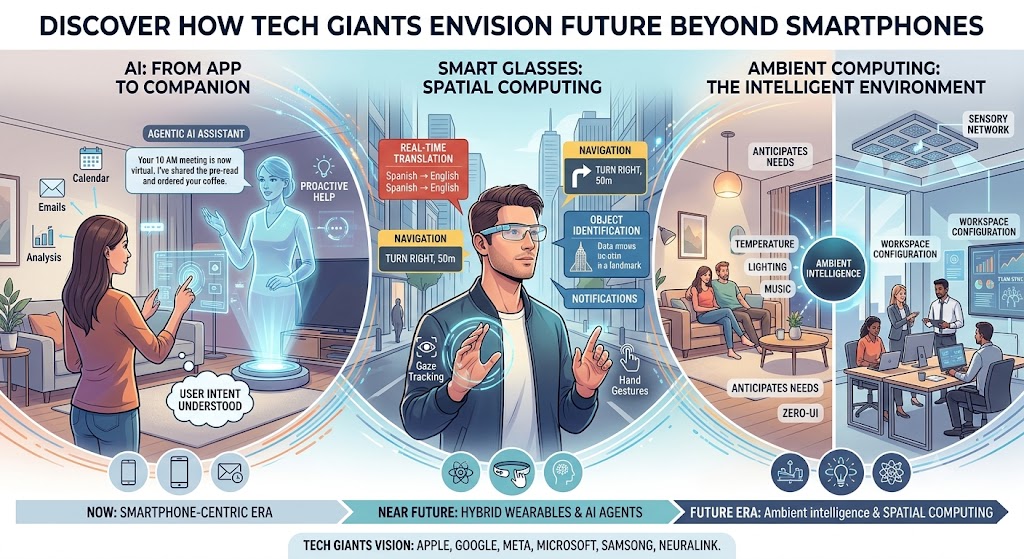
The way people interact with technology has evolved dramatically over the past two decades. Smartphones transformed communication, entertainment, work, and shopping, becoming an essential part of daily life. However, tech giants envision future beyond smartphones by developing devices that blend naturally into everyday experiences rather than requiring users to constantly look at a handheld screen.
According to the provided brief, companies such as Meta, Apple, and Google are shifting their focus toward ambient computing and AI-powered wearables, where artificial intelligence acts as the operating system. Instead of opening apps on a phone, users may access information through smart glasses, voice commands, and gesture controls.
This vision represents one of the biggest shifts in consumer technology since the smartphone revolution.
Why Technology Is Moving Beyond Smartphones
Smartphones remain incredibly powerful, but they also have limitations. Users spend hours looking at screens, switching between apps, and managing constant notifications.
Technology companies believe future devices should become more natural and less distracting by allowing information to appear only when needed.
Rather than replacing smartphones overnight, these innovations aim to make digital interactions simpler and more seamless.
The Rise of Ambient Computing
Ambient computing refers to technology that works quietly in the background, responding to users without requiring constant manual interaction.
Instead of unlocking a phone, opening an application, and typing a search query, future systems may understand spoken requests, recognize gestures, and provide instant information through wearable devices.
This creates a more intuitive experience where technology becomes almost invisible.
AI as the Operating System
Artificial intelligence is expected to become the center of future personal computing.
Rather than navigating dozens of apps, users could simply ask an AI assistant to:
- Schedule meetings
- Send messages
- Translate conversations
- Navigate unfamiliar locations
- Control smart home devices
- Summarize emails
The AI performs these tasks automatically, reducing the need to manually manage multiple applications.
Smart Glasses Could Replace Many Phone Tasks
One of the most discussed innovations is smart glasses.
Instead of checking a phone screen, users could see navigation directions, notifications, translations, or reminders projected directly into their field of vision.
Potential benefits include:
- Hands-free navigation
- Live language translation
- Instant notifications
- Augmented reality experiences
- Better accessibility
Smart glasses combine digital information with the real world without forcing users to constantly look down at a smartphone.
Voice and Gesture Controls
Future computing may rely less on touchscreens.
Voice commands already allow users to search the internet, play music, and control smart devices.
Gesture recognition could add another layer of interaction by allowing users to perform simple actions with hand movements.
These technologies make computing more natural, especially while driving, cooking, exercising, or working.
Comparison of Traditional Smartphones and Future AI Devices
| Feature | Smartphones | AI Wearables |
| Primary Interface | Touchscreen | Voice and gestures |
| Display | Handheld screen | Smart glasses or wearable display |
| AI Integration | App-based assistants | AI-first experience |
| Portability | Pocket device | Worn throughout the day |
| User Interaction | Open apps manually | Context-aware assistance |
Companies Driving the Transition
Several major companies are investing heavily in next-generation computing technologies.
| Company | Primary Focus |
| Meta | Smart glasses and AI wearables |
| Apple | Mixed reality and AI ecosystem |
| Ambient computing and AI assistants |
According to the provided brief, these companies envision an ecosystem where artificial intelligence becomes the central operating system, replacing many traditional app-based interactions.
Challenges Ahead
Despite the excitement, several challenges remain.
Battery Life
Wearable devices require compact batteries capable of lasting an entire day.
Privacy
Always-on cameras and microphones raise concerns about data collection and security.
Cost
Advanced wearable devices may initially be expensive, limiting widespread adoption.
User Acceptance
Many people remain comfortable using smartphones and may be reluctant to adopt entirely new interaction methods.
Real-World Impact
If successful, ambient computing could transform many industries.
Healthcare professionals could access patient information hands-free.
Manufacturing workers could receive safety instructions through smart glasses.
Students might use AI-powered learning assistants during lessons.
Travelers could benefit from real-time translation without removing a phone from their pocket.
These applications demonstrate how AI-powered wearables could improve productivity and convenience.
The Future of Technology in 2027
By 2027, smartphones are unlikely to disappear completely. Instead, they may become supporting devices within a broader ecosystem of AI-powered products.
Consumers may carry fewer traditional devices while relying more on smart glasses, wearable displays, voice assistants, and context-aware artificial intelligence.
Technology companies appear focused on making computing more personal, proactive, and seamlessly integrated into everyday life rather than centered around a handheld screen.
Key Takeaways
- AI is becoming the foundation of future personal computing.
- Smart glasses may reduce dependence on smartphones.
- Voice and gesture controls offer more natural interaction.
- Ambient computing aims to make technology less intrusive.
- Smartphones will likely continue alongside wearable devices during the transition.
Conclusion
The vision that tech giants envision future beyond smartphones reflects a significant shift in how people may interact with technology over the coming years. Rather than relying solely on handheld screens, companies are investing in AI-powered wearables, smart glasses, and ambient computing that provide information exactly when and where it is needed. According to the provided brief, Meta, Apple, and Google see artificial intelligence serving as the operating system for this new ecosystem, enabling users to interact through voice and gestures instead of traditional apps. While smartphones are expected to remain important in the near future, the next generation of computing is likely to become more intelligent, more intuitive, and far less dependent on the devices we carry today.
Frequently Asked Questions
What does Tech Giants Envision Future Beyond Smartphones mean?
It refers to technology companies developing AI-powered devices and wearables that reduce dependence on traditional smartphones.
What is ambient computing?
Ambient computing is technology that operates in the background, providing assistance through context-aware AI, voice, and wearable devices.
Which companies are leading this shift?
The provided brief identifies Meta, Apple, and Google as major companies investing in AI-powered wearables and ambient computing.
Will smartphones disappear?
Most experts expect smartphones to remain useful while wearable technologies gradually become more common.
Why are smart glasses important?
Smart glasses allow users to access digital information hands-free, reducing the need to constantly interact with a smartphone.
References
- Postcard.fm Article Writing Prompt – Production Version (User-provided brief).